 IIIF Color HighRes
National Institute of Informatics - Digital Silk Road Project
| |||||||||
|
| IIIF Color HighRes |
| Serindia : vol.2 |
 |
 |
 |
 |
 |
 |
|
|
 |
|
|
|
|
|
|
|
|
Citation Information
672 THE WESTERNMOST LIMES WALL [Chap. XVIII
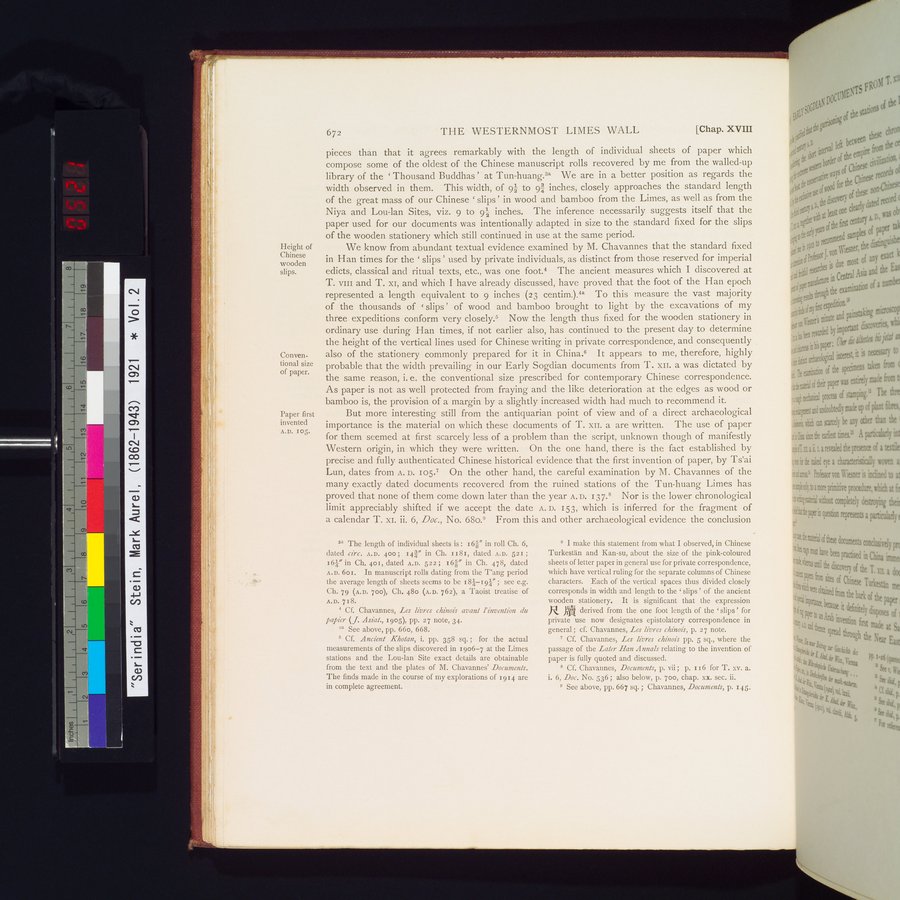
pieces than that it agrees remarkably with the length of individual sheets of paper which compose some of the oldest of the Chinese manuscript rolls recovered by me from the walled-up library of the ` Thousand Buddhas ' at Tun-huang.aa We are in a better position as regards the width observed in them. This width, of 91- to 9; inches, closely approaches the standard length of the great mass of our Chinese ` slips ' in wood and bamboo from the Limes, as well as from the Niya and Lou-lan Sites, viz. 9 to 9; inches. The inference necessarily suggests itself that the paper used for our documents was intentionally adapted in size to the standard fixed for the slips of the wooden stationery which still continued in use at the same period.
We know from abundant textual evidence examined by M. Chavannes that the standard fixed in Han times for the ` slips ' used by private individuals, as distinct from those reserved for imperial edicts, classical and ritual texts, etc., was one foot.4 The ancient measures which I discovered at T. viii and T. xi, and which I have already discussed, have proved that the foot of the Han epoch represented a length equivalent to 9 inches (23 centim.).4a To this measure the vast majority of the thousands of ' slips ' of wood and bamboo brought to light by the excavations of my three expeditions conform very closely.8 Now the length thus fixed for the wooden stationery in ordinary use during Han times, if not earlier also, has continued to the present day to determine the height of the vertical lines used for Chinese writing in private correspondence, and consequently also of the stationery commonly prepared for it in China.° I t appears to me, therefore, highly probable that the width prevailing in our Early Sogdian documents from T. xi'. a was dictated by the same reason, i. e. the conventional size prescribed for contemporary Chinese correspondence. As paper is not as well protected from fraying and the like deterioration at the edges as wood or bamboo is, the provision of a margin by a slightly increased width had much to recommend it.
But more interesting still from the antiquarian point of view and of a direct archaeological importance is the material on which these documents of T. x11. a are written. The use of paper for them seemed at first scarcely less of a problem than the script, unknown though of manifestly Western origin, in which they were written. On the one hand, there is the fact established by precise and fully authenticated Chinese historical evidence that the first invention of paper, by Tsai Lun, dates from A. D. 105.' On the other hand, the careful examination by M. Chavannes of the many exactly dated documents recovered from the ruined stations of the Tun-huang Limes has proved that none of them come down later than the year A.D. 137.8 Nor is the lower chronological limit appreciably shifted if we accept the date A. D. 153, which is inferred for the fragment of a calendar T. xi. ii. 6, Doc., No. 680.° From this and other archaeological evidence the conclusion
3a The length of individual sheets is : I 68" in roll Ch. 6, dated circ. A.D. 400 ; 144" in Ch. I181, dated A.D. 521 ; 16*" in Ch. 401, dated A.D. 522 ; 16$" in Ch. 478, dated A.D. 601. In manuscript rolls dating from the Tang period the average length of sheets seems to be I8 -I91" ; see e.g. Ch. 79 (A.D. 700), Ch. 480 (A.D. 762), a Taoist treatise of A.D. 718.
' Cf. Chavannes, Les livres chinois avant [invention du papier (J. Asia., 1905), pp. 27 note, 34.
'a See above, pp. 66o, 668.
a Cf. Ancient Khotan, i. pp. 358 sq. ; for the actual measurements of the slips discovered in 1906-7 at the Limes stations and the Lou-lan Site exact details are obtainable from the text and the plates of M. Chavannes' Documents. The finds made in the course of my explorations of 1914 are in complete agreement.
6 I make this statement from what I observed, in Chinese Turkestân and Kan-su, about the size of the pink-coloured sheets of letter paper in general use for private correspondence, which have vertical ruling for the separate columns of Chinese characters. Each of the vertical spaces thus divided closely corresponds in width and length to the ' slips ' of the ancient wooden stationery. It is significant that the expression derived from the one foot length of the slips' for private use now designates epistolatory correspondence in general ; cf. Chavannes, Les livres chinois, p. 27 note.
7 Cf. Chavannes, Les livres chinois pp. 5 sq., where the passage of the Later Ilan Annals relating to the invention of paper is fully quoted and discussed.
8 Cf. Chavannes, Documents, p. vii ; p. 116 for T. xv. a. i. 6, Doc. No. 536 ; also below, p. 700, chap. xx. sec. ii.
° See above, pp. 667 sq. ; Chavannes, Documents, p. 145.
Height of Chinese wooden slips.
Conventional size of paper.
Paper first invented A.D. 105.
|
|
|
|
|
|
|
|
|
Copyright (C) 2003-2019 National Institute of Informatics and The Toyo Bunko. All Rights Reserved.