 IIIF Color HighRes
National Institute of Informatics - Digital Silk Road Project
| |||||||||
|
| IIIF Color HighRes |
| Serindia : vol.2 |
 |
 |
 |
 |
 |
 |
|
|
 |
|
|
|
|
|
|
|
|
Citation Information
4
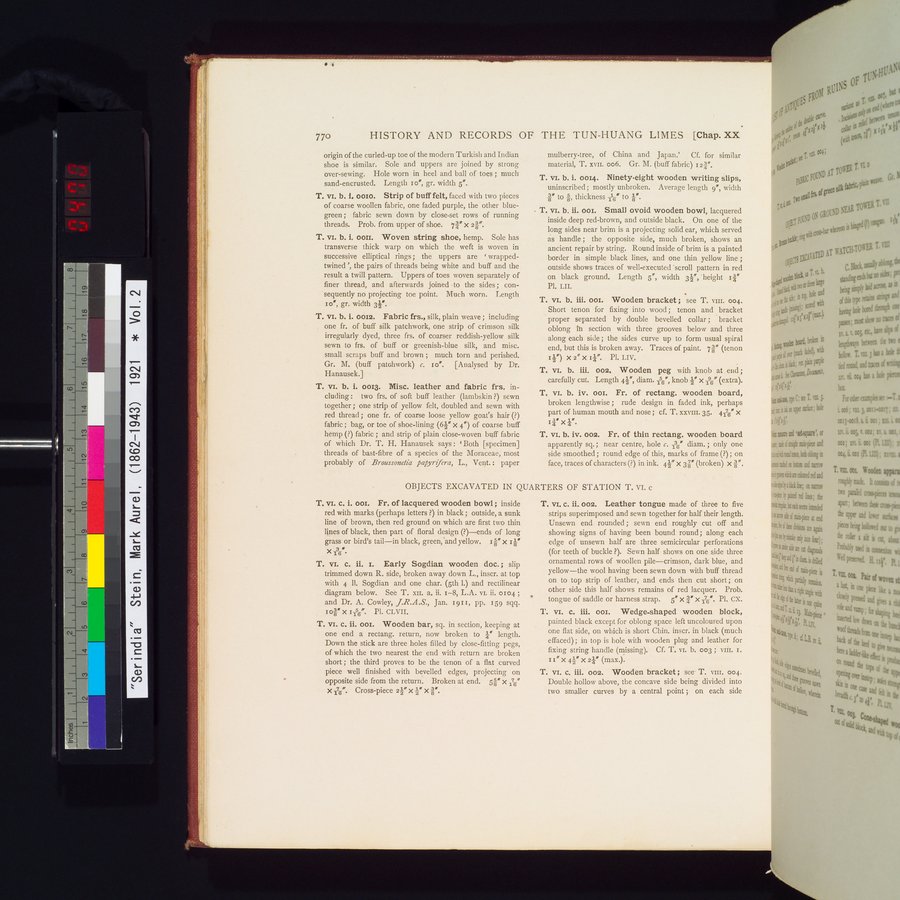
77o HISTORY AND RECORDS OF THE TUN-HUANG LIMES [Chap. XX
origin of the curled-up toe of the modern Turkish and Indian shoe is similar. Sole and uppers are joined by strong over-sewing. Hole worn in heel and ball of toes ; much sand-encrusted. Length ro', gr. width 5"
T. vi. b. i. ooio. Strip of buff felt, faced with two pieces of coarse woollen fabric, one faded purple, the other blue-green ; fabric sewn down by close-set rows of running threads. Prob. from upper of shoe. qa x 2r.
T. vi. b. i. oon. Woven string shoe, hemp. Sole has transverse thick warp on which the weft is woven in successive elliptical rings ; the uppers are ' wrapped-twined ', the pairs of threads being white and buff and the result a twill pattern. Uppers of toes woven separately of finer thread, and afterwards joined to the sides; consequently no projecting toe point. Much worn. Length ro', gr. width 3'.
T. vi. b. i. 0012. Fabric frs., silk, plain weave; including one fr. of buff silk patchwork, one strip of crimson silk irregularly dyed, three frs. of coarser reddish-yellow silk sewn to frs. of buff or greenish-blue silk, and misc. small scraps buff and brown ; much torn and perished. Gr. M. (buff patchwork) c. ro'. [Analysed by Dr. Hanausek.]
T. vi. b. i. oo13. Misc. leather and fabric frs. including : two frs. of soft buff leather (lambskin ?) sewn together; one strip of yellow felt, doubled and sewn with red thread ; one fr. of coarse loose yellow goat's hair (?) fabric ; bag, or toe of shoe-lining (6. ' x 4") of coarse buff hemp (1) fabric ; and strip of plain close-woven buff fabric of which Dr. T. H. Hanausek says : 'Both [specimen] threads of bast-fibre of a species of the Moraceae, most probably of Broussonelia papyrifera, L., Vent.: paper
mulberry-tree, of China and Japan.' Cf. for similar
material, T. xvir. oo6. Gr. M. (buff fabric) I2a'.
T. vr. b. i. ooi4. Ninetyeight wooden writing slips, uninscribed; mostly unbroken. Average length 9', width $' to 8, thickness ig' to
T. vr. b. ii. oox. Small ovoid wooden bowl, lacquered inside deep red-brown, and outside black. On one of the long sides near brim is a projecting solid ear, which served as handle ; the opposite side, much broken, shows an ancient repair by string. Round inside of brim is a painted border in simple black lines, and one thin yellow line ; outside shows traces of well-executed 'scroll pattern in red on black ground. Length 5', width 3y, ' height x ' Pl. LII.
T. vi. b. iii. oox. Wooden bracket ; see T. viii. 004. Short tenon for fixing into wood ; tenon and bracket proper separated by double bevelled collar ; • bracket oblong lb section with three grooves below and three along each side ; the sides curve up to form usual spiral end, but this is broken away. Traces of paint. 7:4- (tenon I) X 2 X Jr. Pl. LIv.
T. vi. b. iii. 002. Wooden peg with knob at end; carefully cut. Length 4 ", diam. Ass, knob i' x "(extra).
T. vr. b. iv. ooi. Fr. of rectang. wooden board, broken lengthwise ; rude design in faded ink, perhaps part of human mouth and nose ; cf. T. xxvin. 35. 4A.' X râ X .
T. vi, b. iv. 002. Fr. of thin rectang. wooden board apparently sq.; near centre, hole c. iu' diam. ; only one side smoothed ; round edge of this, marks of frame (?) ; on face, traces of characters (?) in ink. 4-i" X 3$' (broken) x r.
OBJECTS EXCAVATED IN QUARTERS OF STATION T. vI. c
T. vi. c. i. ooi. Fr. of lacquered wooden bowl ; inside red with marks (perhaps letters ?) in black ; outside, a sunk line of brown, then red ground on which are first two thin lines of black, then part of floral design (?)—ends of long grass or bird's tail—in black, green,'and yellow. I' x it
x ?a'.
T. vi. c. ii. I. Early Sogdian wooden doc. ; slip trimmed down R. side, broken away down L., inscr. at top with 4 II. Sogdian and one char. (5th 1.) and rectilinear diagram below. See T. xx1. a. ii. I-8, L.A. vr. ii. 0104 ; and Dr. A. Cowley, J.R.A.S., Jan. 1911, pp. 159 sqq. 'or X Iig'. Pl. CLVII.
T. vi. c. ii. ooi. Wooden bar, sq. in section, keeping at one end a rectang. return, now broken to r length. Down the stick are three holes filled by close-fitting pegs, of which the two nearest the end with return are broken short ; the third proves to be the tenon of a fiat curved piece well finished with bevelled edges, projecting on opposite side from the return. Broken at end. 51" V x i1;". Cross-piece a" x z' x r.
T. vi. c. ii. 002. Leather tongue made of three to five strips superimposed and sewn together for half their length. Unsewn end rounded ; sewn end roughly cut off and showing signs of having been bound round; along each edge of unsewn half are three semicircular perforations (for teeth of buckle ?). Sewn half shows on one side three ornamental rows of woollen pile—crimson, dark blue, and yellow—the wool having been sewn down with buff thread on to top strip of leather, and ends then cut short ; on other side this half shows remains of red lacquer. Prob. tongue of saddle or harness strap. 5" X rX". PI. CX.
T. v1. c. iii. oox. Wedge-shaped wooden block, painted black except for oblong space left uncoloured upon one flat side, on which is short Chin. inscr. in black (much effaced); in top is hole with wooden plug and leather for fixing string handle (missing). Cf. T. vi. b. 003 ; vIII. r. I I' X 4' X 2*' (max.).
T. vr. c. iii. 002. Wooden bracket; see T. vIII. 004. Double hollow above, the concave side being divided into two smaller curves by a central point ; on each side
|
|
|
|
|
|
|
|
|
Copyright (C) 2003-2019 National Institute of Informatics and The Toyo Bunko. All Rights Reserved.