 IIIF Color HighRes
National Institute of Informatics - Digital Silk Road Project
| |||||||||
|
| IIIF Color HighRes |
| Serindia : vol.2 |
 |
 |
 |
 |
 |
 |
|
|
 |
|
|
|
|
|
|
|
|
Citation Information
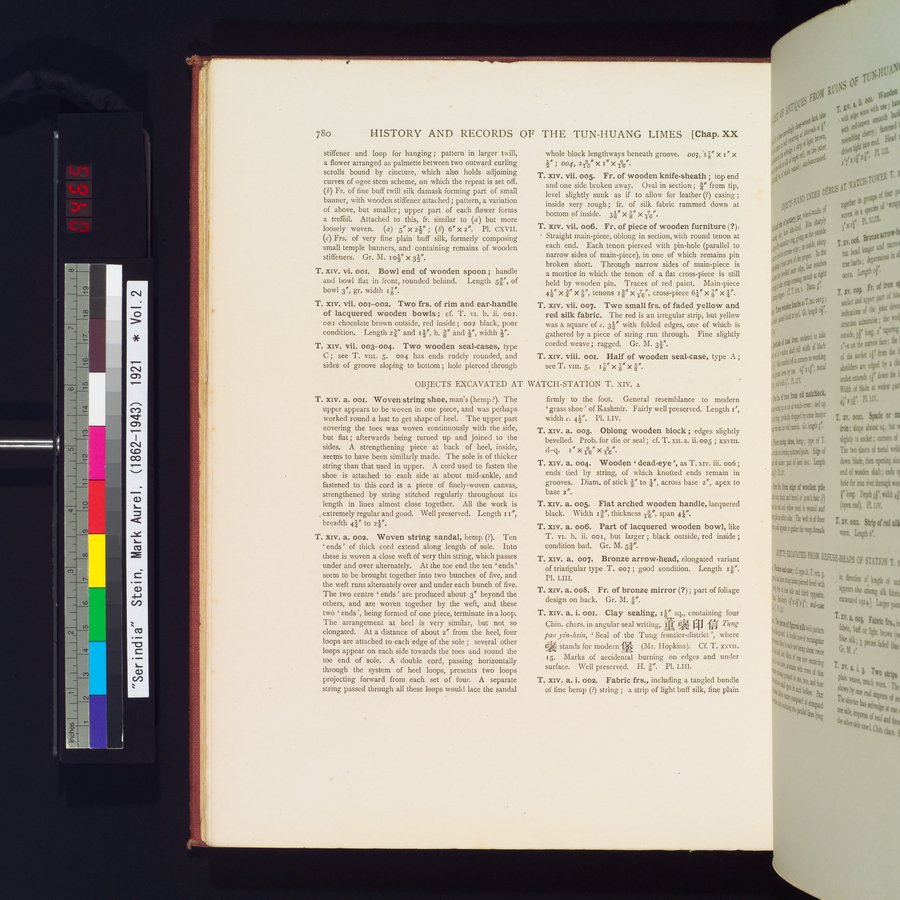
78o HISTORY AND RECORDS OF THE TUN-HUANG LIMES [Chap. XX
stiffener and loop for hanging ; pattern in larger twill, a flower arranged as palmette between two outward curling scrolls bound by cincture, which also holds adjoining curves of ogee stem scheme, on which the repeat is set off.
Fr. of fine buff twill silk damask forming part of small banner, with wooden stiffener attached ; pattern, a variation of above, but smaller; upper part of each flower forms a trefoil. Attached to this, fr. similar to (a) but more loosely woven. (a) 5" x z" ; (b) 6" X 2". Pl. CXVII.
Frs. of very fine plain buff silk, formerly composing small temple banners, and containing remains of wooden stiffeners. Gr. M. Ion" x 3-".
T. xiv. vi. oox. Bowl end of wooden spoon ; handle and bowl fiat in front, rounded behind. Length 5$", of bowl 3", gr. width i g".
T. XIV. vii. 001-002. Two frs. of rim and ear-handle of lacquered wooden bowls; cf. T. v1. b. ii. ooz. ooi chocolate brown outside, red inside; 002 black, poor condition. Length 2*" and Ii", h. 3" and â", width i".
T. xiv. vii. 003-004. Two wooden seal-cases, type C ; see T. VIII. 5. 004 has ends rudely rounded, and sides of groove sloping to bottom ; hole pierced through
whole block lengthways beneath groove. oo;, '1:4" x I" x r; 00¢, 2-'xI"x3-eg".
T. XIV. vii. 005. Fr. of wooden knife.sheath ; top end and one side broken away. Oval in section ; 4" from tip, level slightly sunk as if to allow for leather (?) casing ; inside very rough ; fr. of silk fabric rammed down at bottom of inside. 3" x r
T. xxv. vii. ooh. Fr. of piece of wooden furniture (?).
Straight main-piece, oblong in section, with round tenon at each end. Each tenon pierced with pin-hole (parallel to narrow sides of main-piece), in one of which remains pin broken short. Through narrow sides of main-piece is a mortice in which the tenon of a flat cross-piece is still held by wooden pin. Traces of red paint. Main-piece 4B" x â" X 8", tenons I" X;g", cross-piece 6â" x x
T. xiv. vii. 007. Two small frs. of faded yellow and red silk fabric. The red is an irregular strip, but yellow was a square of c. 3" with folded edges, one of which is gathered by a piece of string run through. Fine slightly corded weave; ragged. Gr. M. 3r.
T. XIV. viii. oox. Half of wooden seal-case, type A ; see T. VIII. 5. I8"x8"xg".
OBJECTS EXCAVATED AT WATCH-STATION T. XIV. A
T. xxv. a. oor. Woven string shoe, man's (hemp ?). The upper appears to be woven in one piece, and was perhaps worked round a last to get shape of heel. The upper part covering the toes was woven continuously with the side, but flat ; afterwards being turned up and joined to the sides. A strengthening piece at back of heel, inside, seeryts to have been similarly made. The sole is of thicker string than that used in upper. A cord used to fasten the shoe is attached to each side at about mid-ankle, and fastened to this cord is a piece of finely-woven canvas, strengthened by string stitched regularly throughout its length in lines almost close together. All the work is , extremely regular and good. Well preserved. Length I i", breadth 4*" to z*".
T. inv. a. 002. Woven string sandal, hemp (?). Ten `ends' of thick cord extend along length of sole. Into these is woven a close weft Of very thin string, which passes under and over alternately. At the toe end the ten ends' seem to be brought together into two bunches of five, and the weft runs alternately over and under each bunch of five. The two centre ' ends ' are produced about 3" beyond the others, and are woven together by the weft, and these two ' ends ', being formed of one piece, terminate in a loop. The arrangement at heel is very similar, but not so elongated. At a distance of about 2" from the heel, four loops are attached to each edge of the sole ; several other loops appear on each side towards the toes and round the toe end of sole. A double cord, passing horizontally through the system of heel loops, presents two loops projecting forward from each set of four. A separate string passed through all these loops would lace the sandal
firmly to the foot. General resemblance to modern ' grass shoe ' of Kashmir. Fairly well preserved. Length 1', width c. 4k". Pl. LIV.
T. xiv. a. 003. Oblong wooden block ; edges slightly bevelled. Prob. for die or seal ; cf. T. xir. a. ii. oo5 ; xxviii. d—q. I"xi$g"xTV.
T. xiv. a. 004. Wooden ' dead•eye', as T. xlv. iii. oo6 ; ends tied by string, of which knotted ends remain in grooves. Diam. of stick z" to i°, across base 2", apex to base z".
T. XIV. a. 005. Flat arched wooden handle, lacquered black. Width I8", thickness a", span 4r.
T. xiv. a. 006. Part of lacquered wooden bowl, like T. vi. b. ii. ooi, but larger ; black outside, red inside ; condition bad. Gr. M. 54".
T. xiv. a. 007. Bronze arrow-head, elongated variant of triazigular type T. 007 ; good condition. Length I8". PI. LIII.
T. XIV. a. oo8. Fr. of bronze mirror (?) ; part of foliage design on back. Gr. M. g".
T. xrv. a. i. o01. Clay sealing, I " sq., containing four
Chin. chars. in angular seal writing, `c Tung
pao yin-hsin, ' Seal of the Tung frontier-district ', where stands for modern f (Mr. Hopkins). Cf. T. xxvit. 15. Marks of accidental burning on edges and under surface. Well preserved. H. é". Pl. LIII.
T. XIV. a. i. 002. Fabric frs., including a tangled bundle of fine hemp (?) string ; a strip of light buff silk, fine plain
|
|
|
|
|
|
|
|
|
Copyright (C) 2003-2019 National Institute of Informatics and The Toyo Bunko. All Rights Reserved.