 IIIF Color HighRes
National Institute of Informatics - Digital Silk Road Project
| |||||||||
|
| IIIF Color HighRes |
| Serindia : vol.2 |
 |
 |
 |
 |
 |
 |
|
|
 |
|
|
|
|
|
|
|
|
Citation Information
îo68 CAVE-TEMPLES & ANTIQUES OF THE THOUSAND BUDDHAS [Ch. XXV
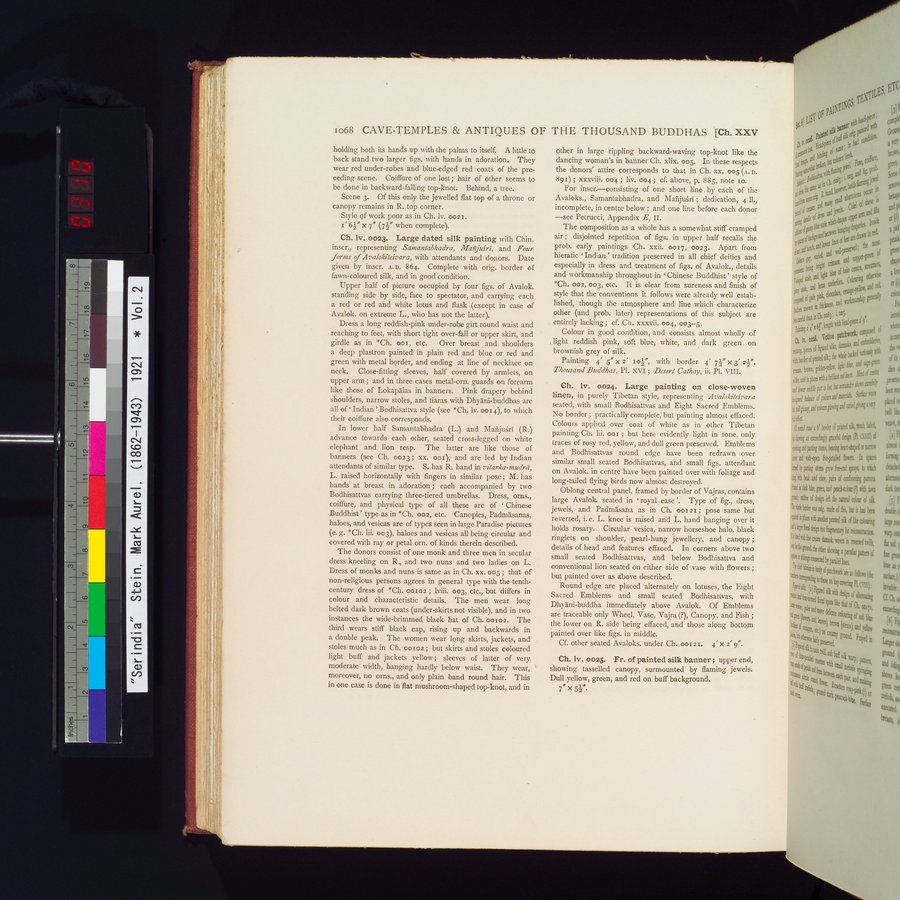
holding both its hands up with the palms to itself. A little to back stand two larger figs. with hands in adoration. They wear red under-robes and blue-edged red coats of the preceding scene. Coiffure of one lost; hair of other seems to be done in backward-falling top-knot. Behind, a tree.
Scene 3. Of this only the jewelled flat top of a throne or canopy remains in R. top corner.
Style of work poor as in Ch. lv. 0021.
I' 6 " x 7" (7i." when complete).
Ch. 1v. 0023. Large dated silk painting with Chin. inscr., representing Samantabhadra, Mai jusri, and Four forms of Avalokitesvara, with attendants and donors. Date given by inscr. A.D. 864. Complete with orig. border of fawn-coloured silk, and in good condition.
Upper half of picture occupied by four figs. of Avalok. standing side by side, face to spectator, and carrying each a red or red and white lotus and flask (except in case of Avalok. on extreme L., who has not the latter).
Dress a long reddish-pink under-robe girt round waist and reaching to feet, with short tight over-fall or upper skirt, and
girdle as in *Ch. oo1, etc. Over breast and shoulders
a deep plastron painted in plain red and blue or red and green with metal border, and ending at line of necklace on neck. Close-fitting sleeves, half covered by armlets, on upper arm ; and in three cases metal-orn. guards on forearm like these of Lokapâlas in banners. Pink drapery behind shoulders, narrow stoles, and tiaras with Dhyâni-buddhas are all of Indian ' Bodhisattva style (see *Ch. Iv. 0014), to which their coiffure also corresponds.
In lower half Samantabhadra (L.) and Maiijusri (R.) advance towards each other, seated cross-legged on white elephant and lion resp. The latter are like those of banners (see Ch. 0023 ; xx. 001), and are led by Indian attendants of similar type. S. has R. hand in vitarka-mudrd, L. raised horizontally with fingers in similar pose; M. has hands at breast in adoration ; each accompanied by two Bodhisattvas carrying three-tiered umbrellas. Dress, orns., coiffure, and physical type of all these are of ' Chinese Buddhist ' type as in *Ch. 002, etc. Canopies, Padmâsanas, haloes, and vesicas are of types seen in large Paradise pictures (e. g. *Ch. lii. 003), haloes and vesicas all being circular and covered with ray or petal orn. of kinds therein described.
The donors consist of one monk and three men in secular dress kneeling on R, and two nuns and two ladies on L. Dress of monks and nuns is same as in Ch. xx. 005 ; that of non-religious persons agrees in general type with the tenth-century dress of *Ch. 00102 ; lviii. 003, etc., but differs in colour and characteristic details. The men wear long belted dark brown coats (under-skirts not visible), and in two instances the wide-brimmed black hat of Ch. 00102. The third wears stiff black cap, rising up and backwards in a double peak. The women wear long skirts, jackets, and stoles much as in Ch. 00102 ; but skirts and stoles coloured light buff and jackets yellow ; sleeves of latter of very moderate width, hanging hardly below waist. They wear, moreover, no orns., and only plain band round hair. This in one case is done in flat mushroom-shaped top-knot, and in
other in large rippling backward-waving top-knot like the dancing woman's in banner Ch. xlix. 005. In these respects the donors' attire corresponds to that in Ch. xx. 005 (a. D. 891) ; xxxviii. 004 ; liv. 004 ; cf. above, p. 885, note 10.
For inscr.—consisting of one short line by each of the Avaloks., Samantabhadra, and Mafijus`ri ; dedication, 4 11., incomplete, in centre below ; and one line before each donor —see Petrucci, Appendix E, II.
The composition as a whole has a somewhat stiff cramped air ; disjointed repetition of figs. in upper half recalls the prob. early paintings Ch. xxii. 0017, 0023. Apart from hieratic 'Indian ' tradition preserved in all chief deities and especially in dress and treatment of figs. of Avalok., details and workmanship throughout in ' Chinese Buddhist ' style of *Ch. 002, 003, etc. It is clear from sureness and finish of style that the conventions it follows were already well established, though the atmosphere and line which characterize other (and prob. later) representations of this subject are entirely lacking; cf. Ch. xxxvii. 004, 003-5.
Colour in good condition, and consists almost wholly of light reddish pink, soft blue, white, and dark green on brownish grey of silk.
Painting 4' 5" x 2' 10r, with border 4' 7i" x 3' 22". Thousand Buddhas, PI. XVI ; Desert Cathay, ii. PI. VIII.
Ch. lv. 0024. Large painting on close•woven linen, in purely Tibetan style, representing Avalokr.essara seated, with small Bodhisattvas and Eight Sacred Emblems. No border ; practically complete, but painting almost effaced. Colours applied over coat of white as in other Tibetan painting Ch. lii. 0o1 ; but here evidently light in tone, only traces of rosy red, yellow, and dull green preserved. Emblems and Bodhisattvas round edge have been redrawn over similar small seated Bodhisattvas, and small figs. attendant on Avalok. in centre have been painted over with foliage and long-tailed flying birds now almost destroyed.
Oblong central panel, framed by border of Vajras, contains large Avalok. seated in ' royal ease '. Type of fig., dress, jewels, and Padmâsana as in Ch. 00121 ; pose same but reversed, i. e. L. knee is raised and L. hand hanging over it holds rosary. Circular vesica, narrow horseshoe halo, black ringlets on shoulder, pearl-hung jewellery, and canopy; details of head and features effaced. In corners above two small seated Bodhisattvas, and below Bodhisattva and conventional lion seated on either side of vase with flowers ; but painted over as above described.
Round edge are placed alternately on lotuses, the Eight Sacred Emblems and small seated Bodhisattvas, with Dhyâni-buddha immediately above Avalok. Of Emblems are traceable only Wheel, Vase, Vajra (1), Canopy, and Fish ; the lower on R. side being effaced, and those along bottom painted over like figs. in middle.
Cf. other seated Avaloks. under Ch. o0121. 4' x 2'9".
Ch. lv. 0025. Fr. of painted silk banner; upper end, showing tasselled canopy, surmounted by flaming jewels. Dull yellow, green, and red on buff background.
7'x52".
|
|
|
|
|
|
|
|
|
Copyright (C) 2003-2019 National Institute of Informatics and The Toyo Bunko. All Rights Reserved.