 IIIF Color HighRes
National Institute of Informatics - Digital Silk Road Project
| |||||||||
|
| IIIF Color HighRes |
| Serindia : vol.2 |
 |
 |
 |
 |
 |
 |
|
|
 |
|
|
|
|
|
|
|
|
Citation Information
| 718 | THE JADE GATE BARRIER | [Chap. XIX |
Finds at watch-tower
T. xx.
Water-level and vegetation show little change.
` Wet border' formed by marsh belt.
Tower T. xxx.
Watch-post T. xxxx. a.
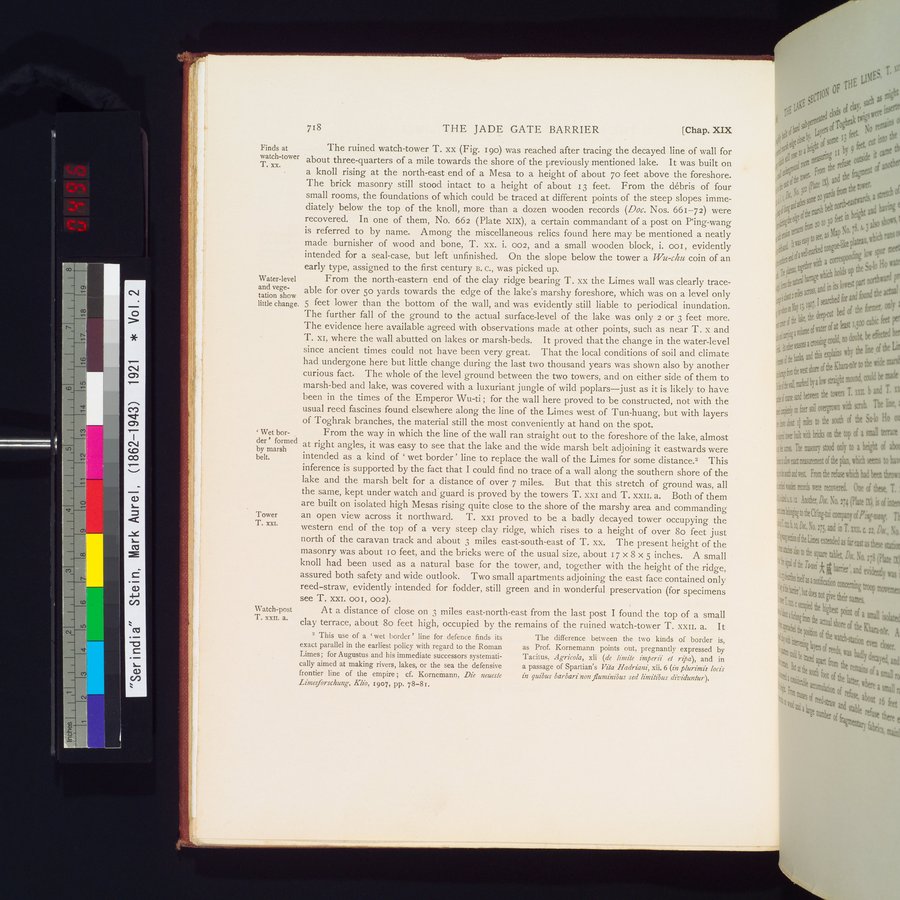
The ruined watch-tower T. xx (Fig. 190) was reached after tracing the decayed line of wall for about three-quarters of a mile towards the shore of the previously mentioned lake. It was built on a knoll rising at the north-east end of a Mesa to a height of about 70 feet above the foreshore. The brick masonry still stood intact to a height of about 13 feet. From the débris of four small rooms, the foundations of which could be traced at different points of the steep slopes immediately below the top of the knoll, more than a dozen wooden records (Doc. Nos. 661-72) were recovered. In one of them, No. 662 (Plate )(IX), a certain commandant of a post on Ping-wang is referred to by name. Among the miscellaneous relics found here may be mentioned a neatly made burnisher of wood and bone, T. xx. i. 002, and a small wooden block, i. 001, evidently intended for a seal-case, but left unfinished. On the slope below the tower a Wu-chu coin of an early type, assigned to the first century B. c., was picked up.
From the north-eastern end of the clay ridge bearing T. xx the Limes wall was clearly traceable for over 5o yards towards the edge of the lake's marshy foreshore, which was on a level only 5 feet lower than the bottom of the wall, and was evidently still liable to periodical inundation. The further fall of the ground to the actual surface-level of the lake was only 2 or 3 feet more. The evidence here available agreed with observations made at other points, such as near T. x and T. x1, where the wall abutted on lakes or marsh-beds. It proved that the change in the water-level since ancient times could not have been very great. That the local conditions of soil and climate had undergone here but little change during the last two thousand years was shown also by another curious fact. The whole of the level ground between the two towers, and on either side of them to marsh-bed and lake, was covered with a luxuriant jungle of wild poplars—just as it is likely to have been in the times of the Emperor Wu-ti ; for the wall here proved to be constructed, not with the usual reed fascines found elsewhere along the line of the Limes west of Tun-huang, but with layers of Toghrak branches, the material still the most conveniently at hand on the spot.
From the way in which the line of the wall ran straight out to the foreshore of the lake, almost at right angles, it was easy to see that the lake and the wide marsh belt adjoining it eastwards were intended as a kind of ` wet border ' line to replace the wall of the Limes for some distance.2 This inference is supported by the fact that I could find no trace of a wall along the southern shore of the lake and the marsh belt for a distance of over 7 miles. But that this stretch of ground was, all the same, kept under watch and guard is proved by the towers T. xxi and T. xxii. a. Both of them are built on isolated high Mesas rising quite close to the shore of the marshy area and commanding an open view across it northward. T. xxi proved to be a badly decayed tower occupying the western end of the top of a very steep clay ridge, which rises to a height of over 8o feet just north of the caravan track and about 3 miles east-south-east of T. xx. The present height of the masonry was about 10 feet, and the bricks were of the usual size, about 17 x 8 x 5 inches. A small knoll had been used as a natural base for the tower, and, together with the height of the ridge, assured both safety and wide outlook. Two small apartments adjoining the east face contained only reed-straw, evidently intended for fodder, still green and in wonderful preservation (for specimens see T. xxi. oo1, 002).
At a distance of close on 3 miles east-north-east from the last post I found the top of a small clay terrace, about 8o feet high, occupied by the remains of the ruined watch-tower T. xx11. a. It
0 jt
2 This use of a wet border ' line for defence finds its exact parallel in the earliest policy with regard to the Roman Limes; for Augustus and his immediate successors systematically aimed at making rivers, lakes, or the sea the defensive frontier line of the empire ; cf. Kornemann. Die neueste Limesforschung, Klio, 1907, pp. 78-81.
The difference between the two kinds of border is, as Prof. Kornemann points out, pregnantly expressed by Tacitus, Agricola, xli (de lineile imperil el ripa), and in a passage of Spartian's Vila Hadrian:, xii. 6 (in plurimis lods in guibus barbari non fiuminibus sed linailtbus (ilz'iduntur).
|
|
|
|
|
|
|
|
|
Copyright (C) 2003-2019 National Institute of Informatics and The Toyo Bunko. All Rights Reserved.