 IIIF Color HighRes
National Institute of Informatics - Digital Silk Road Project
| |||||||||
|
| IIIF Color HighRes |
| Serindia : vol.2 |
 |
 |
 |
 |
 |
 |
|
|
 |
|
|
|
|
|
|
|
|
Citation Information
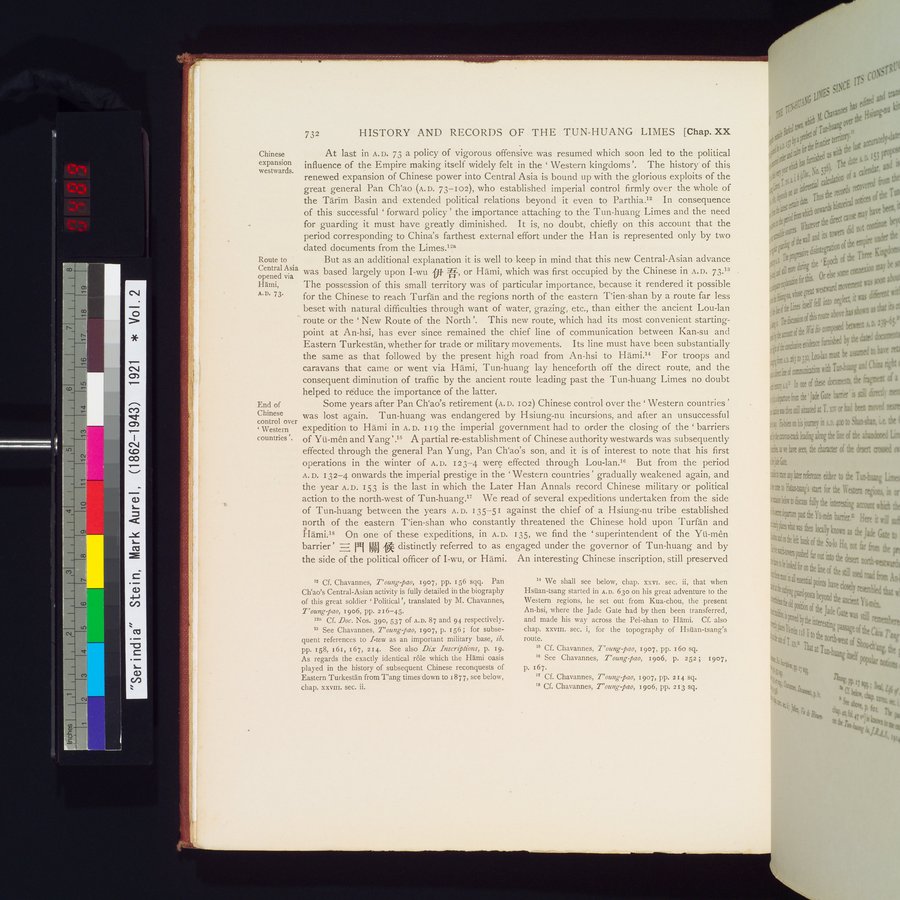
End of Chinese control over Western countries '.
732 HISTORY AND RECORDS OF THE TUN-HUANG LIMES [Chap. XX
At last in A.D. 73 a policy of vigorous offensive was resumed which soon led to the political influence of the Empire making itself widely felt in the ' Western kingdoms'. The history of this renewed expansion of Chinese power into Central Asia is bound up with the glorious exploits of the great general Pan Ch`ao (A.D. 73-102), who established imperial control firmly over the whole of the Tarim Basin and extended political relations beyond it even to Parthia.'2 In consequence of this successful ' forward policy ' the importance attaching to the Tun-huang Limes and the need for guarding it must have greatly diminished. It is, no doubt, chiefly on this account that the period corresponding to China's farthest external effort under the Han is represented only by two dated documents from the Limes.12a
But as an additional explanation it is well to keep in mind that this new Central-Asian advance was based largely upon I-wu f â, or Hami, which was first occupied by the Chinese in A.D. 73.13 The possession of this small territory was of particular importance, because it rendered it possible for the Chinese to reach Turfan and the regions north of the eastern Tien-shan by a route far less beset with natural difficulties through want of water, grazing, etc., than either the ancient Lou-lan route or the ' New Route of the North '. This new route, which had its most convenient starting-point at An-hsi, has ever since remained the chief line of communication between Kan-su and Eastern Turkestan, whether for trade or military movements. Its line must have been substantially the same as that followed by the present high road from An-hsi to Hami.14 For troops and caravans that came or went via Hami, Tun-huang lay henceforth off the direct route, and the consequent diminution of traffic by the ancient route leading past the Tun-huang Limes no doubt helped to reduce the importance of the latter.
Some years after Pan Ch`ao's retirement (A. D. 102) Chinese control over the Western countries' was lost again. Tun-huang was endangered by Hsiung-nu incursions, and after an unsuccessful expedition to Hâmi in A. D. 119 the imperial government had to order the closing of the ' barriers of Yü-mên and Yang '.'6 A partial re-establishment of Chinese authority westwards was subsequently effected through the general Pan Yung, Pan Ch`ao's son, and it is of interest to note that his first operations in the winter of A. D. 123-4 were effected through Lou-lan.'° But from the period A. D. 132-4 onwards the imperial prestige in the ' Western countries ' gradually weakened again, and the year A.D. 153 is the last in which the Later Han Annals record Chinese military or political action to the north-west of Tun-huang." We read of several expeditions undertaken from the side of Tun-huang between the years A. D. 135-51 against the chief of a Hsiung-nu tribe established north of the eastern Tien-shan who constantly threatened the Chinese hold upon Turfân and l'Iami.'$ On one of these expeditions, in A.D. 135, we find the 'superintendent of the Yii-mên
barrier' = 19 4 distinctly referred to as engaged under the governor of Tun-huang and by
the side of the political officer of I-wu, or Hâmi. An interesting Chinese inscription, still preserved
Chinese expansion westwards.
Route to Central Asia opened via Hami,
A. D. 73.
12 Cf. Chavannes, T'oung-pao, 1907, pp. 156 sqq. Pan Ch'ao's Central-Asian activity is fully detailed in the biography of this great soldier ` Political', translated by M. Chavannes, T'oung-pao, 1906, pp. 216-45.
32a Cf. Doc. Nos. 390, 537 of A.D. 87 and 94 respectively.
13 See Chavannes, T`oungpao, 3907, p. 156; for subsequent references to 1-wu as an important military base, ib. pp. 158, 161, 167, 234. See also Dix Inscriptions, p. 39. As regards the exactly identical rôle which the Hami oasis played in the history of subsequent Chinese reconquests of Eastern Turkestan from T'ang times down to 1877, see below, chap. xxvnl. sec. ii.
14 We shall see below, chap. xxvl. sec. ii, that when Hsüan-tsang started in A.D. 630 on his great adventure to the Western regions, he set out from Kua-chou, the present An-hsi, where the Jade Gate had by then been transferred, and made his way across the Pei-shan to Hami. Cf. also chap. xxvtn. sec. i, for the topography of Hsüan-tsang's route.
16 Cf. Chavannes, T'oung-pao, 3907, pp. 16o sq.
18 See Chavannes, T'oung-pao, 1906, p. 252 ; 1907, p. 167.
12 Cf. Chavannes, T'oung-pao, 1907, pp. 234 sq.
18 Cf. Chavannes, T'oung-pao, 1906, pp. 213 sq.
|
|
|
|
|
|
|
|
|
Copyright (C) 2003-2019 National Institute of Informatics and The Toyo Bunko. All Rights Reserved.