 IIIFカラー高解像度
国立情報学研究所 - ディジタル・シルクロード・プロジェクト
| |||||||||
|
| IIIFカラー高解像度 |
| The Book of Ser Marco Polo : vol.2 | |
| マルコ=ポーロ卿の記録 : vol.2 |
 |
 |
 |
 |
 |
 |
|
|
 |
|
|
|
|
|
|
|
|
引用情報
R
4
•
CHAP. XII.
THE ISLAND OF NECUVERAN
307
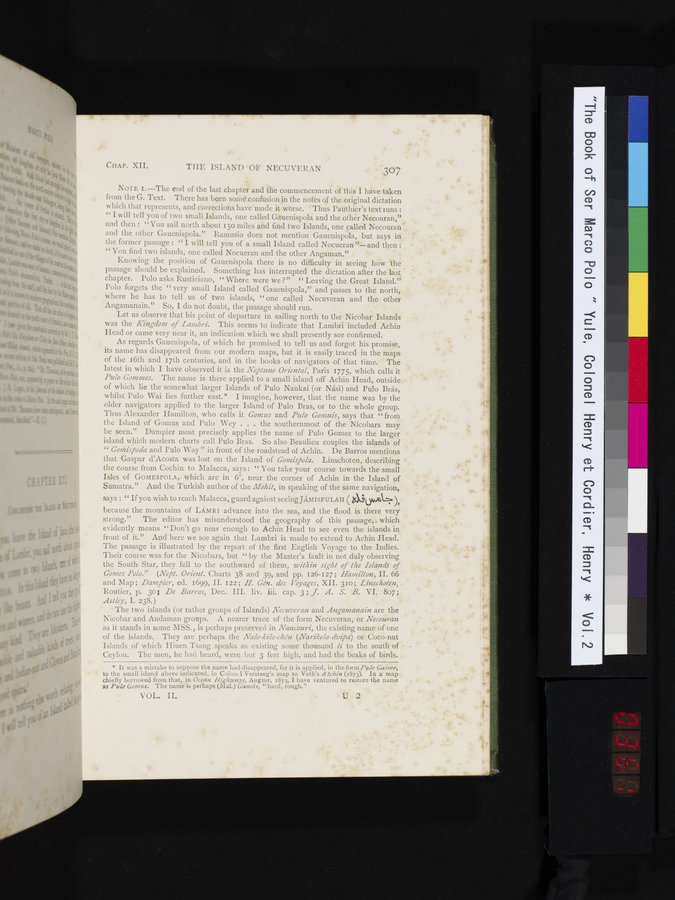
NOTE E I. —The end of the last chapter and the commencement of this I have taken from the G. Text. There has been some confusion in the notes of the original dictation which that represents, and corrections have made it worse. Thus Pauthier's text runs : " T will tell you of two small Islands, one called Gauenispola and the other Necouran," and then : "You sail north about 150 miles and find two Islands, one called Necouran and the other Gauenispola." Ramusio does not mention Gauenispola, but says in the former passage : " I will tell you of a small Island called Nocueran "— and then : " You find two islands, one called Nocueran and the other Angaman."
hnowing the position of Gauenispola there is no difficulty in seeing how the passage should be explained. Something has interrupted the dictation after the last chapter. Polo asks Rusticiano, " Where were we ?" " Leaving the Great Island." Polo forgets the " very small Island called Gauenispola," and passes to the north, where he has to tell us of two islands, " one called Necuveran and the other Angamanain." So, I do not doubt, the passage should run.
Let us observe that his point of departure in sailing north to the Nicobar Islands was the king donz of Lambri. This seems to indicate that Lambri included Achin Mead or came very near it, an indication which we shall presently see confirmed.
As regards Gauenispola, of which he promised to tell us and forgot his promise, its name has disappeared from our modern maps, but it is easily traced in the maps of the 16th and 17th centuries, and in the books of navigators of that time. The latest in which I have observed it is the Neptune Oriental, Paris 1775, which calls it Pulo Gommes. The name is there applied to a small island off Achin Head, outside.' of which lie the somewhat larger Islands of Pulo Nankai (or Nási) and Pulo Brás, whilst Pulo Wai lies further east.* I imagine, however, that the name was by the older navigators applied to the larger Island of Pulo Bras, or to the whole group. Thus Alexander Hamilton, who calls it Gonzus and Pu.lo Gomuis, says that "from the Island of Gomus and Pulo Wey . . . the southernmost of the Nicobars may be seen." Dampier most precisely applies the name of Pulo Gomez to the larger island which modern charts call Pulo Bras. So also Beaulieu couples the islands of " Gomispoda and Pulo Way " in front of the roadstead of Achin. De Barros mentions that Gaspar d'Acosta was lost on the Island of Gomispola. Linschoten, describing the course from Cochin to Malacca, says : " You take your course towards the small Isles of GOMESPOLA, which are in 6°, near the corner of Achin in the Island of
Sumatra." And the Turkish author of the Mohit, in speaking of the same navigation,
says : " If you wish to reach Malacca, guard against seeing JÁMISFULAH CUVot4 ),
4
s
•
s
i • •
~
~~ •
JOE:
.. ~• tIt.
.
. ~
.~►
because the mountains of LÁMRI advance into the sea, and the flood is there very b ' strop " The editor has misunderstood the eo ra h of this assa e which +. :till.'..:_OE•evidently means "Don't go near enough to Achin Head to see even the islands in•front of it." And here we see again that Lambri is made to extend to Achin Head. +..
.it
1 The passage is illustrated by the report of the first English Voyage to the Indies. .4..4.4
Their course was for the Nicobars, but " by the Master's fault in not duly observing
the South Star, they fell to the southward of them, within sight of the Islands of ..,**,.
Gomes Polo." (Nept. Orient. Charts 38 and 39, and pp. 126-127 ; Hamilton, II. 66 •
and Map; Dampier, ed. 1699, II. 122 ; H. Gon. des Voyages, XII. 310; Linschoten,
•
Routier, p. 3o; De Barros, Dec. III. liv. iii. cap. 3 ; J. A. S. B. VI. 807;
x
f
Astley, I. 238. )
The two islands (or rather groups of Islands) Necuveran and Angamanain are the Nicobar and Andaman groups. A nearer trace of the form Necuveran, or Necouran as it stands in some MSS., is perhaps preserved in Nancouri, the existing name of one of the islands. They are perhaps the Nalo-kilo-chJu (Narikela-dvipa) or Coco-nut Islands of which Hiuen Tsang speaks as existing some thousand li to the south of Ceylon. The men, he had heard, were but 3 feet high, and had the beaks of birds.
* It was a mistake to suppose the name had disappeared, for it is applied, in the form Pula Gaimr, to the small island above indicated, in Colons 1 Versteeg's map to Veth's A tchin (1873). In a map
chiefly borrowed from that, in Ocean Highways, August, 1873, I have ventured to restore the name r •
as Pu'10 Gomus. The name is perhaps (Mal.) Ga,nás, "hard, rough." . 4 4"
VOL. II. U 2 • .
...
.,•i'.4
' it. S
•
ă u
•
.t ••• • • r
n.
. •-••
•
t
~ -
r
t
ft
.,+ ~ a '
,. ~i
~ ~• ♦
~ ~ •+, 1
~ r ,' • ~~ ~ .
st.
,
~
~ •
,
|
|
|
|
|
|
|
|
|
Copyright (C) 2003-2019
National Institute of Informatics(国立情報学研究所)
and
The Toyo Bunko(東洋文庫). All Rights Reserved.
本ウェブサイトに掲載するデジタル文化資源の無断転載は固くお断りいたします。