 IIIFカラー高解像度
国立情報学研究所 - ディジタル・シルクロード・プロジェクト
| |||||||||
|
| IIIFカラー高解像度 |
| Serindia : vol.2 | |
| セリンディア : vol.2 |
 |
 |
 |
 |
 |
 |
|
|
 |
|
|
|
|
|
|
|
|
引用情報
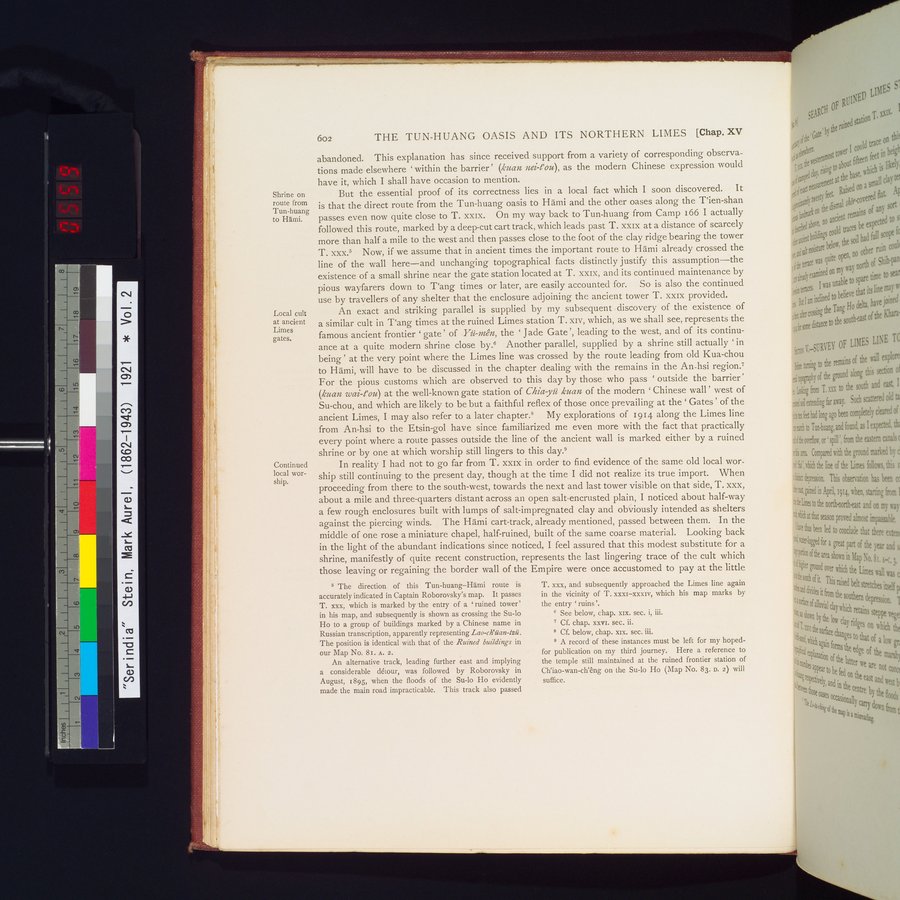
602 THE TUN-HUANG OASIS AND ITS NORTHERN LIMES [Chap. XV
abandoned. This explanation has since received support from a variety of corresponding observations made elsewhere ' within the barrier ' (kuan nei-l'ou), as the modern Chinese expression would have it, which I shall have occasion to mention.
But the essential proof of its correctness lies in a local fact which I soon discovered. It is that the direct route from the Tun-huang oasis to Hâmi and the other oases along the Tien-shan passes even now quite close to T. xxix. On my way back to Tun-huang from Camp i66 I actually followed this route, marked by a deep-cut cart track, which leads past T. xxix at a distance of scarcely more than half a mile to the west and then passes close to the foot of the clay ridge bearing the tower T. xxx.6 Now, if we assume that in ancient times the important route to Hâmi already crossed the line of the wall here—and unchanging topographical facts distinctly justify this assumption—the existence of a small shrine near the gate station located at T. xxix, and its continued maintenance by pious wayfarers down to Tang times or later, are easily accounted for. So is also the continued use by travellers of any shelter that the enclosure adjoining the ancient tower T. xxix provided.
An exact and striking parallel is supplied by my subsequent discovery of the existence of a similar cult in Tang times at the ruined Limes station T. xiv, which, as we shall see, represents the famous ancient frontier gate ' of .Yii-men, the ' Jade Gate ', leading to the west, and of its continuance at a quite modern shrine close by.6 Another parallel, supplied by a shrine still actually ' in being ' at the very point where the Limes line was crossed by the route leading from old Kua-chou to Hami, will have to be discussed in the chapter dealing with the remains in the An-hsi region.? For the pious customs which are observed to this day by those who pass ' outside the barrier' (kuan wai-l'ou) at the well-known gate station of Chia yii kuan of the modern ' Chinese wall ' west of Su-chou, and which are likely to be but a faithful reflex of those once prevailing at the Gates ' of the ancient Limes, I may also refer to a later chapter.$ My explorations of 1914 along the Limes line from An-hsi to the Etsin-gol have since familiarized me even more with the fact that practically every point where a route passes outside the line of the ancient wall is marked either by a ruined shrine or by one at which worship still lingers to this day.9
In reality I had not to go far from T. xxix in order to find evidence of the same old local worship still continuing to the present day, though at the time I did not realize its true import. When proceeding from there to the south-west, towards the next and last tower visible on that side, T. xxx, about a mile and three-quarters distant across an open salt-encrusted plain, I noticed about half-way a few rough enclosures built with lumps of salt-impregnated clay and obviously intended as shelters against the piercing winds. The Hâmi cart-track, already mentioned, passed between them. In the middle of one rose a miniature chapel, half-ruined, built of the same coarse material. Looking back in the light of the abundant indications since noticed, I feel assured that this modest substitute for a shrine, manifestly of quite recent construction, represents the last lingering trace of the cult which those leaving or regaining the border wall of the Empire were once accustomed to pay at the little
Shrine on route from Tun-huang to Hâmi.
Local cult at ancient Limes gates.
Continued local worship.
6 The direction of this Tun-huang—Hami route is accurately indicated in Captain Roborovsky's map. It passes T. xxx, which is marked by the entry of a 'ruined tower' in his map, and subsequently is shown as crossing the Su-lo Ho to a group of buildings marked by a Chinese name in Russian transcription, apparently representing Lao-ch'üan-Izù. The position is identical with that of the Ruined buildings in our Map No. 81. A. 2.
An alternative track, leading further east and implying a considerable détour, was followed by Roborovsky in August, 1895, when the floods of the Su-lo Ho evidently made the main road impracticable. This track also passed
T. xxx, and subsequently approached the Limes line again in the vicinity of T. xxxi—xxxiv, which his map marks by the entry ' ruins'.
o See below, chap. xix. sec. i, iii.
7 Cf. chap. xxvl. sec. ii.
s Cf. below, chap. xix. sec. iii.
° A record of these instances must be left for my hoped-for publication on my third journey. Here a reference to the temple still maintained at the ruined frontier station of Ch'iao-wan-ch`êng on the Su-lo Ho (Map No. 83. D. 2) will suffice.
|
|
|
|
|
|
|
|
|
Copyright (C) 2003-2019
National Institute of Informatics(国立情報学研究所)
and
The Toyo Bunko(東洋文庫). All Rights Reserved.
本ウェブサイトに掲載するデジタル文化資源の無断転載は固くお断りいたします。