 IIIFカラー高解像度
国立情報学研究所 - ディジタル・シルクロード・プロジェクト
| |||||||||
|
| IIIFカラー高解像度 |
| Serindia : vol.2 | |
| セリンディア : vol.2 |
 |
 |
 |
 |
 |
 |
|
|
 |
|
|
|
|
|
|
|
|
引用情報
6z 2 THE OASIS OF NAN-HU AND THE YANG BARRIER [Chap. XVI
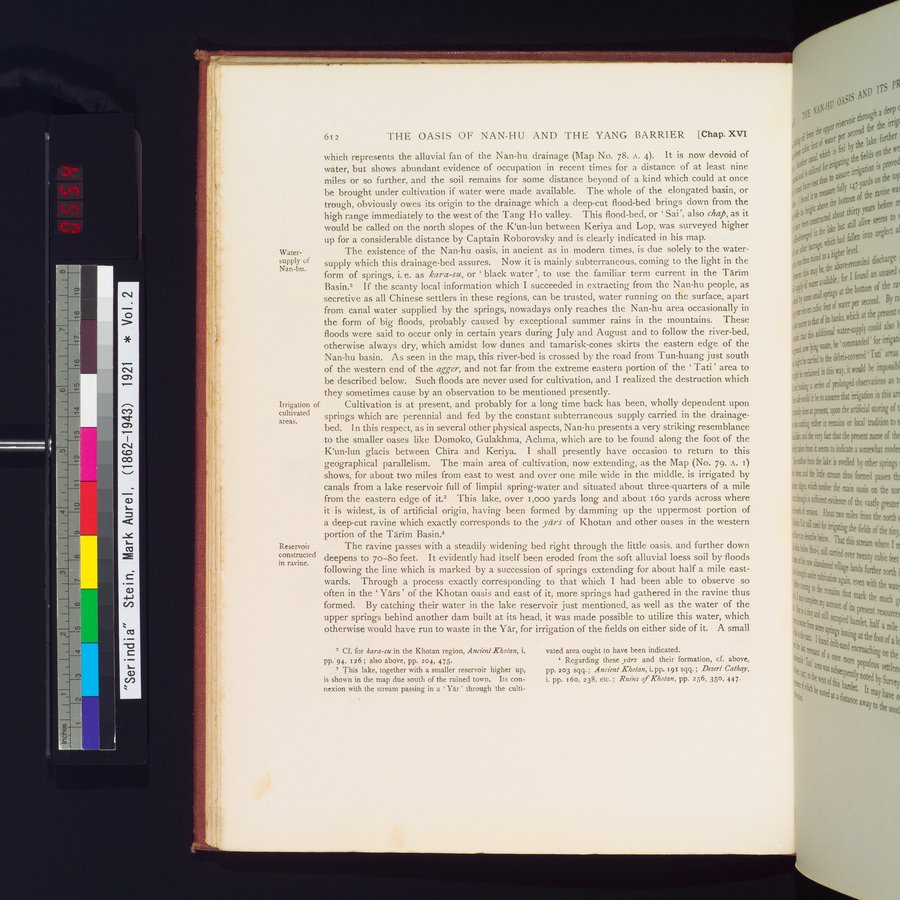
which represents the alluvial fan of the Nan-hu drainage (Map No. 78. A. 4). It is now devoid of water, but shows abundant evidence of occupation in recent times for a distance of at least nine miles or so further, and the soil remains for some distance beyond of a kind which could at once be brought under cultivation if water were made available. The whole of the elongated basin, or trough, obviously owes its origin to the drainage which a deep-cut flood-bed brings down from the high range immediately to the west of the Tang Ho valley. This flood-bed, or ` Sai', also chap, as it would be called on the north slopes of the K`un-lun between Keriya and Lop, was surveyed higher up for a considerable distance by Captain Roborovsky and is clearly indicated in his map.
The existence of the Nan-hu oasis, in ancient as in modern times, is due solely to the water-supply which this drainage-bed assures. Now it is mainly subterraneous, coming to the light in the form of springs, i. e. as kara-su, or ` black water ', to use the familiar term current in the Tarim Basin.2 If the scanty local information which I succeeded in extracting from the Nan-hu people, as secretive as all Chinese settlers in these regions, can be trusted, water running on the surface, apart from canal water supplied by the springs, nowadays only reaches the Nan-hu area occasionally in the form of big floods, probably caused by exceptional summer rains in the mountains. These floods were said to occur only in certain years during July and August and to follow the river-bed, otherwise always dry, which amidst low dunes and tamarisk-cones skirts the eastern edge of the Nan-hu basin. As seen in the map, this river-bed is crossed by the road from Tun-huang just south of the western end of the agger, and not far from the extreme eastern portion of the ` Tati ' area to be described below. Such floods are never used for cultivation, and I realized the destruction which they sometimes cause by an observation to be mentioned presently.
Cultivation is at present, and probably for a long time back has been, wholly dependent upon springs which are perennial and fed by the constant subterraneous supply carried in the drainage-bed. In this respect, as in several other physical aspects, Nan-hu presents a very striking resemblance to the smaller oases like Domoko, Gulakhma, Achma, which are to be found along the foot of the K`un-lun glacis between Chira and Keriya. I shall presently have occasion to return to this geographical parallelism. The main area of cultivation, now extending, as the Map (No. 79. A. i) shows, for about two miles from east to west and over one mile wide in the middle, is irrigated by canals from a lake reservoir full of limpid spring-water and situated about three-quarters of a mile from the eastern edge of it.3 This lake, over r,000 yards long and about 16o yards across where it is widest, is of artificial origin, having been formed by damming up the uppermost portion of a deep-cut ravine which exactly corresponds to the yars of Khotan and other oases in the western portion of the Tarim Basin.4
The ravine passes with a steadily widening bed right through the little oasis, and further down deepens to 70-80 feet. It evidently had itself been eroded from the soft alluvial loess soil by floods following the line which is marked by a succession of springs extending for about half a mile eastwards. Through a process exactly corresponding to that which I had been able to observe so often in the ` Yârs' of the Khotan oasis and east of it, more springs had gathered in the ravine thus formed. By catching their water in the lake reservoir just mentioned, as well as the water of the upper springs behind another dam built at its head, it was made possible to utilize this water, which otherwise would have run to waste in the Yâr, for irrigation of the fields on either side of it. A small
1 Cf. for kara-su in the Khotan region, Ancient Khotan, i. PP•.94, 126; also above, pp. 204, 475.
'. This lake, together with a smaller reservoir higher up, is shown in the map due south of the ruined town. Its connexion with the stream passing in a ` Yâr' through the culti
vated area ought to have been indicated.
' Regarding these yàrs and their formation, cf. above, pp. 203 sqq.; Ancient Khotan, i. pp. 191 sqq.; Desert Cathay, i. pp. 160, 238, etc.; Ruins of Khotan, pp. 236, 350, 447.
Water-supply of Nan-hu.
Irrigation of cultivated areas.
Reservoir constructed in ravine.
|
|
|
|
|
|
|
|
|
Copyright (C) 2003-2019
National Institute of Informatics(国立情報学研究所)
and
The Toyo Bunko(東洋文庫). All Rights Reserved.
本ウェブサイトに掲載するデジタル文化資源の無断転載は固くお断りいたします。