 IIIFカラー高解像度
国立情報学研究所 - ディジタル・シルクロード・プロジェクト
| |||||||||
|
| IIIFカラー高解像度 |
| Serindia : vol.2 | |
| セリンディア : vol.2 |
 |
 |
 |
 |
 |
 |
|
|
 |
|
|
|
|
|
|
|
|
引用情報
68o THE WESTERNMOST LIMES WALL [Chap. XVIII
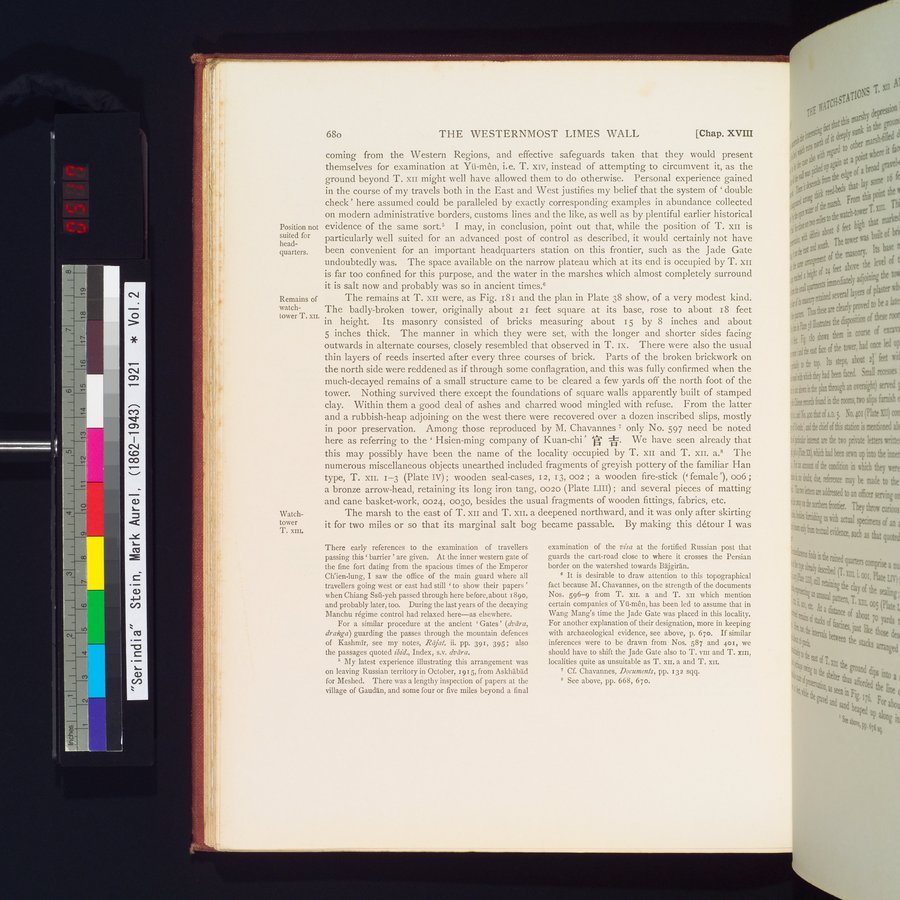
coming from the Western Regions, and effective safeguards taken that they would present themselves for examination at Yii-mên, i.e. T. xiv, instead of attempting to circumvent it, as the ground beyond T. xi' might well have allowed them to do otherwise. Personal experience gained in the course of my travels both in the East and West justifies my belief that the system of ` double check ' here assumed could be paralleled by exactly corresponding examples in abundance collected on modern administrative borders, customs lines and the like, as well as by plentiful earlier historical evidence of the same sort.5 I may, in conclusion, point out that, while the position of T. x11 is particularly well suited for an advanced post of control as described, it would certainly not have been convenient for an important headquarters station on this frontier, such as the Jade Gate undoubtedly was. The space available on the narrow plateau which at its end is occupied by T. xi' is far too confined for this purpose, and the water in the marshes which almost completely surround it is salt now and probably was so in ancient times.°
The remains at T. xi' were, as Fig. 181 and the plan in Plate 38 show, of a very modest kind. The badly-broken tower, originally about 21 feet square at its base, rose to about 18 feet in height. Its masonry consisted of bricks measuring about 15 by 8 inches and about 5 inches thick. The manner in which they were set, with the longer and shorter sides facing outwards in alternate courses, closely resembled that observed in T. ix. There were also the usual thin layers of reeds inserted after every three courses of brick. Parts of the broken brickwork on the north side were reddened as if through some conflagration, and this was fully confirmed when the much-decayed remains of a small structure came to be cleared a few yards off the north foot of the tower. Nothing survived there except the foundations of square walls apparently built of stamped clay. Within them a good deal of ashes and charred wood mingled with refuse. From the latter and a rubbish-heap adjoining on the west there were recovered over a dozen inscribed slips, mostly in poor preservation. Among those reproduced by M. Chavannes only No. 597 need be noted here as referring to the ` Hsien-ming company of Kuan-chi â .. We have seen already that this may possibly have been the name of the locality occupied by T. xii and T. x11. a.8 The numerous miscellaneous objects unearthed included fragments of greyish pottery of the familiar Han type, T. x11. 1-3 (Plate IV) ; wooden seal-cases, 12, 13, 002 ; a wooden fire-stick (' female'), oo6 ; a bronze arrow-head, retaining its long iron tang, 0020 (Plate LIII) ; and several pieces of matting and cane basket-work, 0024, 0030, besides the usual fragments of wooden fittings, fabrics, etc.
The marsh to the east of T. x11 and T. x11. a deepened northward, and it was only after skirting it for two miles or so that its marginal salt bog became passable. By making this détour I was
There early references to the examination of travellers passing this barrier ' are given. At the inner western gate of the fine fort dating from the spacious times of the Emperor Chien-lung, I saw the office of the main guard where all travellers going west or east had still ' to show their papers' when Chiang Ssû-yeh passed through here before,about 189o, and probably later, too. During the last years of the decaying Manchu régime control had relaxed here—as elsewhere.
For a similar procedure at the ancient Gates' (dvara, drairga) guarding the passes through the mountain defences of Kashmir, see my notes, Ràjat. ii. pp. 39r, 395 ; also the passages quoted :bid., Index, s.v. dvnra.
6 My latest experience illustrating this arrangement was on leaving Russian territory in October, 1915, from Askhâbâd for Meshed. There was a lengthy inspection of papers at the village of Gaudân, and some four or five miles beyond a final
examination of the visa at the fortified Russian post that guards the cart-road close to where it crosses the Persian border on the watershed towards Bàjgirân.
° It is desirable to draw attention to this topographical fact because M. Chavannes, on the strength of the documents Nos. 596-9 from T. xII. a and T. xII which mention certain companies of Yü-mên, has been led to assume that in Wang Mang's time the Jade Gate was placed in this locality. For another explanation of their designation, more in keeping with archaeological evidence, see above, p. 67o. If similar inferences were to be drawn from Nos. 587 and 401, we should have to shift the Jade Gate also to T. vinn and T. xxxi, localities quite as unsuitable as T. xII. a and T. xi'.
' Cf. Chavannes, Documents, pp. 132 sqq.
$ See above, pp. 668, 67o.
Position not suited for headquarters.
Remains of watch-
tower T. xu.
Watch- tower T. mu.
|
|
|
|
|
|
|
|
|
Copyright (C) 2003-2019
National Institute of Informatics(国立情報学研究所)
and
The Toyo Bunko(東洋文庫). All Rights Reserved.
本ウェブサイトに掲載するデジタル文化資源の無断転載は固くお断りいたします。