 IIIFカラー高解像度
国立情報学研究所 - ディジタル・シルクロード・プロジェクト
| |||||||||
|
| IIIFカラー高解像度 |
| Serindia : vol.2 | |
| セリンディア : vol.2 |
 |
 |
 |
 |
 |
 |
|
|
 |
|
|
|
|
|
|
|
|
引用情報
Mural decoration of Ch. I.
Mural
paintings of porch.
Sculptural remains in shrine Ch. II.
Wall-
paintings of cella Ch. ü.
928 CAVE-TEMPLES & ANTIQUES OF THE THOUSAND BUDDHAS [Ch. XXV
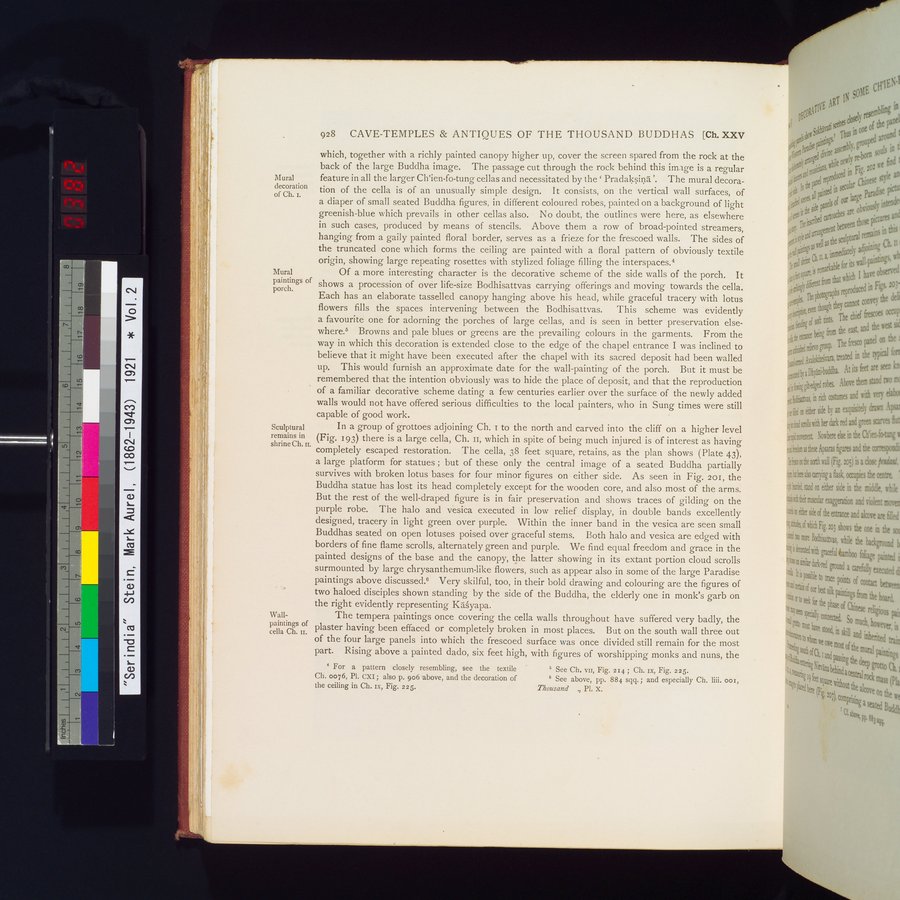
which, together with a richly painted canopy higher up, cover the screen spared from the rock at the back of the large Buddha image. The passage cut through the rock behind this image is a regular feature in all the larger Chien-fo-tung cellas and necessitated by the ` Pradaksind'. The mural decoration of the cella is of an unusually simple design. It consists, on the vertical wall surfaces, of a diaper of small seated Buddha figures, in different coloured robes, painted on a background of light greenish-blue which prevails in other cellas also. No doubt, the outlines were here, as elsewhere in such cases, produced by means of stencils. Above them a row of broad-pointed streamers, hanging from a gaily painted floral border, serves as a frieze for the frescoed walls. The sides of the truncated cone which forms the ceiling are painted with a floral pattern of obviously textile origin, showing large repeating rosettes with stylized foliage filling the interspaces.4
Of a more interesting character is the decorative scheme of the side walls of the porch. It shows a procession of over life-size Bodhisattvas carrying offerings and moving towards the cella. Each has an elaborate tasselled canopy hanging above his head, while graceful tracery with lotus flowers fills the spaces intervening between the Bodhisattvas. This scheme was evidently a favourite one for adorning the porches of large cellas, and is seen in better preservation elsewhere.° Browns and pale blues or greens are the prevailing colours in the garments. From the way in which this decoration is extended close to the edge of the chapel entrance I was inclined to believe that it might have been executed after the chapel with its sacred deposit had been walled up. This would furnish an approximate date for the wall-painting of the porch. But it must be remembered that the intention obviously was to hide the place of deposit, and that the reproduction of a familiar decorative scheme dating a few centuries earlier over the surface of the newly added walls would not have offered serious difficulties to the local painters, who in Sung times were still capable of good work.
In a group of grottoes adjoining Ch. I to the north and carved into the cliff on a higher level (Fig. 193) there is a large cella, Ch. n, which in spite of being much injured is of interest as having completely escaped restoration. The cella, 38 feet square, retains, as the plan shows (Plate 43), a large platform for statues ; but of these only the central image of a seated Buddha partially survives with broken lotus bases for four minor figures on either side. As seen in Fig. 201, the Buddha statue has lost its head completely except for the wooden core, and also most of the arms. But the rest of the well-draped figure is in fair preservation and shows traces of gilding on the purple robe. The halo and vesica executed in low relief display, in double bands excellently designed, tracery in light green over purple. Within the inner band in the vesica are seen small Buddhas seated on open lotuses poised over graceful stems. Both halo and vesica are edged with borders of fine flame scrolls, alternately green and purple. We find equal freedom and grace in the painted designs of the base and the canopy, the latter showing in its extant portion cloud scrolls surmounted by large chrysanthemum-like flowers, such as appear also in some of the large Paradise paintings above discussed.° Very skilful, too, in their bold drawing and colouring are the figures of two haloed disciples shown standing by the side of the Buddha, the elderly one in monk's garb on the right evidently representing Kä yapa.
The tempera paintings once covering the cella walls throughout have suffered very badly, the plaster having been effaced or completely broken in most places. But on the south wall three out of the four large panels into which the frescoed surface was once divided still remain for the most part. Rising above a painted dado, six feet high, with figures of worshipping monks and nuns, the
| ' For a pattern closely resembling, see the textile Ch. 0076, Pl. CXI; also p. 906 above, and the decoration of the ceiling in Ch. Ix, Fig. 225. | 5 See Ch. VII, Fig. 214 ; Ch. Ix, Fig. 225. 6 See above, pp. 884 sqq.; and especially Ch. liii. oor, Thousand ., Pl. X. |
|
|
|
|
|
|
|
|
|
Copyright (C) 2003-2019
National Institute of Informatics(国立情報学研究所)
and
The Toyo Bunko(東洋文庫). All Rights Reserved.
本ウェブサイトに掲載するデジタル文化資源の無断転載は固くお断りいたします。