 IIIFカラー高解像度
国立情報学研究所 - ディジタル・シルクロード・プロジェクト
| |||||||||
|
| IIIFカラー高解像度 |
| Ancient Khotan : vol.1 | |
| 古代コータン : vol.1 |
 |
 |
 |
 |
 |
 |
|
|
 |
|
|
|
|
|
|
|
|
引用情報
206 ANCIENT SITES OF THE KHOTAN OASIS [Chap. VIII
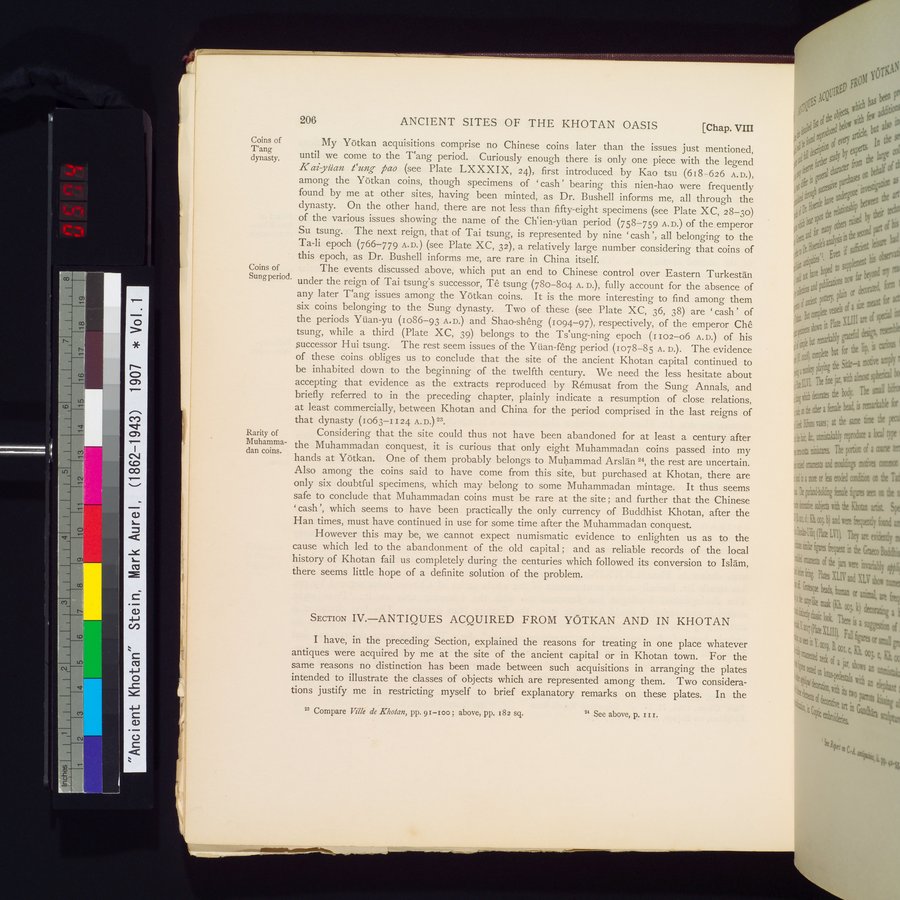
My Ybtkan acquisitions comprise no Chinese coins later than the issues just mentioned, until we come to the Tang period. Curiously enough there is only one piece with the legend Kai yüan tsung j5ao (see Plate LXXXIX, 24), first introduced by Kao tsu (618-626 A.D.), among the Ybtkan coins, though specimens of `cash' bearing this nien-hao were frequently found by me at other sites, having been minted, as Dr. Bushell informs me, all through the dynasty. On the other hand, there are not less than fifty-eight specimens (see Plate XC, 28-3o) of the various issues showing the name of the Chien-yüan period (758-759 A.D.) of the emperor Su tsung. The next reign, that of Tai tsung, is represented by nine `cash', all belonging to the Ta-li epoch (766-779 A.D.) (see Plate XC, 32), a relatively large number considering that coins of this epoch, as Dr. Bushell informs me, are rare in China itself.
The events discussed above, which put an end to Chinese control over Eastern Turkestan under the reign of Tai tsung's successor, Té tsung (780-804 A. D.), fully account for the absence of any later Tang issues among the Ybtkan coins. It is the more interesting to find among them six coins belonging to the Sung dynasty. Two of these (see Plate XC, 36, 38) are ` cash ' of the periods Yüan-yu (1086-93 A.D.) and Shao-shêng (1094-97), respectively, of the emperor Chê tsung, while a third (Plate XC, 39) belongs to the Ts`ung-ning epoch (1102-06 A.D.) of his successor Hui tsung. The rest seem issues of the Yüan-fêng period (1078-85 A. D.). The evidence of these coins obliges us to conclude that the site of the ancient Khotan capital continued to be inhabited down to the beginning of the twelfth century. We need the less hesitate about accepting that evidence as the extracts reproduced by Rémusat from the Sung Annals, and briefly referred to in the preceding chapter, plainly indicate a resumption of close relations, at least commercially, between Khotan and China for the period comprised in the last reigns of that dynasty (1063-1124 A.D.) 23.
Considering that the site could thus not have been abandoned for at least a century after the Muhammadan conquest, it is curious that only eight Muhammadan coins passed into my hands at Yôtkan. One of them probably belongs to Muliammad Arslan 24, the rest are uncertain. Also among the coins said to have come from this site, but purchased at Khotan, there are only six doubtful specimens, which may belong to some Muhammadan mintage. It thus seems safe to conclude that Muhammadan coins must be rare at the site ; and further that the Chinese
cash ', which seems to have been practically the only currency of Buddhist Khotan, after the Han times, must have continued in use for some time after the Muhammadan conquest.
However this may be, we cannot expect numismatic evidence to enlighten us as to the cause which led to the abandonment of the old capital ; and as reliable records of the local history of Khotan fail us completely during the centuries which followed its conversion to Islam, there seems little hope of a definite solution of the problem.
SECTION IV.—ANTIQUES ACQUIRED FROM YÖTKAN AND IN KHOTAN
I have, in the preceding Section, explained the reasons for treating in one place whatever antiques were acquired by me at the site of the ancient capital or in Khotan town. For the same reasons no distinction has been made between such acquisitions in arranging the plates intended to illustrate the classes of objects which are represented among them. Two considerations justify me in restricting myself to brief explanatory remarks on these plates. In the
23 Compare Ville de Khotan, pp. 9t—zoo ; above, pp. 182 sq. 24 See above, p. z t z.
Coins of T'ang dynasty.
Coins of Sung period.
Rarity of Muhammadan coins.
|
|
|
|
|
|
|
|
|
Copyright (C) 2003-2019
National Institute of Informatics(国立情報学研究所)
and
The Toyo Bunko(東洋文庫). All Rights Reserved.
本ウェブサイトに掲載するデジタル文化資源の無断転載は固くお断りいたします。