 IIIFカラー高解像度
国立情報学研究所 - ディジタル・シルクロード・プロジェクト
| |||||||||
|
| IIIFカラー高解像度 |
| Serindia : vol.2 | |
| セリンディア : vol.2 |
 |
 |
 |
 |
 |
 |
|
|
 |
|
|
|
|
|
|
|
|
引用情報
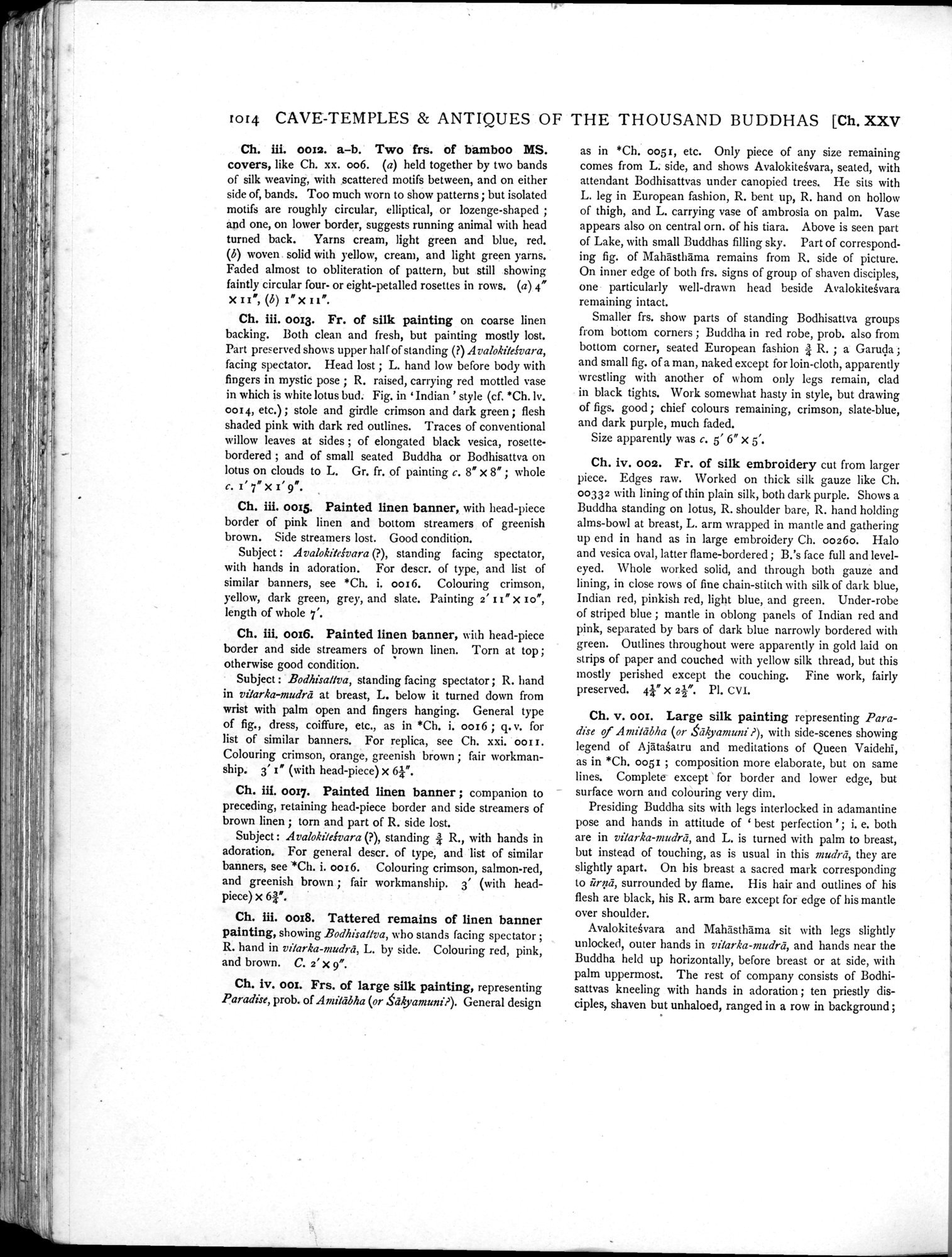
coco CAVE-TEMPLES & ANTIQUES OF THE THOUSAND BUDDHAS [Ch. XXV
Ch. iii. 0012. a-b. Two frs. of bamboo MS. covers, like Ch. xx. oo6. (a) held together by two bands of silk weaving, with scattered motifs between, and on either side of, bands. Too much worn to show patterns ; but isolated motifs are roughly circular, elliptical, or lozenge-shaped ; and one, on lower border, suggests running animal with head turned back. Yarns cream, light green and blue, red. (b) woven solid with yellow, cream, and light green yarns. Faded almost to obliteration of pattern, but still showing faintly circular four- or eight-petalled rosettes in rows. (a) 4" X II", (b) I"X I I".
Ch. iii. oo13. Fr. of silk painting on coarse linen backing. Both clean and fresh, but painting mostly lost. Part preserved shows upper half of standing (?) Avalokilelvara, facing spectator. Head lost ; L. hand low before body with fingers in mystic pose ; R. raised, carrying red mottled vase in which is white lotus bud. Fig. in ' Indian ' style (cf. *Ch. lv. 0014, etc.) ; stole and girdle crimson and dark green ; flesh shaded pink with dark red outlines. Traces of conventional willow leaves at sides ; of elongated black vesica, rosette-bordered ; and of small seated Buddha or Bodhisattva on lotus on clouds to L. Gr. fr. of painting c. 8' x 8" ; whole c. I'7"x 1'9".
Ch. iii. 0015. Painted linen banner, with head-piece border of pink linen and bottom streamers of greenish brown. Side streamers lost. Good condition.
Subject : Avalokileivara (?), standing facing spectator, with hands in adoration. For descr. of type, and list of similar banners, see *Ch. i. 0016. Colouring crimson, yellow, dark green, grey, and slate. Painting 2' I I" X Io", length of whole 7'.
Ch. iii. oo16. Painted linen banner, with head-piece border and side streamers of brown linen. Torn at top ; otherwise good condition.
Subject : Bodhisallva, standing facing spectator ; R. hand in vitarka-mudrä at breast, L. below it turned down from wrist with palm open and fingers hanging. General type of fig., dress, coiffure, etc., as in *Ch. i. 0016 ; q. v. for list of similar banners. For replica, see Ch. xxi. oorI. Colouring crimson, orange, greenish brown ; fair workmanship. 3' I" (with head-piece) x 6k".
Ch. iii. 0ov . Painted linen banner ; companion to preceding, retaining head-piece border and side streamers of brown linen ; torn and part of R. side lost.
Subject : Avaloki/eivara (?), standing â R., with hands in adoration. For general descr. of type, and list of similar banners, see *Ch. i. 0016. Colouring crimson, salmon-red, and greenish brown ; fair workmanship. 3' (with headpiece) x 6f".
Ch. iii. oox8. Tattered remains of linen banner painting, showing Bodhisallva, who stands facing spectator ; R. hand in vitarka-mudrü, L. by side. Colouring red, pink, and brown. C. 2' X 9".
Ch. iv. ooz. Frs. of large silk painting, representing Paradise, prob. of Amilâbha (or ,§iikyantuni?). General design
as in *Ch. 0051, etc. Only piece of any size remaining comes from L. side, and shows Avalokite§vara, seated, with attendant Bodhisattvas under canopied trees. He sits with L. leg in European fashion, R. bent up, R. hand on hollow of thigh, and L. carrying vase of ambrosia on palm. Vase appears also on central orn. of his tiara. Above is seen part of Lake, with small Buddhas filling sky. Part of corresponding fig. of Mahâsthâma remains from R. side of picture. On inner edge of both frs. signs of group of shaven disciples, one particularly well-drawn head beside Avalokite§vara remaining intact.
Smaller frs. show parts of standing Bodhisattva groups from bottom corners ; Buddha in red robe, prob. also from bottom corner, seated European fashion â R. ; a Garuda ; and small fig. of a man, naked except for loin-cloth, apparently wrestling with another of whom only legs remain, clad in black tights. Work somewhat hasty in style, but drawing of figs. good ; chief colours remaining, crimson, slate-blue, and dark purple, much faded.
Size apparently was c. 5' 6" x 5'.
Ch. iv. 002. Fr. of silk embroidery cut from larger piece. Edges raw. Worked on thick silk gauze like Ch. 00332 with lining of thin plain silk, both dark purple. Shows a Buddha standing on lotus, R. shoulder bare, R. hand holding alms-bowl at breast, L. arm wrapped in mantle and gathering up end in hand as in large embroidery Ch. 00260. Halo and vesica oval, latter flame-bordered ; B.'s face full and level-eyed. Whole worked solid, and through both gauze and lining, in close rows of fine chain-stitch with silk of dark blue, Indian red, pinkish red, light blue, and green. Under-robe of striped blue ; mantle in oblong panels of Indian red and pink, separated by bars of dark blue narrowly bordered with green. Outlines throughout were apparently in gold laid on strips of paper and couched with yellow silk thread, but this mostly perished except the couching. Fine work, fairly
preserved. 2 ". Pl. Cv1.
Ch. v. ooz. Large silk painting representing Paradise of Amilâbhra (or Siikyamuni l), with side-scenes showing legend of Ajâta§atru and meditations of Queen Vaidehi, as in *Ch. 0051 ; composition more elaborate, but on same lines. Complete except for border and lower edge, but surface worn and colouring very dim.
Presiding Buddha sits with legs interlocked in adamantine pose and hands in attitude of ' best perfection '; i. e. both are in vitarka-mudrâ, and L. is turned with palm to breast, but instead of touching, as is usual in this mudrir, they are slightly apart. On his breast a sacred mark corresponding to irrvd, surrounded by flame. His hair and outlines of his flesh are black, his R. arm bare except for edge of his mantle over shoulder.
Avalokite§vara and Mahästhâma sit with legs slightly unlocked, outer hands in vitarka-mudrâ, and hands near the Buddha held up horizontally, before breast or at side, with palm uppermost. The rest of company consists of Bodhisattvas kneeling with hands in adoration ; ten priestly disciples, shaven but unhaloed, ranged in a row in background;
|
|
|
|
|
|
|
|
|
Copyright (C) 2003-2019
National Institute of Informatics(国立情報学研究所)
and
The Toyo Bunko(東洋文庫). All Rights Reserved.
本ウェブサイトに掲載するデジタル文化資源の無断転載は固くお断りいたします。