 IIIFカラー高解像度
国立情報学研究所 - ディジタル・シルクロード・プロジェクト
| |||||||||
|
| IIIFカラー高解像度 |
| Cathay and the Way Thither : vol.1 | |
| 中国および中国への道 : vol.1 |
 |
 |
 |
 |
 |
 |
|
|
 |
|
|
|
|
|
|
|
|
引用情報
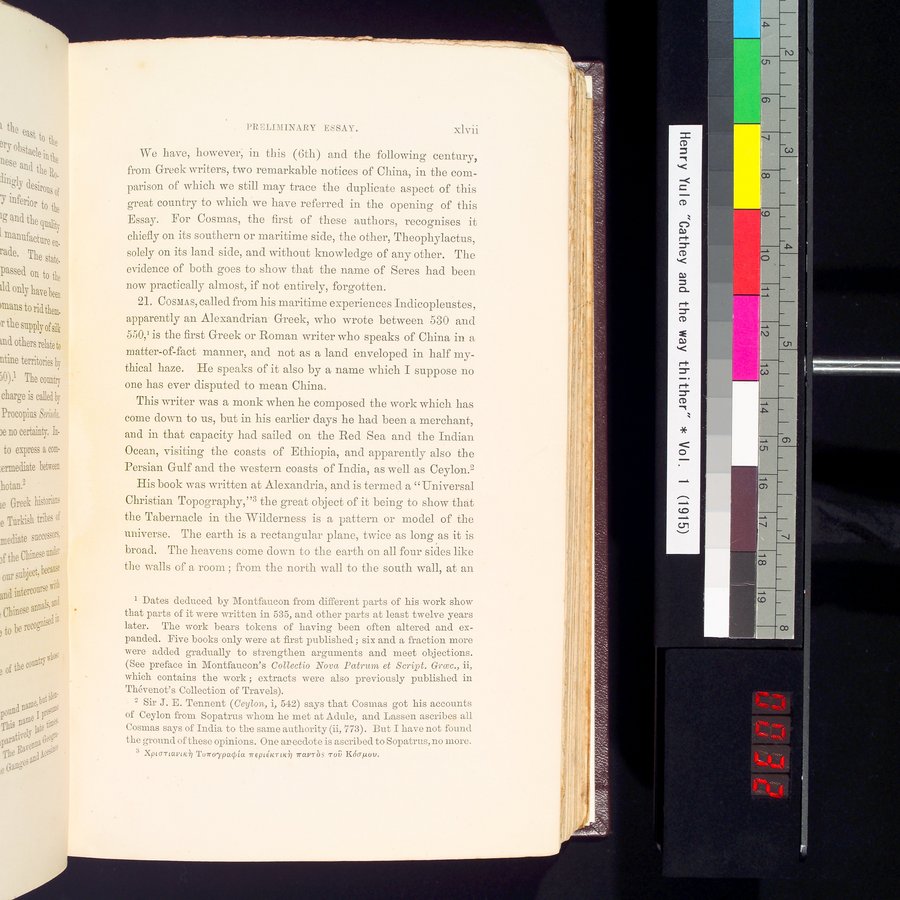
PRELIItINARY ESSAY. xlvii
We have, however; in this (6th) and the following century, from Greek writers, two remarkable notices of China, in the comparison of which we still may trace the duplicate aspect of this great country to which we have referred in the opening of this Essay. For Cosmas, the first of these authors, recognises it chiefly on its southern or maritime side, the other, Theophylactus, solely on its land side, and without knowledge of any other. The evidence of both goes to show that the name of Seres had been. now practically almost, if not entirely, forgotten.
21. COSMAS, called from his maritime experiences Indicopleustes, apparently an Alexandrian Greek, who wrote between 530 and 550,' is the first Greek or Roman writer who speaks of China in a matter-of-fact manner, and not as a land enveloped in half mythical haze. He speaks of it also by a name which I suppose no one has ever disputed to mean China.
This writer was a monk when he composed the work which has come down to us, but in his earlier days he had been a merchant, and in that capacity had sailed on the Red Sea and the Indian Ocean, visiting the coasts of Ethiopia, and apparently also the Persian Gulf and the western coasts of India, as well as Ceylon.2
His book was written at Alexandria, and is termed a "Universal Christian Topography,"3 the great object of it being to show that the Tabernacle in the Wilderness is a pattern or model of the universe. The earth is a rectangular plane, twice as long as it is broad. The heavens come down to the earth on all four sides like the walls of a room ; from the north wall to the south wall, at an
1 Dates deduced by Montfaucon from different parts of his work show that parts of it were written in 535, and other parts at least twelve years later. The work bears tokens of having been often altered and expanded. Five books only were at first published ; six and a fraction more were added gradually to strengthen arguments and meet objections. (See preface in Montfaucon's Collectio Nova Patrum et Script. Grcec., ii, which contains the work ; extracts were also previously published in Thévenot's Collection of Travels).
2 Sir J. E. Tennent (Ceylon, i, 542) says that Cosmas got his accounts of Ceylon from Sopatrus whom he met at Adule, and Lassen ascribes all Cosmas says of India to the same authority (ii, 773). But I have not found the ground of these opinions. One anecdote is ascribed to Sopatrus, no more.
3 XpLQTLŒVLK4J TuiroypcupLa 7TEpLÉKTLK4) 7ravr s TOO K601µ01/.
|
|
|
|
|
|
|
|
|
Copyright (C) 2003-2019
National Institute of Informatics(国立情報学研究所)
and
The Toyo Bunko(東洋文庫). All Rights Reserved.
本ウェブサイトに掲載するデジタル文化資源の無断転載は固くお断りいたします。