 IIIF Color HighRes
National Institute of Informatics - Digital Silk Road Project
| |||||||||
|
| IIIF Color HighRes |
| Notes on Marco Polo : vol.2 |
 |
 |
 |
 |
 |
 |
|
|
 |
|
|
|
|
|
|
|
|
Citation Information
352. TANA 845
Stockholm, I, 39-59, and, above all, 1 5c Wang Pi-wên, « On the City and Streets of Ta-tu,
Capital of the Yüan Dynasty» (in Chinese), in Bull. of the Soc. for Research in Chinese Architecture, vi, 3 (September 1936), 69-120, with illustrations.
TAMBUR
tambur Z tembul R
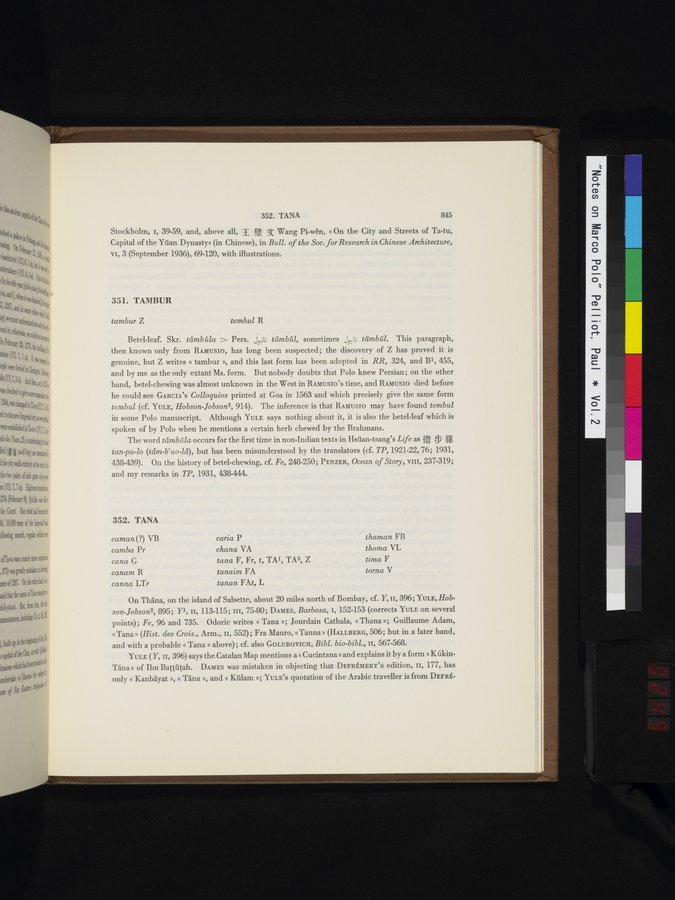
Betel-leaf. Skr. tâmbûla > Pers. jr.>1; tâmbûl, sometimes jr l tdmbûl. This paragraph, then known only from RAMUSIO, has long been suspected; the discovery of Z has proved it is genuine, but Z writes « tambur », and this last form has been adopted in RR, 324, and B1, 455, and by me as the only extant Ms. form. But nobody doubts that Polo knew Persian; on the other hand, betel-chewing was almost unknown in the West in RAMUSIO'S time, and RAMUSIO died before he could see GARCIA's Colloquios printed at Goa in 1563 and which precisely give the same form tembul (cf. YULE, Hobson-Jobson2, 914). The inference is that RAMUSIO may have found tembul in some Polo manuscript. Although YULE says nothing about it, it is also the betel-leaf which is spoken of by Polo when he mentions a certain herb chewed by the Brahmans.
The word tdmbûla occurs for the first time in non-Indian texts in Hsüan-tsang's Life as 4P. tan pu-lo (tdm-b`uo-lâ), but has been misunderstood by the translators (cf. TP, 1921-22, 76; 1931, 438439). On the history of betel-chewing, cf. Fe, 248-250; PENZER, Ocean of Story, VIII, 237-319; and my remarks in TP, 1931, 438-444.
caman(?) VB camba Pr cana G canam R canna LTr | caria P Ghana VA Lana F, Fr, t, TAI, TAS, Z tanaim FA tanan FAt, L | Chaman FB thoma VL tima F torn V |
On Thana, on the island of Saisette, about 20 miles north of Bombay, cf. Y, II, 396; YULE, Hobson-Jobson2, 895; Yl, II, 113-115; III, 75-80; DAMES, Barbosa, I, 152-153 (corrects YULE on several points) ; Fe, 96 and 735. Odoric writes « Tana »; Jourdain Cathala, « Thana »; Guillaume Adam, «Tana» (Hist. des Crois., Arm., II, 552); Fra Mauro, «Tanna» (HALLBERG, 506; but in a later hand, and with a probable « Tana » above) ; cf. also GoLUBOVICH, Bibl. bio-bibi., II, 567-568.
YULE ( Y, II, 396) says the Catalan Map mentions a « Cucintana » and explains it by a form «KûkinTâna» of Ibn Battûtah. DAMES was mistaken in objecting that DEFRÉMERY'S edition, II, 177, has only « Kanbayat », « Tana », and « Kûlam »; YULE'S quotation of the Arabic traveller is from DEFRÉ-
|
|
|
|
|
|
|
|
|
Copyright (C) 2003-2019 National Institute of Informatics and The Toyo Bunko. All Rights Reserved.