 IIIF Color HighRes
National Institute of Informatics - Digital Silk Road Project
| |||||||||
|
| IIIF Color HighRes |
| Explorations in Turkestan : Expedition of 1904 : vol.1 |
 |
 |
 |
 |
 |
 |
|
|
 |
|
|
|
|
|
|
|
|
Citation Information
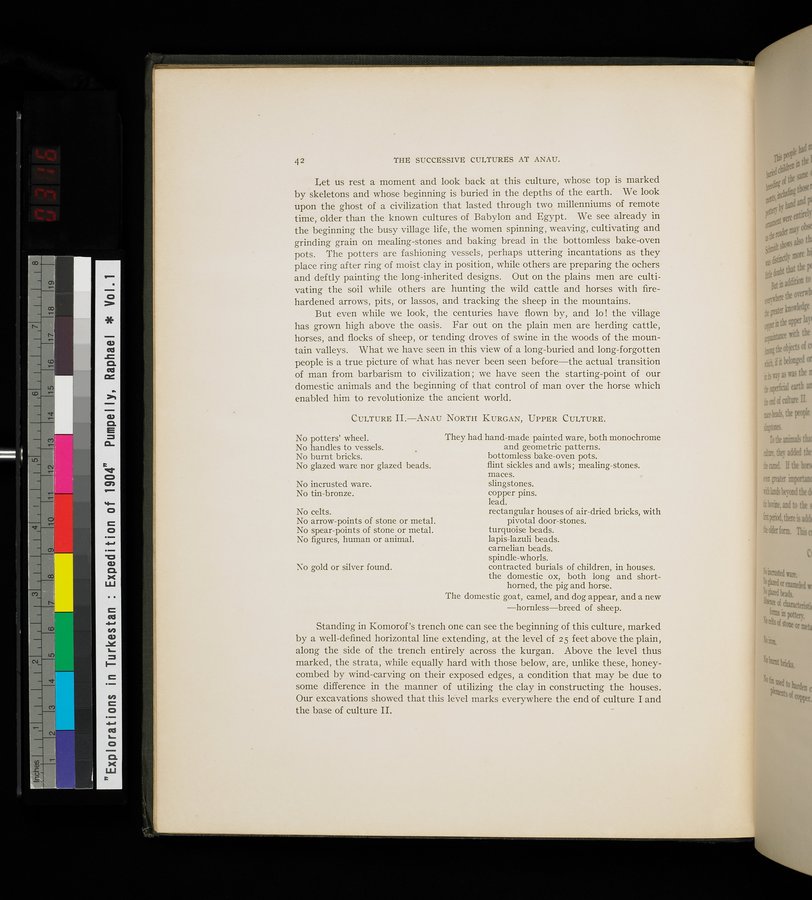
42 THE SUCCESSIVE CULTURES AT ANAU.
Let us rest a moment and look back at this culture, whose top is marked by skeletons and whose beginning is buried in the depths of the earth. We look upon the ghost of a civilization that lasted through two millenniums of remote time, older than the known cultures of Babylon and Egypt. We see already in the beginning the busy village life, the women spinning, weaving, cultivating and grinding grain on mealing-stones and baking bread in the bottomless bake-oven pots. The potters are fashioning vessels, perhaps uttering incantations as they place ring after ring of moist clay in position, while others are preparing the ochers and deftly painting the long-inherited designs. Out on the plains men are cultivating the soil while others are hunting the wild cattle and horses with fire-hardened arrows, pits, or lassos, and tracking the sheep in the mountains.
But even while we look, the centuries have flown by, and lo ! the village has grown high above the oasis. Far out on the plain men are herding cattle, horses, and flocks of sheep, or tending droves of swine in the woods of the mountain valleys. What we have seen in this view of a long-buried and long-forgotten people is a true picture of what has never been seen before—the actual transition of man from barbarism to civilization ; we have seen the starting-point of our domestic animals and the beginning of that control of man over the horse which enabled him to revolutionize the ancient world.
CULTURE II.-ANAU NORTH KURGAN, UPPER CULTURE.
No potters' wheel. They had hand-made painted ware, both monochrome
No handles to vessels. and geometric patterns.
No burnt bricks. bottomless bake-oven pots.
No glazed ware nor glazed beads. flint sickles and awls; mealing-stones.
maces.
No incrusted ware. slingstones.
No tin-bronze. copper pins.
lead.
No celts. rectangular houses of air-dried bricks, with
No arrow-points of stone or metal. pivotal door-stones.
No spear-points of stone or metal. turquoise beads.
No figures, human or animal. lapis-lazuli beads.
carnelian beads. spindle-whorls.
No gold or silver found. contracted burials of children, in houses.
the domestic ox, both long and short-horned, the pig and horse.
The domestic goat, camel, and dog appear, and a new —hornless—breed of sheep.
Standing in Komorof's trench one can see the beginning of this culture, marked by a well-defined horizontal line extending, at the level of 25 feet above the plain, along the side of the trench entirely across the kurgan. Above the level thus marked, the strata, while equally hard with those below, are, unlike these, honeycombed by wind-carving on their exposed edges, a condition that may be due to some difference in the manner of utilizing the clay in constructing the houses. Our excavations showed that this level marks everywhere the end of culture I and the base of culture II.
|
|
|
|
|
|
|
|
|
Copyright (C) 2003-2019 National Institute of Informatics and The Toyo Bunko. All Rights Reserved.