 IIIF Color HighRes
National Institute of Informatics - Digital Silk Road Project
| |||||||||
|
| IIIF Color HighRes |
| Notes on Marco Polo : vol.1 |
 |
 |
 |
 |
 |
 |
|
|
 |
|
|
|
|
|
|
|
|
Citation Information
108
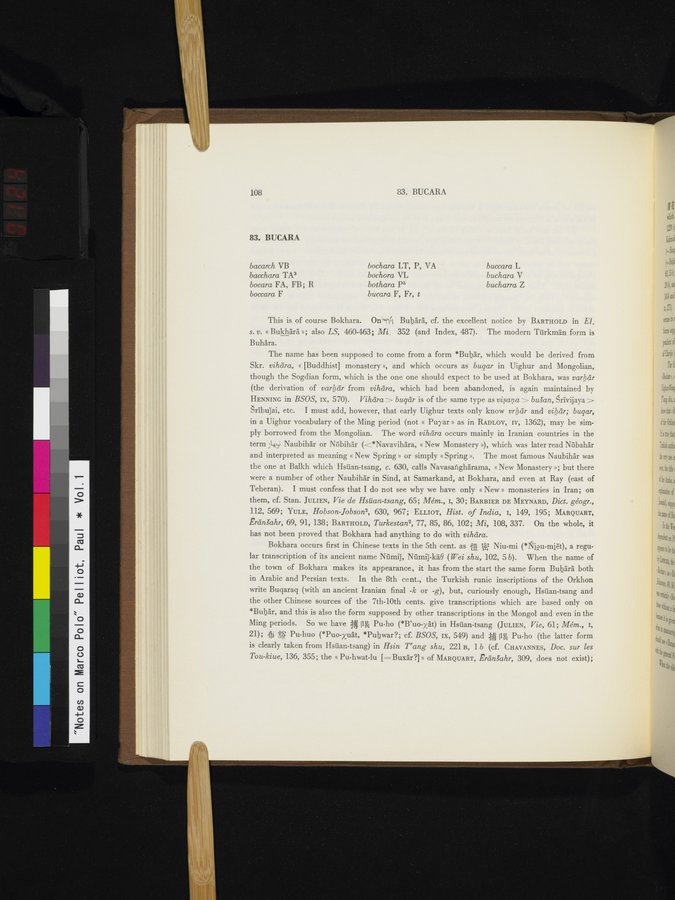
83. BUCARA
83. BUCARA
bacarch VB bacchara TA3 bocara FA, FB; R boccara F
bochara LT, P, VA bochora VL bothara P5 bucara F, Fr, t
buccara L
buchara V
bucharra Z
This is of course Bokhara. On1(■ Bub-di-a, cf. the excellent notice by BARTHOLD in El, s. v. «Bukhârâ »; also LS, 460-463; Mi, 352 (and Index, 487). The modern Türkmän form is Buhâra.
The name has been supposed to come from a form *Buhâr, which would be derived from Skr. vihâra, « [Buddhist] monastery », and which occurs as buqar in Uighur and Mongolian, though the Sogdian form, which is the one one should expect to be used at Bokhara, was varhâr (the derivation of varizâr from vihâra, which had been abandoned, is again maintained by HENNING in BSOS, ix, 570). Vihâra > buqar is of the same type as visana bulan, Srivijaya > Sribujai, etc. I must add, however, that early Uighur texts only know vrhâr and vilhâr; bugar, in a Uighur vocabulary of the Ming period (not « Puyar » as in RADLOV, Iv, 1362), may be simply borrowed from the Mongolian. The word vihâra occurs mainly in Iranian countries in the term ;46) Naubihàr or Nôbihàr (<*Navavihâra, « New Monastery »), which was later read Nôbahâr and interpreted as meaning « New Spring » or simply «Spring ». The most famous Naubihàr was the one at Balkh which Hsüan-tsang, c. 630, calls Navasangharama, « New Monastery »; but there were a number of other Naubihàr in Sind, at Samarkand, at Bokhara, and even at Ray (east of Teheran). I must confess that I do not see why we have only « New » monasteries in Iran; on them, cf. Stan. JULIEN, Vie de Hsüan-tsang, 65; Mém., I, 30; BARBIER DE MEYNARD, Dirt. géogr., 112, 569; YULE, Hobson-Jobson2, 630, 967; ELLIOT, Hist. of India, I, 149, 195; MARQUART, Erân. ahr, 69, 91, 138; BARTHOLD, Turkestan2, 77, 85, 86, 102; Mi, 108, 337. On the whole, it has not been proved that Bokhara had anything to do with vihâra.
Bokhara occurs first in Chinese texts in the 5th cent. as Niu-mi (*Niau-miét), a regu-
lar transcription of its ancient name Nümij, Nûmij-kä9 (Wei shu, 102, 5 b). When the name of the town of Bokhara makes its appearance, it has from the start the same form Buhàrâ both in Arabic and Persian texts. In the 8th cent., the Turkish runic inscriptions of the Orkhon write Buqaraq (with an ancient Iranian final -k or -g), but, curiously enough, Hsüan-tsang and the other Chinese sources of the 7th-10th cents. give transcriptions which are based only on *Buhâr, and this is also the form supposed by other transcriptions in the Mongol and even in the Ming periods. So we have 44 p , Pu-ho (*B'uo-xât) in Hsüan-tsang (JULIEN, Vie, 61; Mém., I, 21); ;i $ Pu-huo (*Puo-xuât, *Puhwar?; cf. BSOS, ix, 549) and 4§ p , Pu-ho (the latter form is clearly taken from Hsüan-tsang) in Hsin T'ang shu, 221 B, 1 b (cf. CHAVANNES, Doc. sur les Tou-kiue, 136, 355; the « Pu-hwat-lu [ = Buxàr?] » of MARQUART, Erânlahr, 309, does not exist);
|
|
|
|
|
|
|
|
|
Copyright (C) 2003-2019 National Institute of Informatics and The Toyo Bunko. All Rights Reserved.