 IIIF Color HighRes
National Institute of Informatics - Digital Silk Road Project
| |||||||||
|
| IIIF Color HighRes |
| Notes on Marco Polo : vol.1 |
 |
 |
 |
 |
 |
 |
|
|
 |
|
|
|
|
|
|
|
|
Citation Information
158. CINGHIS 319
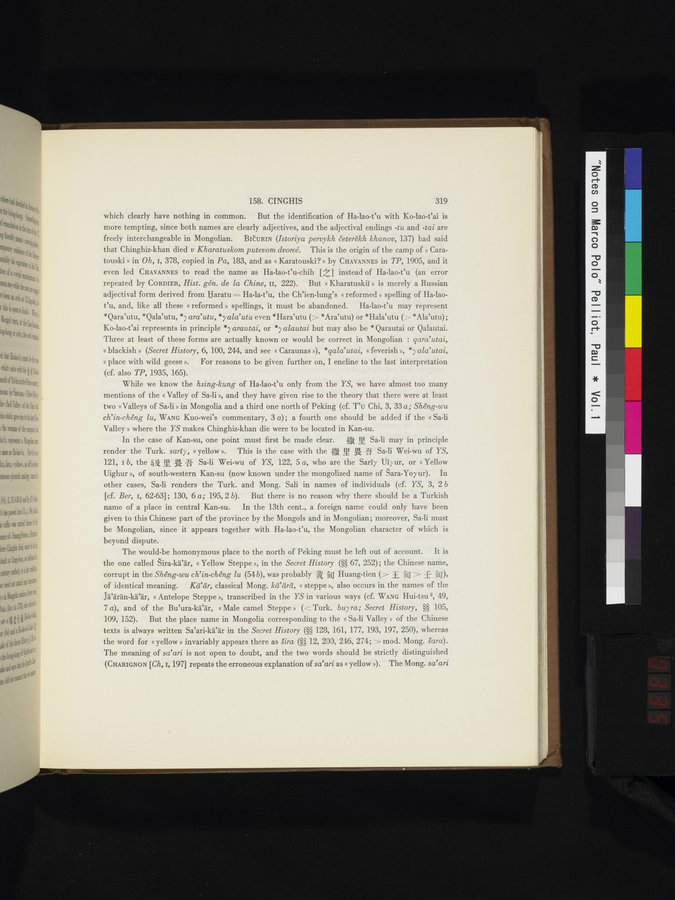
which clearly have nothing in common. But the identification of Ha-lao-t'u with Ko-lao-t'ai is more tempting, since both names are clearly adjectives, and the adjectival endings -tu and -tai are freely interchangeable in Mongolian. BgURIN (Istoriya pervykh ëeterëkh khanov, 137) had said that Chinghiz-khan died v Kharatuskom putevom dvorcé. This is the origin of the camp of « Caratouski » in Oh, I, 378, copied in Pa, 183, and as « Karatouski? » by CHAVANNES in TP, 1905, and it even led CHAVANNES to read the name as Ha-lao-t'u-chih [Z] instead of Ha-lao-t'u (an error repeated by CORDIER, Hist. gén. de la Chine, II, 222). But « Kharatuskii » is merely a Russian adjectival form derived from Ijaratu = Ha-la-t'u, the Ch'ien-lung's « reformed » spelling of Ha-laot'u, and, like all these « reformed » spellings, it must be abandoned. Ha-lao-t'u may represent *Qara'utu, *Qala'utu, *, ara'utu, *yala'utu even *Hara'utu (> *Ara'utu) or *Hara'utu (> *Ala'utu); Ko-lao-t'ai represents in principle *yarautai, or *7 alautai but may also be * Qarautai or Qalautai. Three at least of these forms are actually known or would be correct in Mongolian : qara'utai, « blackish » (Secret History, 6, 100, 244, and see « Caraunas »), *qala'utai, « feverish », *yala'utai, « place with wild geese ». For reasons to be given further on, I encline to the last interpretation (cf. also TP, 1935, 165).
While we know the hsing-kung of Ha-lao-t'u only from the YS, we have almost too many mentions of the « Valley of Sa-li », and they have given rise to the theory that there were at least two «Valleys of Sa-li » in Mongolia and a third one north of Peking (cf. T'u Chi, 3, 33a; Shêng-wu ch'in-chêng lu, WANG Kuo-wei's commentary, 3 a); a fourth one should be added if the « Sa-li Valley » where the YS makes Chinghiz-khan die were to be located in Kan-su.
In the case of Kan-su, one point must first be made clear. gt Sa-li may in principle
render the Turk. sarly, «yellow ». This is the case with the fa .f A Sa-li Wei-wu of YS,
121, I b, the M V. A Â Sa-li Wei-wu of YS, 122, 5 a, who are the Sariy Uiyur, or « Yellow Uighur », of south-western Kan-su (now known under the mongolized name of Sara-Yoyur). In other cases, Sa-li renders the Turk. and Mong. Sali in names of individuals (cf. YS, 3, 2 b [cf. Ber, I, 62-63]; 130, 6 a; 195, 2 b). But there is no reason why there should be a Turkish name of a place in central Kan-su. In the 13th cent., a foreign name could only have been given to this Chinese part of the province by the Mongols and in Mongolian; moreover, Sa-li must be Mongolian, since it appears together with Ha-lao-t'u, the Mongolian character of which is beyond dispute.
The would-be homonymous place to the north of Peking must be left out of account. It is the one called Sira-kä'är, « Yellow Steppe », in the Secret History (§§ 67, 252); the Chinese name,
corrupt in the Shêng-wu ch'in-chêng lu (54b), was probably Huang-tien (> I 'ßt7
of identical meaning. Kä'är, classical Mong. kä'ärä, « steppe », also occurs in the names of the Jä'ärän-kä'är, « Antelope Steppe », transcribed in the YS in various ways (cf. WANG Hui-tsu 2, 49, 7 a), and of the Bu'ura-kä'är, « Male camel Steppe » (< Turk. buyra; Secret History, §§ 105, 109, 152). But the place name in Mongolia corresponding to the « Sa-li Valley » of the Chinese texts is always written Sa'ari-kä'är in the Secret History (§§ 128, 161, 177, 193, 197, 250), whereas the word for « yellow » invariably appears there as lira (§§ 12, 200, 246, 274; > mod. Mong. lara). The meaning of sa'ari is not open to doubt, and the two words should be strictly distinguished (CHARIGNON [Ch, I, 197] repeats the erroneous explanation of sa'ari as «yellow »). The Mong. sa'ari
|
|
|
|
|
|
|
|
|
Copyright (C) 2003-2019 National Institute of Informatics and The Toyo Bunko. All Rights Reserved.