 IIIF Color HighRes
National Institute of Informatics - Digital Silk Road Project
| |||||||||
|
| IIIF Color HighRes |
| Notes on Marco Polo : vol.1 |
 |
 |
 |
 |
 |
 |
|
|
 |
|
|
|
|
|
|
|
|
Citation Information
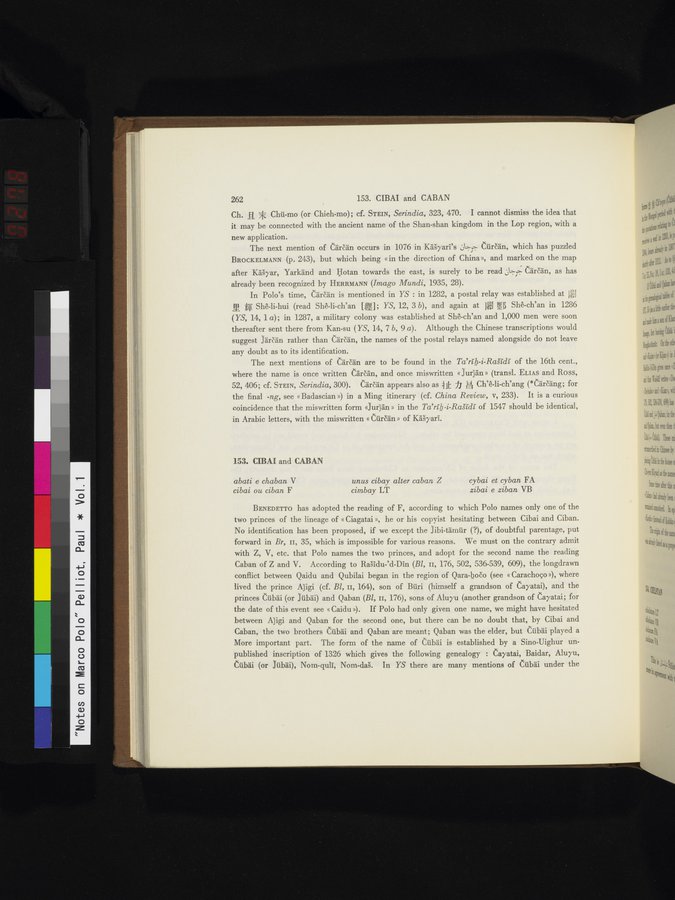
262 153. CIBAI and CABAN
Ch. Chü-mo (or Chieh-mo); cf. STEIN, Serindia, 323, 470. I cannot dismiss the idea that
it may be connected with the ancient name of the Shan-shan kingdom in the Lop region, with a new application.
The next mention of Cärcän occurs in 1076 in Kàsyari's CiirMn, which has puzzled
BROCKELMANN (p. 243), but which being «in the direction of China», and marked on the map
after Kàsyar, Yarkänd and Hotan towards the east, is surely to be read Cärcän, as has
already been recognized by HERRMANN (Imago Mundi, 1935, 28).
In Polo's time, Cärcän is mentioned in YS : in 1282, a postal relay was established at X11 Shê-li-hui (read Shê-li-ch'an [, I ] ; YS, 12, 3 b), and again at 4 Nis Shê-ch'an in 1286 (YS, 14, 1 a) ; in 1287, a military colony was established at Shê-ch'an and 1,000 men were soon thereafter sent there from Kan-su (YS, 14, 7 b, 9 a). Although the Chinese transcriptions would suggest Järcän rather than Cärcän, the names of the postal relays named alongside do not leave any doubt as to its identification.
The next mentions of Cärcän are to be found in the Ta'rih,-i-Rasidi of the 16th cent., where the name is once written Carcàn, and once miswritten «jurjàn» (transi. ELIAS and Ross,
52, 406; cf. STEIN, Serindia, 300). Cärcän appears also as 41± jj Ch'ê-li-ch'ang (*Cärcäng; for
the final -ng, see « Badascian ») in a Ming itinerary (cf. China Review, v, 233). It is a curious coincidence that the miswritten form «Jurjan» in the Ta'rih-i-Rasidi of 1547 should be identical,
in Arabic letters, with the miswritten « » of Kàsyari.
153. CIBAI and CABAN
| abati e chaban V cibai ou ciban F | unus cibay alter caban Z cybai et cyban FA cimbay LT zibai e ziban VB |
BENEDETTO has adopted the reading of F, according to which Polo names only one of the two princes of the lineage of « Ciagatai », he or his copyist hesitating between Cibai and Ciban. No identification has been proposed, if we except the Jibi-tämür (?), of doubtful parentage, put forward in Br, II, 35, which is impossible for various reasons. We must on the contrary admit with Z, V, etc. that Polo names the two princes, and adopt for the second name the reading Caban of Z and V. According to Rasidu-'d-Din (Bl, II, 176, 502, 536-539, 609), the longdrawn conflict between Qaidu and Qubilai began in the region of Qara-1,106o (see « Carachoço »), where lived the prince Ajigi (cf. Bl, II, 164), son of Büri (himself a grandson of Gayatai), and the princes Cübäi (or Jübäi) and Qaban (Bl, II, 176), sons of Aluyu (another grandson of Cayatai; for the date of this event see «Caidu »). If Polo had only given one name, we might have hesitated between Ajigi and Qaban for the second one, but there can be no doubt that, by Cibai and Caban, the two brothers Cübäi and Qaban are meant; Qaban was the elder, but Tübäi played a More important part. The form of the name of Tübäi is established by a Sino-Uighur unpublished inscription of 1326 which gives the following genealogy : Cayatai, Baidar, Aluyu, Cübäi (or Jübäi), Nom-qulï, Nom-dag. In YS there are many mentions of Cübäi under the
|
|
|
|
|
|
|
|
|
Copyright (C) 2003-2019 National Institute of Informatics and The Toyo Bunko. All Rights Reserved.