 IIIF Color HighRes
National Institute of Informatics - Digital Silk Road Project
| |||||||||
|
| IIIF Color HighRes |
| Notes on Marco Polo : vol.1 |
 |
 |
 |
 |
 |
 |
|
|
 |
|
|
|
|
|
|
|
|
Citation Information
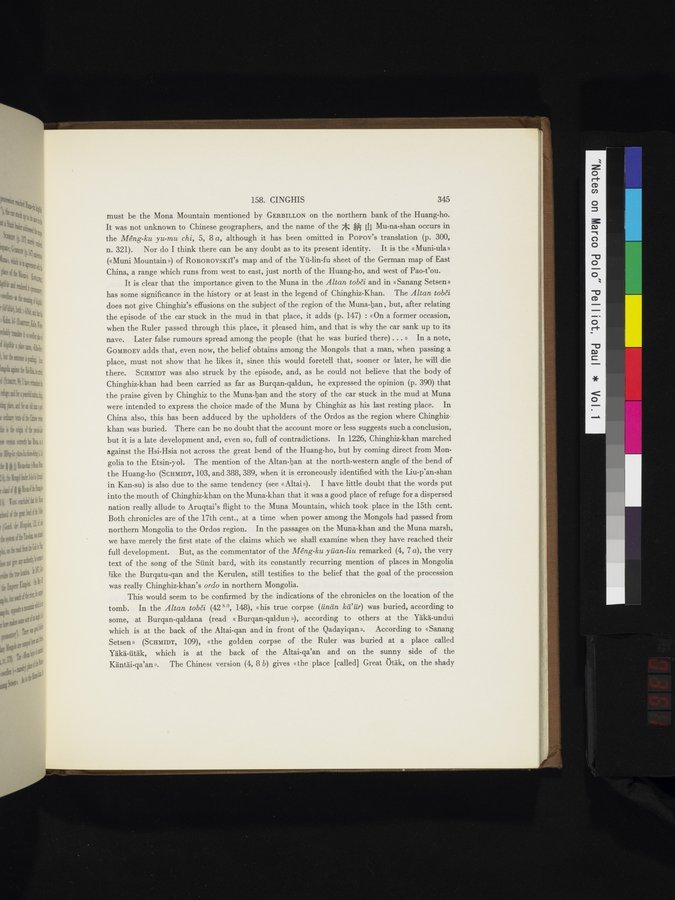
158. CINGHIS 345
must be the Mona Mountain mentioned by GERBILLON on the northern bank of the Huang-ho.
It was not unknown to Chinese geographers, and the name of the 4c 111 Mu-na-shan occurs in
the Mêng-ku yu-mu chi, 5, 8 a, although it has been omitted in POPOV's translation (p. 300, n. 321). Nor do I think there can be any doubt as to its present identity. It is the «Muni-ula» («Muni Mountain») of ROBORovsKIÏ's map and of the Yü-lin-fu sheet of the German map of East China, a range which runs from west to east, just north of the Huang-ho, and west of Pao-t'ou.
It is clear that the importance given to the Muna in the Altan tobci and in «Sanang Setsen» has some significance in the history or at least in the legend of Chinghiz-Khan. The Altan tobci does not give Chinghiz's effusions on the subject of the region of the Muna-ban , but, after relating the episode of the car stuck in the mud in that place, it adds (p. 147) : «On a former occasion,
when the Ruler passed through this place, it pleased him, and that is why the car sank up to its nave. Later false rumours spread among the people (that he was buried there) ... » In a note, GOMBOEV adds that, even now, the belief obtains among the Mongols that a man, when passing a place, must not show that he likes it, since this would foretell that, sooner or later, he will die
there. SCHMIDT was also struck by the episode, and, as he could not believe that the body of Chinghiz-khan had been carried as far as Burgan-galdun, he expressed the opinion (p. 390) that the praise given by Chinghiz to the Muna-ban and the story of the car stuck in the mud at Muna were intended to express the choice made of the Muna by Chinghiz as his last resting place. In China also, this has been adduced by the upholders of the Ordos as the region where Chinghiz.
khan was buried. There can be no doubt that the account more or less suggests such a conclusion, but it is a late development and, even so, full of contradictions. In 1226, Chinghiz-khan marched against the Hsi-Hsia not across the great bend of the Huang-ho, but by coming direct from Mongolia to the Etsin-yoi. The mention of the Altan-ban at the north-western angle of the bend of the Huang-ho (SCHMIDT, 103, and 388, 389, when it is erroneously identified with the Liu-p'an-shan in Kan-su) is also due to the same tendency (see «Altai»). I have little doubt that the words put into the mouth of Chinghiz-khan on the Muna-khan that it was a good place of refuge for a dispersed nation really allude to Aruqtai's flight to the Muna Mountain, which took place in the 15th cent. Both chronicles are of the 17th cent., at a time when power among the Mongols had passed from northern Mongolia to the Ordos region. In the passages on the Muna-khan and the Muna marsh, we have merely the first state of the claims which we shall examine when they have reached their full development. But, as the commentator of the Mêng-ku yüan-liu remarked (4, 7 a), the very text of the song of the Sünit bard, with its constantly recurring mention of places in Mongolia like the Burqatu-qan and the Kerulen, still testifies to the belief that the goal of the procession was really Chinghiz-khan's ordo in northern Mongolia.
This would seem to be confirmed by the indications of the chronicles on the location of the tomb. In the Altan tobci (42 ", 148), «his true corpse (ünän kä'iir) was buried, according to some, at Burgan-gaidana (read « Burqan-qaldun »), according to others at the Yäkä-undui which is at the back of the Altai-qan and in front of the Qadayiqan». According to «Sanang Setsen» (SCHMIDT, 109), «the golden corpse of the Ruler was buried at a place called )(Ad-MA, which is at the back of the Altai-qa'an and on the sunny side of the Käntäi-qa'an ». The Chines( version (4, 8 b) gives « the place [called] Great Ûtäk, on the shady
|
|
|
|
|
|
|
|
|
Copyright (C) 2003-2019 National Institute of Informatics and The Toyo Bunko. All Rights Reserved.