 IIIF Color HighRes
National Institute of Informatics - Digital Silk Road Project
| |||||||||
|
| IIIF Color HighRes |
| Notes on Marco Polo : vol.1 |
 |
 |
 |
 |
 |
 |
|
|
 |
|
|
|
|
|
|
|
|
Citation Information
116 181. COTAN
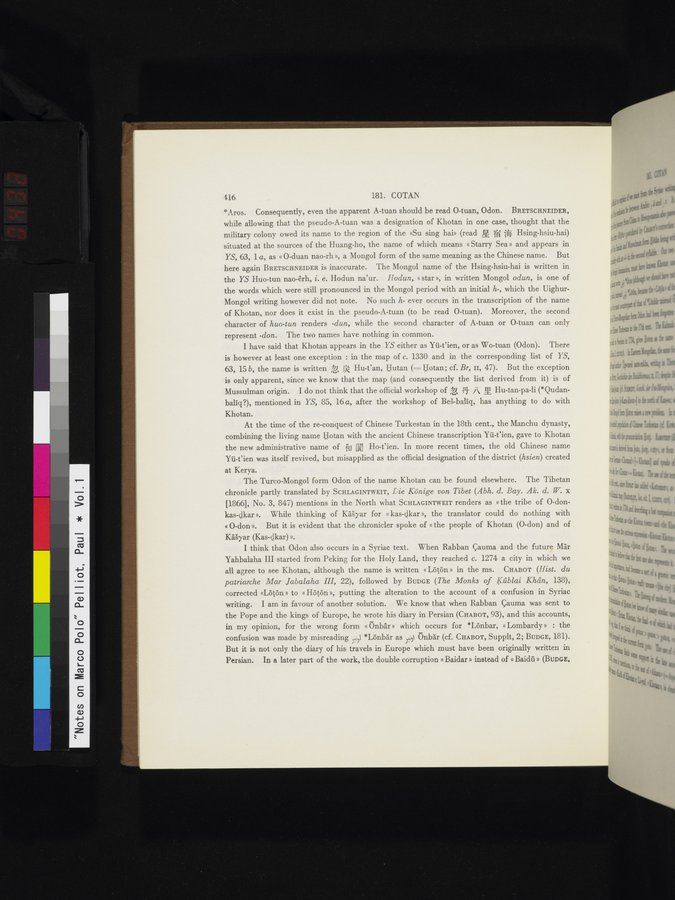
*Gros. Consequently, even the apparent A-tuan should be read 0-tuan, Odon. BRETSCHNEIDER, while allowing that the pseudo-A-tuan was a designation of Khotan in one case, thought that the military colony owed its name to the region of the «Su sing hai» (read krd{ Hsing-hsiu-hai) situated at the sources of the Huang-ho, the name of which means «Starry Sea » and appears in YS, 63, 1 a, as «0-duan nao-rh », a Mongol form of the same meaning as the Chinese name. But here again BRETSCHNEIDER is inaccurate. The Mongol name of the Hsing-hsiu-hai is written in the YS Huo-tun nao-êrh, i. e. Hodun na'ur. Hodun, « star », in written Mongol odun, is one of the words which were still pronounced in the Mongol period with an initial h-, which the Uighur-Mongol writing however did not note. No such h- ever occurs in the transcription of the name of Khotan, nor does it exist in the pseudo-A-tuan (to be read 0-tuan). Moreover, the second character of huo-tun renders -dun, while the second character of A-tuan or 0-tuan can only represent -don. The two names have nothing in common.
I have said that Khotan appears in the YS either as Yü-t'ien, or as Wo-tuan (Odon). There is however at least one exception : in the map of c. 1330 and in the corresponding list of YS, 63, 15 b, the name is written 1, in Hu-t'an, Hutan (-_= hlotan; cf. Br, II, 47). But the exception is only apparent, since we know that the map (and consequently the list derived from it) is of
Mussuiman origin. I do not think that the official workshop of i 11- , Hu-tan-pa-li (*Qudan-
bal.iq?), mentioned in YS, 85, 16 a, after the workshop of B6'-baliq, has anything to do with Khotan.
At the time of the re-conquest of Chinese Turkestan in the 18th cent., the Manchu dynasty, combining the living name Hotan with the ancient Chinese transcription Yii-t'ien, gave to Khotan
the new administrative name of [I Ho-t'ien. In more recent times, the old Chinese name
Yü-t'ien was itself revived, but misapplied as the official designation of the district (hsien) created at Kerya.
The Turco-Mongol form Odon of the name Khotan can be found elsewhere. The Tibetan chronicle partly translated by SCHLAGINTWEIT, Lie Könige von Tibet (Abh. d. Bay. Ak. d. W. x [1866], No. 3, 847) mentions in the North what SCHLAGINTWEIT renders as « the tribe of 0-donkas-dkar ». While thinking of Kasyar for «kas-dkar », the translator could do nothing with «0-don ». But it is evident that the chronicler spoke of « the people of Khotan (0-don) and of Kâgyar (Kas-dkar) ».
I think that Odon also occurs in a Syriac text. When Rabban Çauma and the future Mar Yahbalaha III started from Peking for the Holy Land, they reached c. 1274 a city in which we all agree to see Khotan, although the name is written « Lôtôn » in the ms. CHABOT ([list. du patriarche Mar Jabalaha III, 22), followed by BUDGE (The Monks of Kûblai Khân, 138), corrected «Lôtan» to «Hôtan», putting the alteration to the account of a confusion in Syriac writing. I am in favour of another solution. We know that when Rabban Çauma was sent to the Pope and the kings of Europe, he wrote his diary in Persian (CHABOT, 93), and this accounts, in my opinion, for the wrong form «Onbâr» which occurs for *Unbar, «Lombardy» : the confusion was made by misreading ju51 *Unbar as y.;yl Onbâr (cf. CHABOT, Suppit, 2; BUDGE, 181). But it is not only the diary of his travels in Europe which must have been originally written in Persian. In a later part of the work, the double corruption «Baidar» instead of «Baidù» (BUDGE,
|
|
|
|
|
|
|
|
|
Copyright (C) 2003-2019 National Institute of Informatics and The Toyo Bunko. All Rights Reserved.