 IIIF Color HighRes
National Institute of Informatics - Digital Silk Road Project
| |||||||||
|
| IIIF Color HighRes |
| Notes on Marco Polo : vol.1 |
 |
 |
 |
 |
 |
 |
|
|
 |
|
|
|
|
|
|
|
|
Citation Information
183. COTTON 425
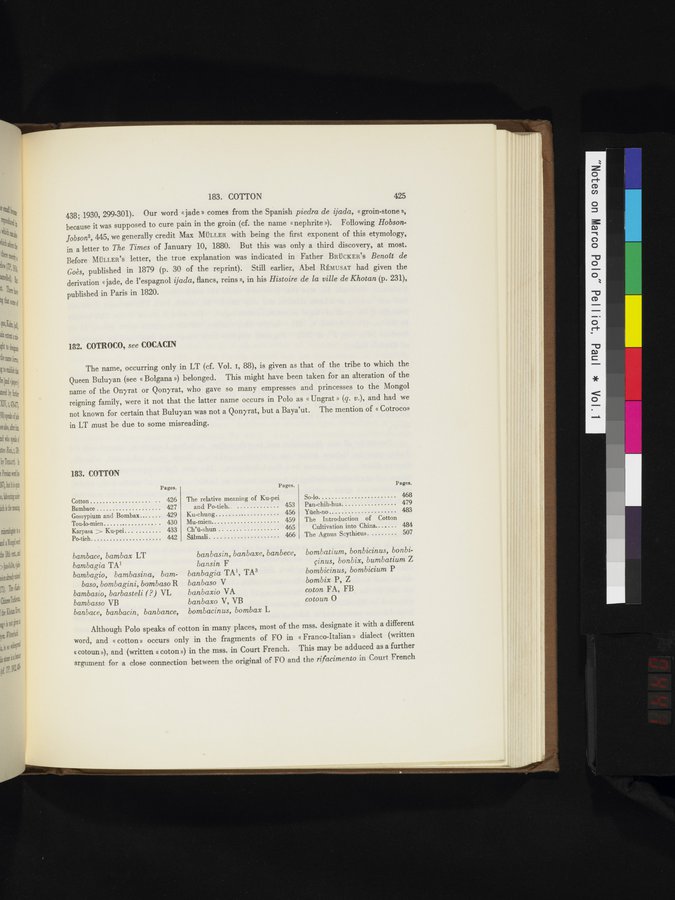
438; 1930, 299-301). Our word «jade » comes from the Spanish piedra de ijada, «groin-stone », because it was supposed to cure pain in the groin (cf. the name «nephrite »). Following HobsonJobson2, 445, we generally credit Max MÜLLER with being the first exponent of this etymology, in a letter to The Times of January 10, 1880. But this was only a third discovery, at most. Before MOLLER'S letter, the true explanation was indicated in Father BRÜCKER'S BenoUt de Goès, published in 1879 (p. 30 of the reprint). Still earlier, Abel REMUSAT had given the derivation «jade, de l'espagnol ijada, flancs, reins », in his Histoire de la ville de Khotan (p. 231), published in Paris in 1820.
COTROCO, see COCACIN
The name, occurring only in LT (cf. Vol. t, 88), is given as that of the tribe to which the Queen Buluyan (see « Bolgana ») belonged. This might have been taken for an alteration of the name of the Onyrat or Qonyrat, who gave so many empresses and princesses to the Mongol reigning family, were it not that the latter name occurs in Polo as « Ungrat » (q. v.), and had we not known for certain that Buluyan was not a Qonyrat, but a Baya'ut. The mention of « Cotroco» in LT must be due to some misreading.
COTTON
Pages.
Cotton 426
Bambace 427
Gossypium and Bombai.. 429
Tou-lo-mien 430
Karpasa > Ku-pei. 433
Po-tieh 442
bambace, bambax LT bambagia TA1
bambagio, bambasina, barn-
baso, bombagini, bombaso R bambasio, barbasteli (?) VL bambasso VB
banbace, banbacin, banbance,
Pages.
The relative meaning of Ku-pei
and Po-tieh.. 453
Ku-chung 456
Mu-mien 459
Ch'ü-shun .. 465
iman .... 466
banbasin, banbaxe, banbece,
bansin F
banbagia TA', TA3
banbaso V
banbaxio VA
banbaxo V, VB
bombacinus, bombax L
Pages.
So-lo 468
Pan-chih-hua 479
Yüeh-no . 483
The Introduction of Cotton
Cultivation into China 484
The Agnus Scythicus. 507
bombatium, bonbicinus, bonbi-
çi.nus, bonbix, bumbatium Z bombicinus, bombicium P bombix P, Z
coton FA, FB
cotoun 0
Although Polo speaks of cotton in many places, most of the mss. designate it with a different word, and « cotton» occurs only in the fragments of FO in « Franco-Italian » dialect (written a cotoun »), and (written « coton») in the mss. in Court French. This may be adduced as a further arguaient for a close connection between the original of FO and the rifacimento in Court French
~
|
|
|
|
|
|
|
|
|
Copyright (C) 2003-2019 National Institute of Informatics and The Toyo Bunko. All Rights Reserved.