 IIIF Color HighRes
National Institute of Informatics - Digital Silk Road Project
| |||||||||
|
| IIIF Color HighRes |
| Notes on Marco Polo : vol.1 |
 |
 |
 |
 |
 |
 |
|
|
 |
|
|
|
|
|
|
|
|
Citation Information
193. CURDISTA \ 575
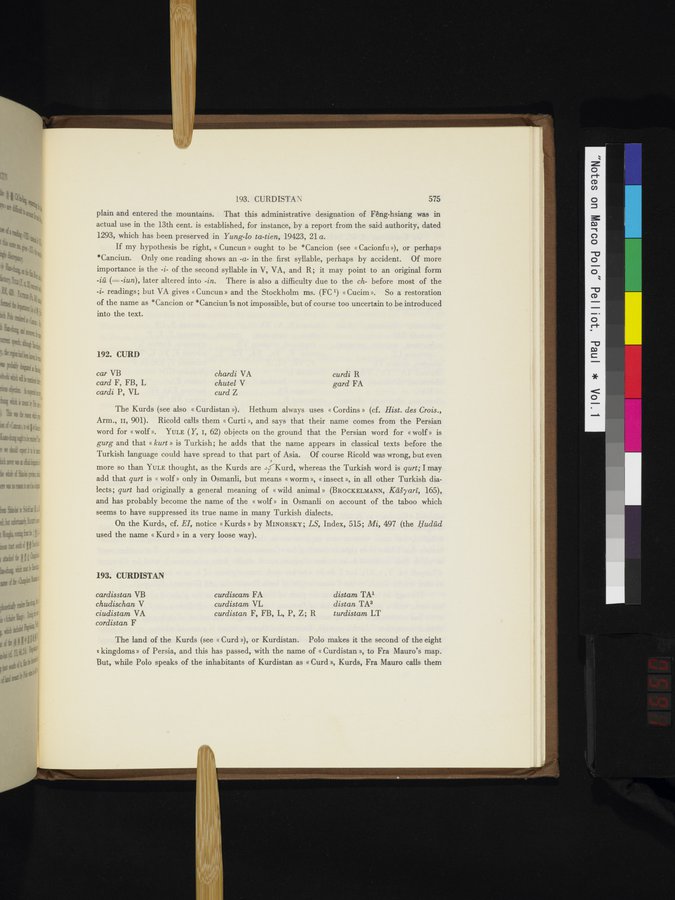
plain and entered the mountains. That this administrative designation of Fêng-hsiang was in actual use in the 13th cent. is established, for instance, by a report from the said authority, dated 1293, which has been preserved in Yung-lo ta-tien, 19423, 21 a.
If my hypothesis be right, «Cuncun » ought to be *Cancion (see « Cacionfu »), or perhaps *Canciun. Only one reading shows an -a- in the first syllable, perhaps by accident. Of more importance is the -i- of the second syllable in V, VA, and R; it may point to an original form -iû (= -iun), later altered into -in. There is also a difficulty due to the ch- before most of the -i- readings; but VA gives «Cuncun» and the Stockholm ms. (FC1) «Cucim». So a restoration of the name as *Cancion or *Canciun is not impossible, but of course too uncertain to be introduced into the text.
car VB card F, FB, L cardi P, VL | chardi VA chutel V curd Z | curdi R gard FA |
The Kurds (see also « Curdistan »). Hethum always uses « Cordins » (cf. Hist. des Crois., Arm., II, 901). Ricold calls them « Curti », and says that their name comes from the Persian word for « wolf ». YULE ( Y, I, 62) objects on the ground that the Persian word for « wolf » is Burg and that « kurt » is Turkish; he adds that the name appears in classical texts before the Turkish language could have spread to that part of Asia. Of course Ricold was wrong, but even
more so than YULE thought, as the Kurds are .>IKurd, whereas the Turkish word is qurt; I may add that qurt is « wolf » only in Osmanli, but means « worm », « insect », in all other Turkish dialects; qurt had originally a general meaning of « wild animal » (BROCKELMANN, Kayari, 165), and has probably become the name of the « wolf » in Osmanli on account of the taboo which seems to have suppressed its true name in many Turkish dialects.
On the Kurds, cf. EI, notice «Kurds» by MINORSKY; LS, Index, 515; Mi, 497 (the Iludûd used the name « Kurd » in a very loose way).
CURDISTAN
| cardisstan VB chudischan V ciudistam VA cordistan F | curdiscam FA curdistam VL curdistan F, FB, L, P, Z; R | distam TAi distan TA3 turdistam LT |
The land of the Kurds (see « Curd »), or Kurdistan. Polo makes it the second of the eight r kingdoms» of Persia, and this has passed, with the name of « Curdistan », to Fra Mauro's map. But, while Polo speaks of the inhabitants of Kurdistan as « Curd », Kurds, Fra Mauro calls them
|
|
|
|
|
|
|
|
|
Copyright (C) 2003-2019 National Institute of Informatics and The Toyo Bunko. All Rights Reserved.