 IIIF Color HighRes
National Institute of Informatics - Digital Silk Road Project
| |||||||||
|
| IIIF Color HighRes |
| Notes on Marco Polo : vol.1 |
 |
 |
 |
 |
 |
 |
|
|
 |
|
|
|
|
|
|
|
|
Citation Information
472 183. COTTON
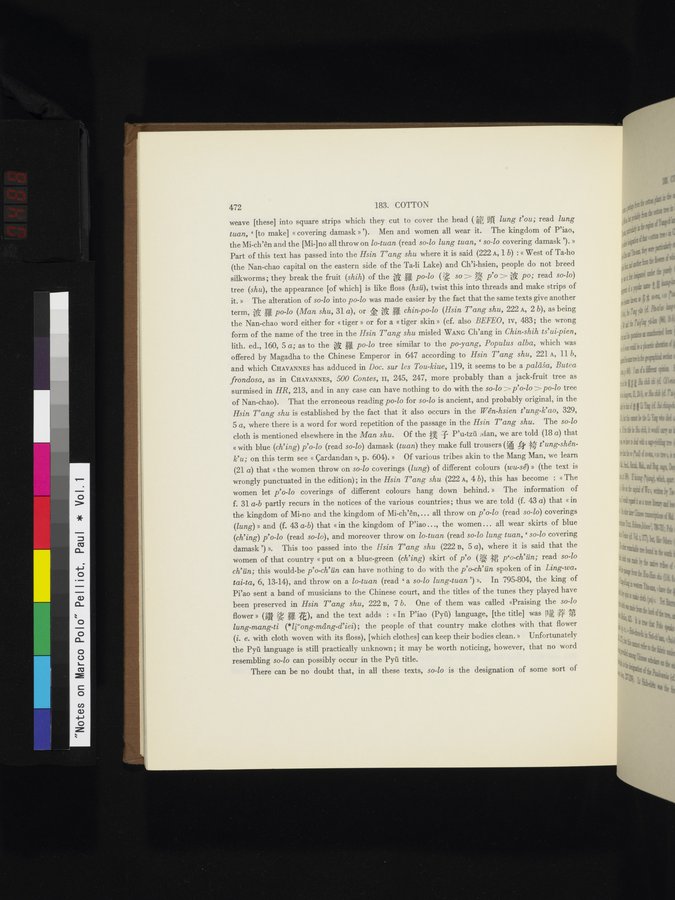
weave [these] into square strips which they cut to cover the head (p PR lung t'ou; read lung tuan, [to make] « covering damask »'). Men and women all wear it. The kingdom of P'iao, the Mi-ch'ên and the [Mi-]no all throw on lo-tuan (read so-lo lung wan, ' so-lo covering damask'). » Part of this text has passed into the Hsin T'ang shu where it is said (222 A, 1 b) :« West of Ta-ho (the Nan-chao capital on the eastern side of the Ta-li Lake) and Ch'i-hsien, people do not breed
silkworms; they break the fruit (shih) of the -a, po-lo (:r so > ] p'o % po; read so-lo)
tree (shu), the appearance [of which] is like floss (hsü), twist this into threads and make strips of it. » The alteration of so-lo into po-lo was made easier by the fact that the same texts give another
term, K. po-lo (Man shu, 31 a), or t. g chin po-lo (Hsin T'ang shu, 222 A, 2 b), as being
the Nan-chao word either for « tiger » or for a « tiger skin » (cf. also BEFEO, iv, 483; the wrong form of the name of the tree in the Hsin T'ang shu misled WANG Ch'ang in Chin-shih ts'ui pien,
lith. ed., 160, 5 a; as to the g po-lo tree similar to the po-yang, Populus alba, which was
offered by Magadha to the Chinese Emperor in 647 according to Hsin T'ang shu, 221 A, 11 b, and which CHAVANNES has adduced in Doc. sur les Tou-kiue, 119, it seems to be a palâsa, Butea frondosa, as in CHAVANNES, 500 Contes, ii, 245, 247, more probably than a jack-fruit tree as surmised in HR, 213, and in any case can have nothing to do with the so-lo p'o-lo > po-lo tree of Nan-chao). That the erroneous reading po-lo for so-lo is ancient, and probably original, in the Hsin T'ang shu is established by the fact that it also occurs in the Wên-hsien t'ung-k'ao, 329, 5 a, where there is a word for word repetition of the passage in the Hsin T'ang shu. The so-lo
cloth is mentioned elsewhere in the Man shu. Of the P'u-tzû elan, we are told (18 a) that
«with blue (ch'ing) p'o-lo (read so-lo) damask (tuan) they make full trousers (A g t'ung-shên-
k'u; on this term see « Çardandan », p. 604). » Of various tribes akin to the Mang Man, we learn (21 a) that « the women throw on so-lo coverings (lung) of different colours (wu-sê) » (the text is wrongly punctuated in the edition) ; in the Hsin T'ang shu (222 A, 4 b), this has become : « The women let p'o-lo coverings of different colours hang down behind. » The information of f. 31 a-b partly recurs in the notices of the various countries; thus we are told (f. 43 a) that « in the kingdom of Mi-no and the kingdom of Mi-ch'ên, ... all throw on p'o-lo (read so-lo) coverings (lung) » and (f. 43 a-b) that « in the kingdom of P'iao ..., the women ... all wear skirts of blue (ch'ing) p'o-lo (read so-lo), and moreover throw on lo-tuan (read so-lo lung tuan, ' so-lo covering damask ') ». This too passed into the fIsin T'ang shu (222 B, 5 a), where it is said that the
women of that country « put on a blue-green (ch'ing) skirt of p'o (t p'o-ch'ün; read so-lo
ch'ün; this would-be p'o-ch'ün can have nothing to do with the p'o-ch'ün spoken of in Ling-wa. tai-ta, 6, 13-14), and throw on a to-tuan (read ' a so-lo lung-tuan') ». In 795-804, the king of
Pi'ao sent a band of musicians to the Chinese court, and the titles of the tunes they played have been preserved in Hsin T'ang shu, 222 B, 7 b. One of them was called «Praising the so-lo
flower » ( %x :), and the text adds : « In P'iao (Pyû) language, [the title] was 1 4
lung-mang-ti (*li-ong-mdng-d'iei); the people of that country make clothes with that flower (i. e. with cloth woven with its floss), [which clothes] can keep their bodies clean. » Unfortunately the Pyû language is still practically unknown; it may be worth noticing, however, that no word resembling so-lo can possibly occur in the Pyû title.
There can be no doubt that, in all these texts, so-lo is the designation of some sort of
|
|
|
|
|
|
|
|
|
Copyright (C) 2003-2019 National Institute of Informatics and The Toyo Bunko. All Rights Reserved.