 IIIF Color HighRes
National Institute of Informatics - Digital Silk Road Project
| |||||||||
|
| IIIF Color HighRes |
| The Book of Ser Marco Polo : vol.2 |
 |
 |
 |
 |
 |
 |
|
|
 |
|
|
|
|
|
|
|
|
Citation Information
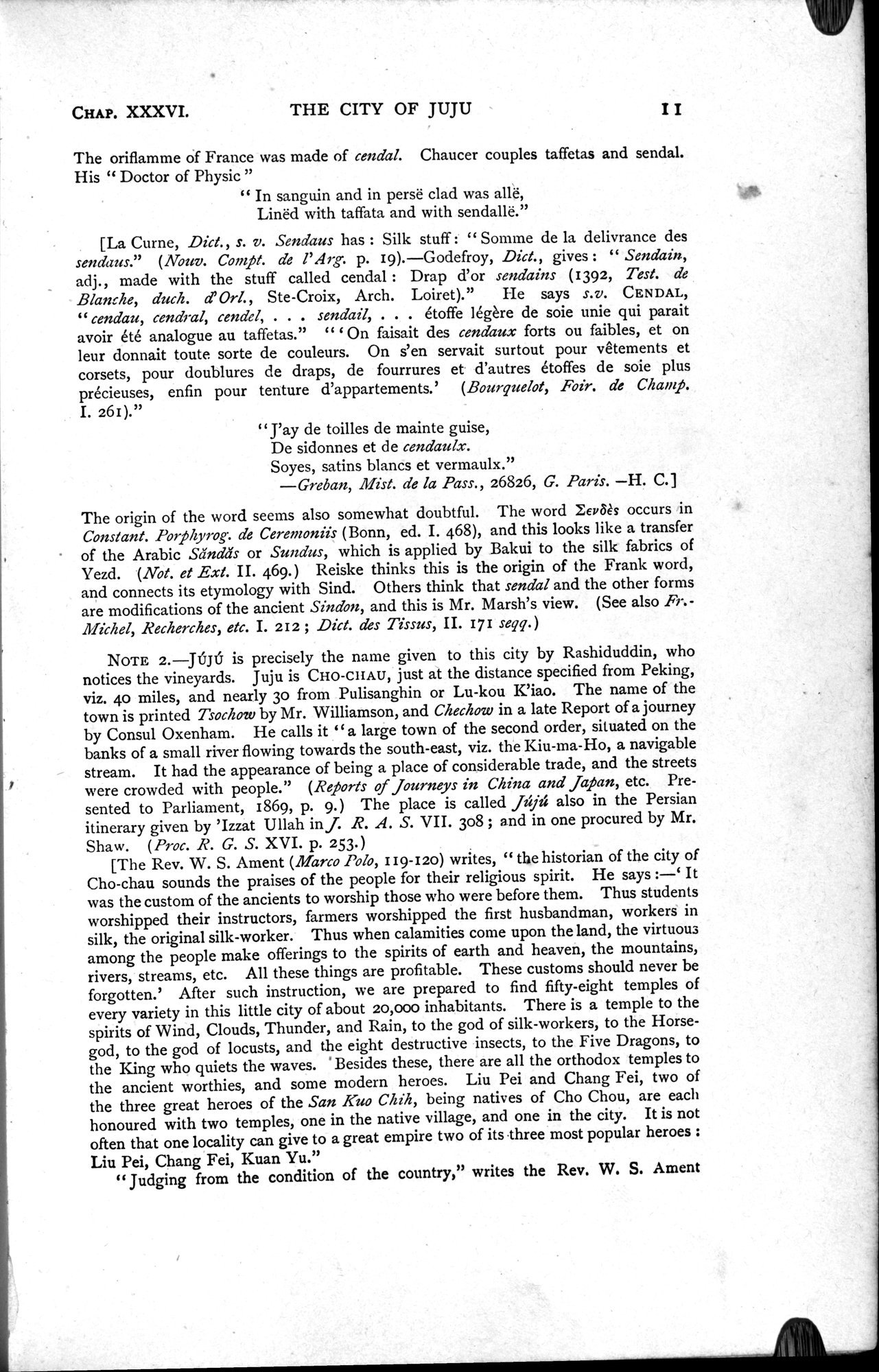
CHAP. XXXVI. THE CITY OF JUJU
II
it
" J'ay de toilles de mainte guise,
De sidonnes et de cendaulx.
Soyes, satins blancs et vermaulx."
—Greban, Mist. de la Pass., 26826, G. Paris. —H. C.1
The origin of the word seems also somewhat doubtful. The word IczOEUs occurs in Constant. Pozphyrog-. de Ceremoniis (Bonn, ed. I. 468), and this looks like a transfer of the Arabic Sdndds or Su;zdus, which is applied by Bakui to the silk fabrics of Vezd. (Not. et Ext. II. 469.) Reiske thinks this is the origin of the Frank word, and connects its etymology with Sind. Others think that sendal and the other forms are modifications of the ancient Sindon, and this is Mr. Marsh's view. (See also Fr.-h
Michel, Recherches, etc. I. 212 ; Dict. des Tissus, II. 171 segq. )
NOTE 2. JúJú is precisely the name given to this city by Rashiduddin, who notices the vineyards. Juju is CHO-CHAU, just at the distance specified from Peking, viz. 4o miles, and nearly 3o from Pulisanghin or Lu-kou K'iao. The name of the town is printed TsocTzow by Mr. Williamson, and Clzeclzow in a late Report of a journey by Consul Oxenham. He calls it "a large town of the second order, situated on the banks of a small river flowing towards the south-east, viz. the Kiu-ma-Ho, a navigable stream. It had the appearance of being a place of considerable trade, and the streets were crowded with people." (Reports of journeys in China and japan, etc. Presented to Parliament, 1869, p. 9.) The place is called jújú also in the Persian itinerary given by 'Izzat Ullah in/ R. A. S. VII. 308 ; and in one procured by Mr. Shaw. (Proc. R. G. S. XVI. p. 253.)
[The Rev. W. S. Ament (Marco Polo, 119-120) writes, " the historian of the city of Cho-chau sounds the praises of the people for their religious spirit. He says :—` It was the custom of the ancients to worship those who were before them. Thus students worshipped their instructors, farmers worshipped the first husbandman, workers in silk, the original silk-worker. Thus when calamities come upon the land, the virtuous among the people make offerings to the spirits of earth and heaven, the mountains, rivers, streams, etc. All these things are profitable. These customs should never be forgotten.' After such instruction, we are prepared to find fifty-eight temples of every variety in this little city of about 20,000 inhabitants. There is a temple to the spirits of Wind, Clouds, Thunder, and Rain, to the god of silk-workers, to the Horse-god, to the god of locusts, and the eight destructive insects, to the Five Dragons, to the King who quiets the waves. Besides these, there are all the orthodox temples to the ancient worthies, and some modern heroes. Liu Pei and Chang Fei, two of the three great heroes of the San Kuo Chih, being natives of Cho Chou, are each honoured with two temples, one in the native village, and one in the city. It is not often that one locality can give to a great empire two of its three most popular heroes : Liu Pei, Chang Fei, Kuan Yu."
" Judging from the condition of the country," writes the Rev. W. S. Ament
The oriflamme of France was made of cendal. Chaucer couples taffetas and sendal. His " Doctor of Physic "
In sanguin and in persë clad was allë, Linëd with taffata and with sendallë."
[La Curne, Diet., s. v. Sendaus has : Silk stuff : " Somme de la delivrance des sendzus." (Nouv. Compt% de l'Art p. 19).—Godefroy, Dict., gives : " Sendaizz., adj., made with the stuff called cendal : Drap d'or sendains (1392, Test. de
Blanche, duck. d'Orl., Ste-Croix, Arch. Loiret)." He says s.v. CENDAL,
(ccendau, cendral, cendal, . . . sendail, . . . étoffe ]égére de soie unie qui parait avoir été analogue au taffetas." " ` On faisait des cendaux forts ou faibles, et on leur donnait toute sorte de couleurs. On s'en servait surtout pour vêtements et corsets, pour doublures de draps, de fourrures et d'autres étoffes de soie plus précieuses, enfin pour tenture d'appartements.' (Bourquelot, Foir. de Champ. I. 261)."
|
|
|
|
|
|
|
|
|
Copyright (C) 2003-2019 National Institute of Informatics and The Toyo Bunko. All Rights Reserved.