 IIIF Color HighRes
National Institute of Informatics - Digital Silk Road Project
| |||||||||
|
| IIIF Color HighRes |
| The Book of Ser Marco Polo : vol.2 |
 |
 |
 |
 |
 |
 |
|
|
 |
|
|
|
|
|
|
|
|
Citation Information
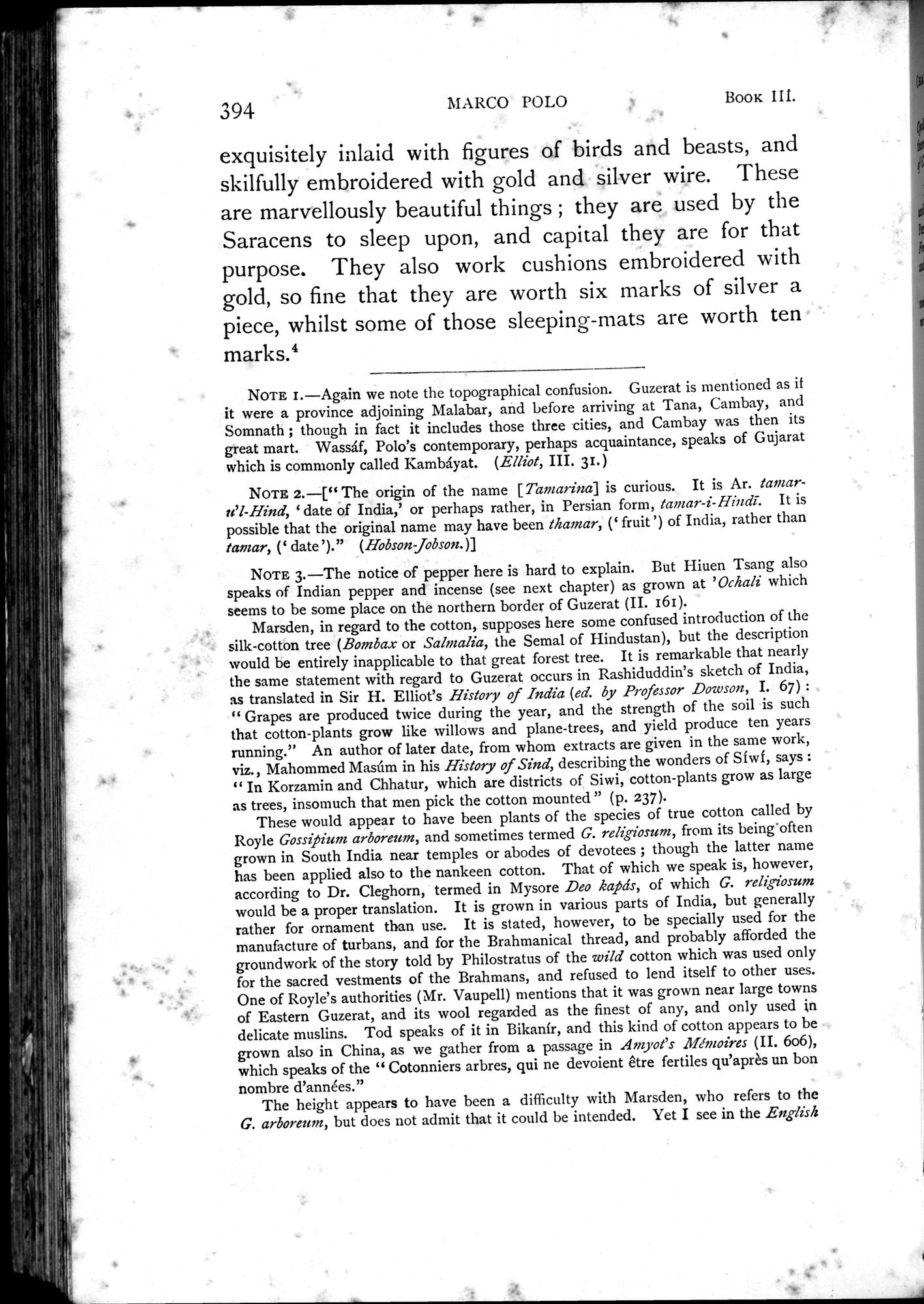
394
MARCO POLO 1300K III.
exquisitely inlaid with figures of birds and beasts, and
skilfully embroidered with gold and silver wire. These
are marvellously beautiful things ; they are used by the
Saracens to sleep upon, and capital they are for that
purpose. They also work cushions embroidered with
gold, so fine that they are worth six marks of silver a
piece, whilst some of those sleeping-mats are worth ten
marks.4
~h
NOTE 1.—Again we note the topographical confusion. Guzerat is mentioned as if it were a province adjoining Malabar, and before arriving at Tana, Cambay, and Somnath ; though in fact it includes those three cities, and Cambay was then its great mart. Wassáf, Polo's contemporary, perhaps acquaintance, speaks of Gujarat which is commonly called Kambáyat. (Elliot, III. 31.)
NOTE 2.—[" The origin of the name [Tamaz-ina] is curious. It is Ar. Lamaru'l-Hind, date of India,' or perhaps rather, in Persian form, tanzar-i-Hizzdī. It is possible that the original name may have been thamar, (` fruit ') of India, rather than Lamar, (` date ')." (Hobson Dobson. )]
NOTE 3.—The notice of pepper here is hard to explain. But Hiuen Tsang also speaks of Indian pepper and incense (see next chapter) as grown at 'Ochali which seems to be some place on the northern border of Guzerat (II. 161).
Marsden, in regard to the cotton, supposes here some confused introduction of the silk-cotton tree (Bombax or Salznalia, the Semal of Hindustan), but the description
. • -,
.• .
L w
' would be entirely inapplicable to that great forest tree. It is remarkable that nearly
the same statement with regard to Guzerat occurs in Rashiduddin's sketch of India, as translated in Sir H. Elliot's History of India (ed by Professor Dawson, I. 67) : " Grapes are produced twice during the year, and the strength of the soil is such that cotton-plants grow like willows and plane-trees, and yield produce ten years running." An author of later date, from whom extracts are given in the same work, viz., Mahommed Masúm in his History of Sind, describing the wonders of Sfwf, says : " In Korzamin and Chhatur, which are districts of Siwi, cotton-plants grow as large as trees, insomuch that men pick the cotton mounted " (p. 237).
These would appear to have been plants of the species of true cotton called by Royle Gossipiunz arboreuzn, and sometimes termed G. religiosunz, from its being often grown in South India near temples or abodes of devotees ; though the latter name has been applied also to the nankeen cotton. That of which we speak is, however, according to Dr. Cleghorn, termed in Mysore Deo kapás, of which G. relzg iosum would be a proper translation. It is grown in various parts of India, but generally rather for ornament than use. It is stated, however, to be specially used for the manufacture of turbans, and for the Brahmanical thread, and probably afforded the groundwork of the story told by Philostratus of the wild cotton which was used only for the sacred vestments of the Brahmans, and refused to lend itself to other uses. One of Royle's authorities (Mr. Vaupell) mentions that it was grown near large towns of Eastern Guzerat, and its wool regarded as the finest of any, and only used in delicate muslins. Tod speaks of it in Bikanír, and this kind of cotton appears to be grown also in China, as we gather from a passage in Anzyot's Mémoires (II. 6o6), which speaks of the " Cotonniers arbres, qui ne devoient être fertiles qu'aprés un bon nombre d'années."
The height appears to have been a difficulty with Marsden, who refers to the G. arboreum, but does not admit that it could be intended. Yet I see in the English
~ N+
•
|
|
|
|
|
|
|
|
|
Copyright (C) 2003-2019 National Institute of Informatics and The Toyo Bunko. All Rights Reserved.