 IIIF Color HighRes
National Institute of Informatics - Digital Silk Road Project
| |||||||||
|
| IIIF Color HighRes |
| The Book of Ser Marco Polo : vol.2 |
 |
 |
 |
 |
 |
 |
|
|
 |
|
|
|
|
|
|
|
|
Citation Information
s"
a
5 2 MARCO POLO Boon II.
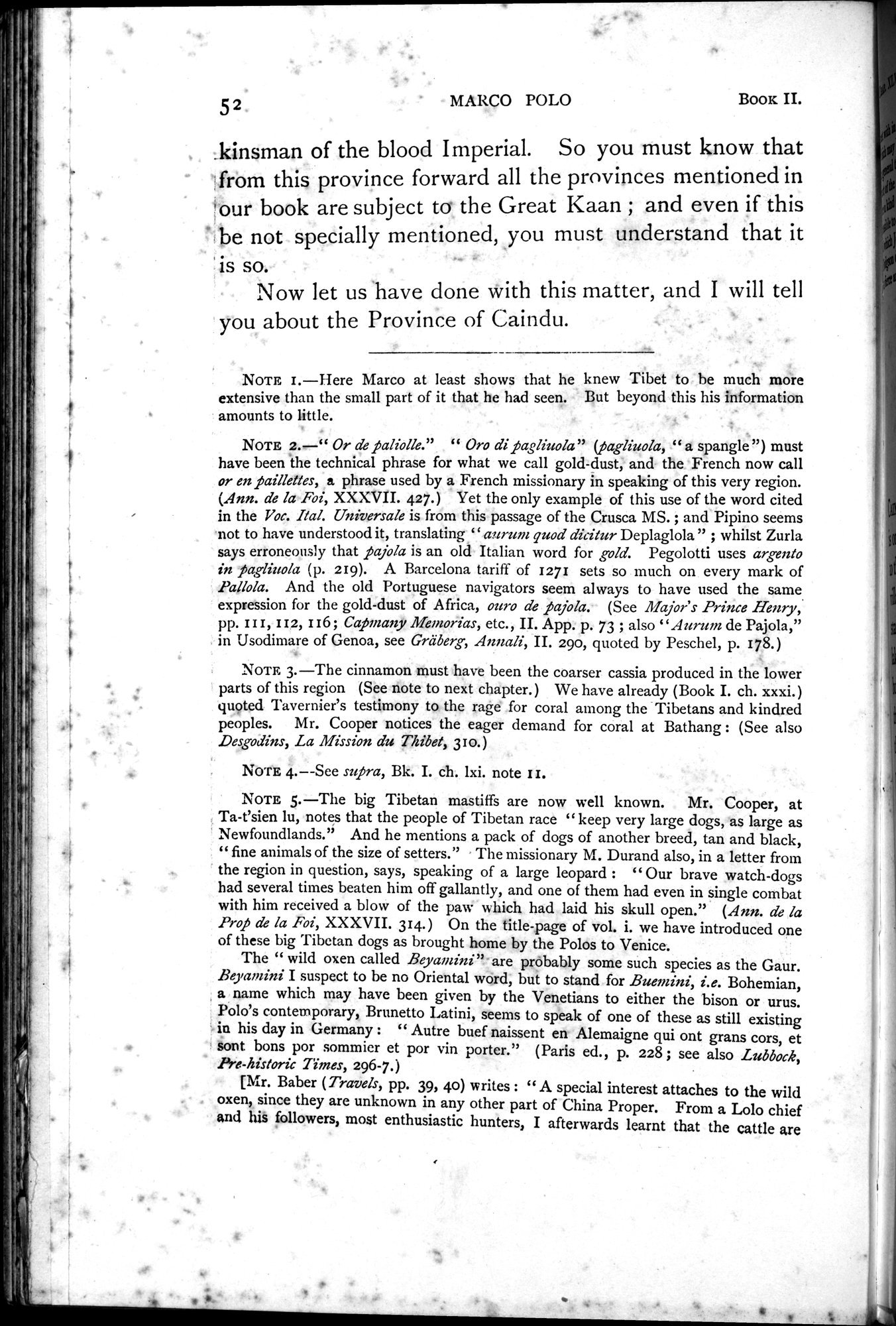
.kinsman of the blood Imperial. So you must know that
from this province forward all the provinces mentioned in
our book are subject to the Great Kaan ; and even if this
be not specially mentioned, you must understand that it
is so.
Now let us have done with this matter, and I will tell
you about the Province of Caindu.
NOTE I.—Here Marco at least shows that he knew Tibet to he much more extensive than the small part of it that he had seen. But beyond this his information amounts to little.
w
NOTE 2.—" Or de paliolle." " Oro di pa; liuola" (pagliuola, "a spangle ") must have been the technical phrase for what we call gold-dust, and the French now call or en paillettes, a phrase used by a French missionary in speaking of this very region. (Ann. de la Foi, XXXVII. 427.) Yet the only example of this use of the word cited in the Poe. Ital. Universale is from this passage of the Crusca MS. ; and Pipino seems not to have understood it, translating ` ` aurum quod dicitur Deplaglola " ; whilst Zurla says erroneously that pajola is an old Italian word for gold. Pegolotti uses argento in pa;lizrola (p. 219). A Barcelona tariff of 1271 sets so much on every mark of Pallola. And the old Portuguese navigators seem always to have used the same expression for the gold-dust of Africa, ouro de pajola. (See Major's Prince Henry, pp. III, 112, 116; Capnzany Memorias, etc., II. App. p. 73 ; also "Auruin de Pajola," in Usodimare of Genoa, see Gräberg, Annalz, II. 290, quoted by Peschel, p. 178. )
NOTE 3.—The cinnamon must have been the coarser cassia produced in the lower parts of this region (See note to next chapter.) We have already (Book I. ch. xxxi.) quoted Tavernier's testimony to the rage for coral among the Tibetans and kindred peoples. Mr. Cooper notices the eager demand for coral at Bathang : (See also Desgodins, La Mission du Tkibet, 310.)
NOTE 4.--See supra, Bk. I. eh. lxi. note
NOTE 5.—The big Tibetan mastiffs are now well known. Mr. Cooper, at Ta-t'sien lu, notes that the people of Tibetan race " keep very large dogs, as large as Newfoundlands." And he mentions a pack of dogs of another breed, tan and black, " fine animals of the size of setters." The missionary M. Durand also, in a letter from the region in question, says, speaking of a large leopard : " Our brave watch-dogs had several times beaten him off gallantly, and one of them had even in single combat with him received a blow of the paw which had laid his skull open." (Ann. de la Prop de la Foi, XXXVII. 314.) On the title-page of vol. i. we have introduced one of these big Tibetan dogs as brought home by the Polos to Venice.
The " wild oxen called Beyanzini " are probably some such species as the Gaur. Beya>'zzni I suspect to be no Oriental word, but to stand for Buenzini, i.e. Bohemian, a name which may have been given by the Venetians to either the bison or urus. Polo's contemporary, Brunetto Latini, seems to speak of one of these as still existing in his day in Germany : " Autre buef naissent en Alemaigne qui ont grans cors, et sont bons por sommier et por vin porter." (Paris ed., p. 228 ; see also Lubbock, Pre-historic Times, 296-7.)
[Mr. Baber (Travels, pp. 39, 40) writes : " A special interest attaches to the wild oxen, since they are unknown in any other part of China Proper. From a Lolo chief and his followers, most enthusiastic hunters, I afterwards learnt that the cattle are
~ S .
1
|
|
|
|
|
|
|
|
|
Copyright (C) 2003-2019 National Institute of Informatics and The Toyo Bunko. All Rights Reserved.