 IIIF Color HighRes
National Institute of Informatics - Digital Silk Road Project
| |||||||||
|
| IIIF Color HighRes |
| Ruins of Desert Cathay : vol.2 |
 |
 |
 |
 |
 |
 |
|
|
 |
|
|
|
|
|
|
|
|
Citation Information
io8 ALONG THE ANCIENT WALL CH. LIX
yellowish light as if the plaster coating of their walls were
still intact to make them conspicuous. As they showed
up from afar, with long stretches of the wall between them
often clearly rising as straight brownish lines above the
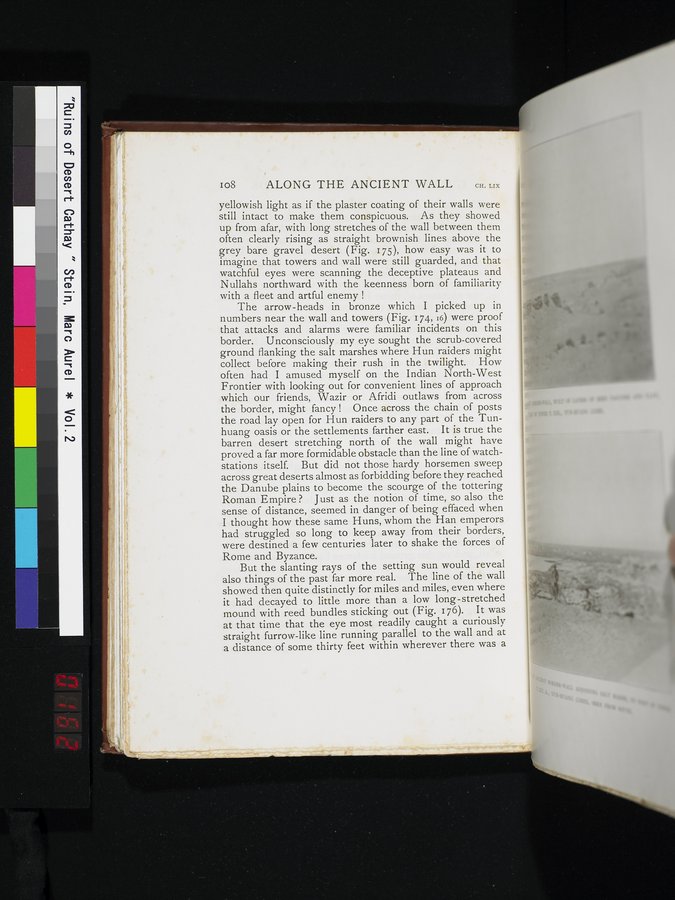
grey bare gravel desert (Fig. 175), how easy was it to
imagine that towers and wall were still guarded, and that
watchful eyes were scanning the deceptive plateaus and
Nullahs northward with the keenness born of familiarity
with a fleet and artful enemy !
The arrow-heads in bronze which I picked up in
numbers near the wall and towers (Fig. 174, i6) were proof
that attacks and alarms were familiar incidents on this
border. Unconsciously my eye sought the scrub-covered
ground flanking the salt marshes where Hun raiders might
collect before making their rush in the twilight. How
often had I amused myself on the Indian North-West
Frontier with looking out for convenient lines of approach
which our friends, Wazir or Afridi outlaws from across
the border, might fancy ! Once across the chain of posts
the road lay open for Hun raiders to any part of the Tun-
huang oasis or the settlements farther east. It is true the
barren desert stretching north of the wall might have
proved a far more formidable obstacle than the line of watch-
stations itself. But did not those hardy horsemen sweep
across great deserts almost as forbidding before they reached
the Danube plains to become the scourge of the tottering
Roman Empire ? Just as the notion of time, so also the
sense of distance, seemed in danger of being effaced when
I thought how these same Huns, whom the Han emperors
had struggled so long to keep away from their borders,
were destined a few centuries later to shake the forces of
Rome and Byzance.
But the slanting rays of the setting sun would reveal
also things of the past far more real. The line of the wall
showed then quite distinctly for miles and miles, even where
it had decayed to little more than a low long-stretched
mound with reed bundles sticking out (Fig. 176). It was
at that time that the eye most readily caught a curiously
straight furrow-like line running parallel to the wall and at
a distance of some thirty feet within wherever there was a
|
|
|
|
|
|
|
|
|
Copyright (C) 2003-2019 National Institute of Informatics and The Toyo Bunko. All Rights Reserved.