 IIIF Color HighRes
National Institute of Informatics - Digital Silk Road Project
| |||||||||
|
| IIIF Color HighRes |
| Ruins of Desert Cathay : vol.2 |
 |
 |
 |
 |
 |
 |
|
|
 |
|
|
|
|
|
|
|
|
Citation Information
426 FROM AK-SU TO YARKAND
CI[. XC
The study of the extant conditions in these hills, where springs are now extremely rare, and all travel depends on an exact knowledge of the water-supply obtainable from natural cisterns or ` Kaks,' was to me of special interest ; for very similar conditions may be supposed to have prevailed in the now absolutely waterless hills of the Peishan south of Hami during the period when bands of Hun raiders could still make their way through them towards Tun-huang and the great Chinese route to the west. In fact, Kirghiz raids of a corresponding character, effected from the T'ien-shan valleys upon the Ak-su-Kashgar high road in the plains, are still a matter of living recollection, and might yet be revived in practice if the hold of the Chinese administration were relaxed.
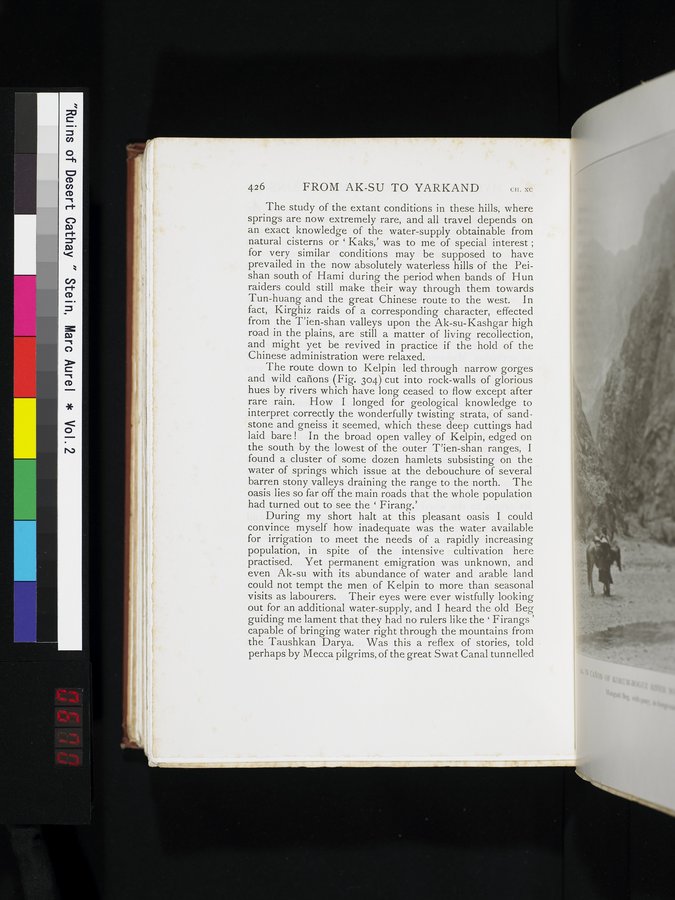
The route down to Kelpin led through narrow gorges and wild canons (Fig. 304) cut into rock-walls of glorious hues by rivers which have long ceased to flow except after rare rain. How I longed for geological knowledge to interpret correctly the wonderfully twisting strata, of sandstone and gneiss it seemed, which these deep cuttings had laid bare ! In the broad open valley of Kelpin, edged on the south by the lowest of the outer T'ien-shan ranges, I found a cluster of some dozen hamlets subsisting on the water of springs which issue at the debouchure of several barren stony valleys draining the range to the north. The oasis lies so far off the main roads that the whole population had turned out to see the ` Firang.'
During my short halt at this pleasant oasis I could convince myself how inadequate was the water available for irrigation to meet the needs of a rapidly increasing population, in spite of the intensive cultivation here practised. Yet permanent emigration was unknown, and even Ak-su with its abundance of water and arable land
could not tempt the men of Kelpin to more than seasonal visits as labourers. Their eyes were ever wistfully looking
out for an additional water-supply, and I heard the old Beg
guiding me lament that they had no rulers like the ` Firangs ' capable of bringing water right through the mountains from
the Taushkan Darya. Was this a reflex of stories, told perhaps by Mecca pilgrims, of the great Swat Canal tunnelled
|
|
|
|
|
|
|
|
|
Copyright (C) 2003-2019 National Institute of Informatics and The Toyo Bunko. All Rights Reserved.