 IIIFカラー高解像度
国立情報学研究所 - ディジタル・シルクロード・プロジェクト
| |||||||||
|
| IIIFカラー高解像度 |
| Southern Tibet : vol.7 | |
| 南チベット : vol.7 |
 |
 |
 |
 |
 |
 |
|
|
 |
|
|
|
|
|
|
|
|
引用情報
MARCO POLO.
7
,
u
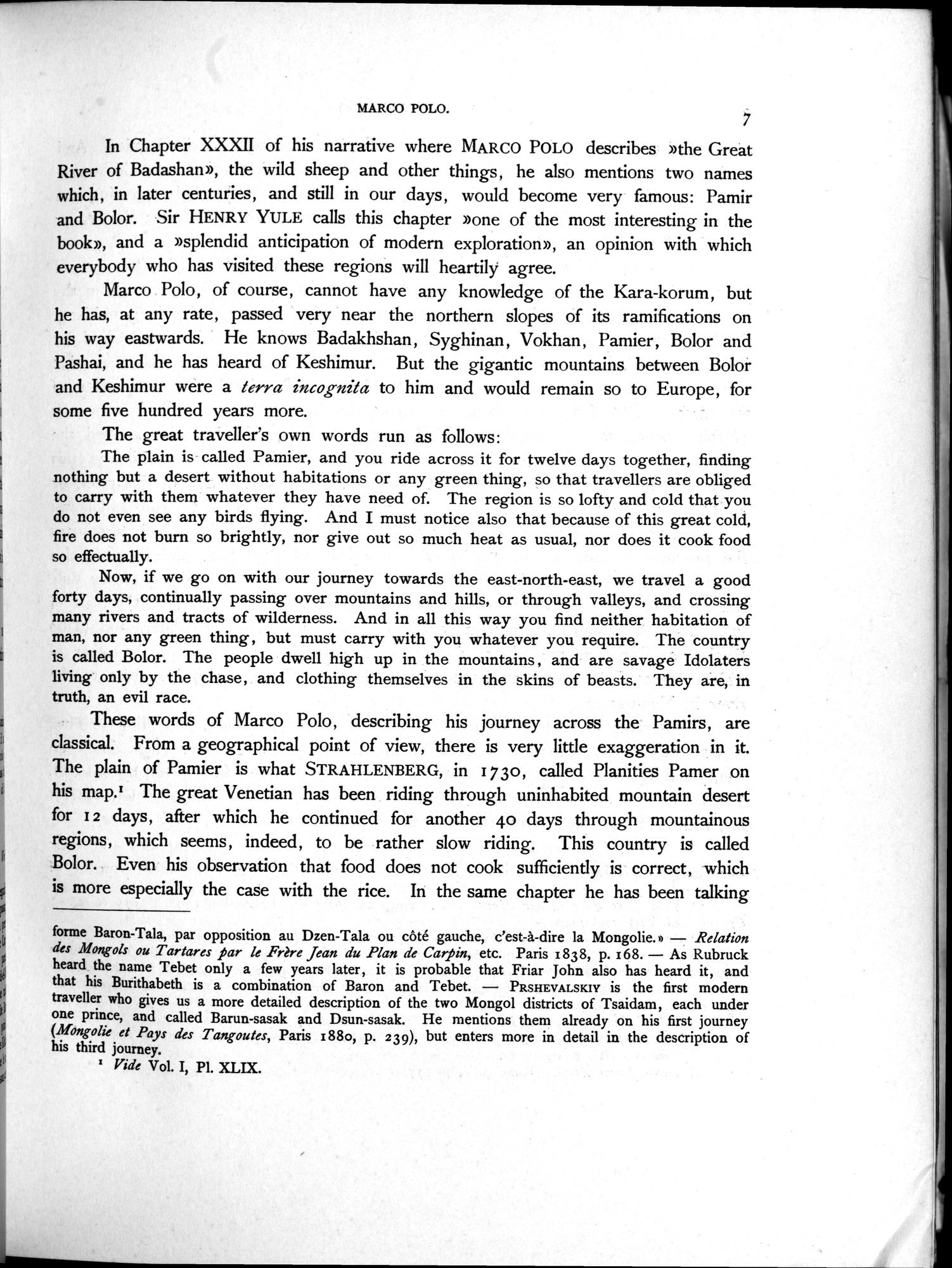
In Chapter XXXII of his narrative where MARCO POLO describes »the Great River of Badashan», the wild sheep and other things, he also mentions two names which, in later centuries, and still in our days, would become very famous: Pamir and Bolor. Sir HENRY YULE calls this chapter »one of the most interesting in the book», and a »splendid anticipation of modern exploration», an opinion with which everybody who has visited these regions will heartily agree.
Marco Polo, of course, cannot have any knowledge of the Kara-korum, but he has, at any rate, passed very near the northern slopes of its ramifications on his way eastwards. He knows Badakhshan, Syghinan, Vokhan, Pamier, Bolor and Pashai, and he has heard of Keshimur. But the gigantic mountains between Bolor and Keshimur were a ferra incognita to him and would remain so to Europe, for some five hundred years more.
The great traveller's own words run as follows:
The plain is called Pamier, and you ride across it for twelve days together, finding nothing but a desert without habitations or any green thing, so that travellers are obliged to carry with them whatever they have need of. The region is so lofty and cold that you do not even see any birds flying. And I must notice also that because of this great cold, fire does not burn so brightly, nor give out so much heat as usual, nor does it cook food so effectually.
Now, if we go on with our journey towards the east-north-east, we travel a good forty days, continually passing over mountains and hills, or through valleys, and crossing many rivers and tracts of wilderness. And in all this way you find neither habitation of man, nor any green thing, but must carry with you whatever you require. The country is called Bolor. The people dwell high up in the mountains , and are savage Idolaters living only by the chase, and clothing themselves in the skins of beasts. They are, in truth, an evil race.
These words of Marco Polo, describing his journey across the Pamirs, are classical. From a geographical point of view, there is very little exaggeration in it. The plain of Pamier is what STRAHLENBERG, in 1730, called Planities Pamer on his map.' The great Venetian has been riding through uninhabited mountain desert for i 2 days, after which he continued for another 4o days through mountainous regions, which seems, indeed, to be rather slow riding. This country is called Bolor. Even his observation that food does not cook sufficiently is correct, which is more especially the case with the rice. In the same chapter he has been talking
forme Baron-Tala, par opposition au Dzen-Tala ou côté gauche, c'est-à-dire la Mongolie.» — Relation des Mongols ou Tartares par le Frère Jean du Plan de Carpin, etc. Paris 1838, p. 168. — As Rubruck heard the name Tebet only a few years later, it is probable that Friar John also has heard it, and that his Burithabeth is a combination of Baron and Tebet. — PRSHEVALSKIY is the first modern traveller who gives us a more detailed description of the two Mongol districts of Tsaidam, each under one prince, and called Barun-sasak and Dsun-sasak. He mentions them already on his first journey (Mongolie et Pays des Tangoutes, Paris r88o, p. 239), but enters more in detail in the description of his third journey.
I Vide Vol. I, Pl. XLIX.
|
|
|
|
|
|
|
|
|
Copyright (C) 2003-2019
National Institute of Informatics(国立情報学研究所)
and
The Toyo Bunko(東洋文庫). All Rights Reserved.
本ウェブサイトに掲載するデジタル文化資源の無断転載は固くお断りいたします。