 IIIFカラー高解像度
国立情報学研究所 - ディジタル・シルクロード・プロジェクト
| |||||||||
|
| IIIFカラー高解像度 |
| Southern Tibet : vol.7 | |
| 南チベット : vol.7 |
 |
 |
 |
 |
 |
 |
|
|
 |
|
|
|
|
|
|
|
|
引用情報
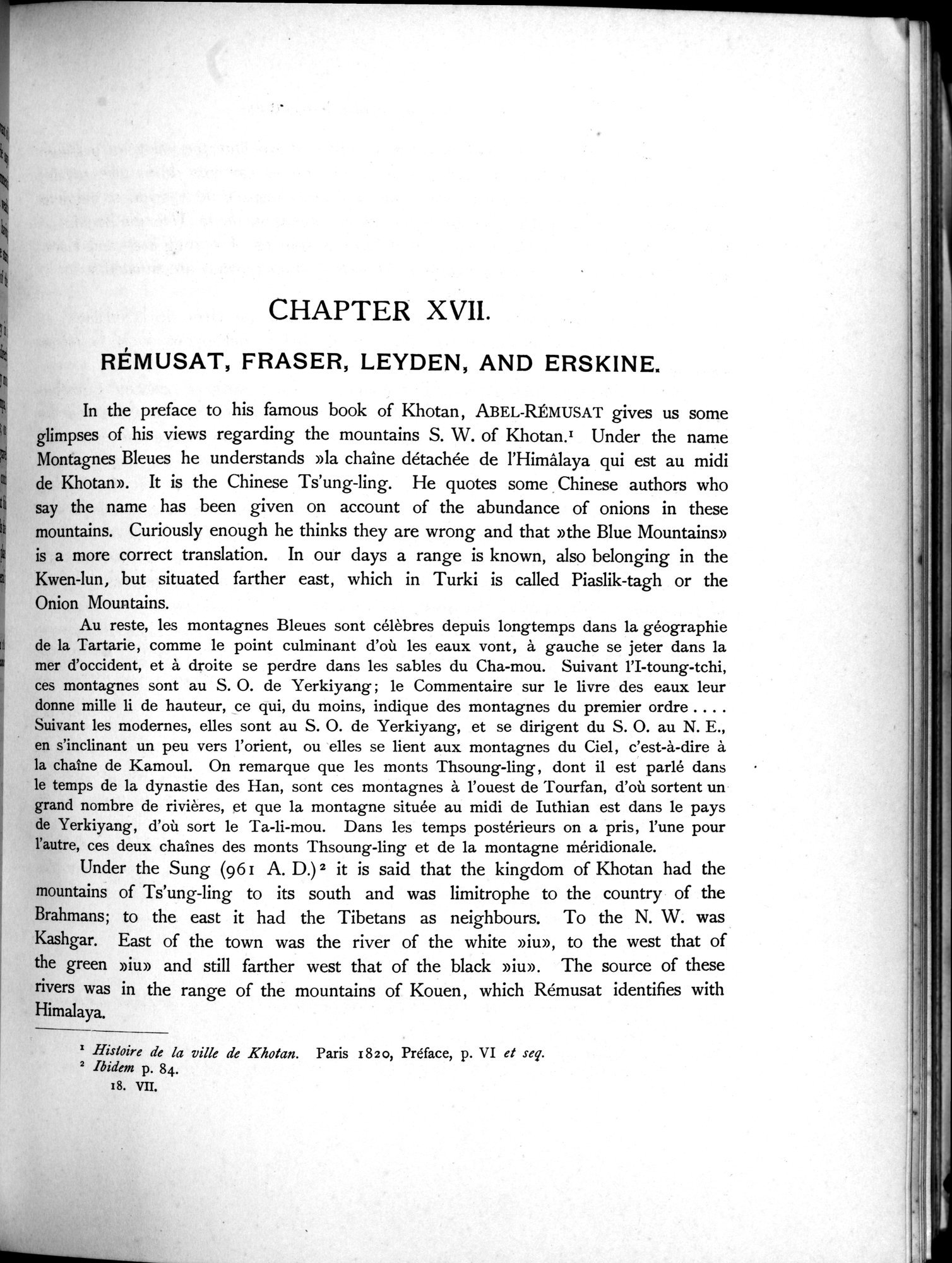
CHAPTER XVII.
RÉMUSAT, FRASER, LEYDEN, AND ERSKINE.
In the preface to his famous book of Khotan, ABEL-RÉMUSAT gives us some glimpses of his views regarding the mountains S. W. of Khotan.I Under the name Montagnes Bleues he understands »la chaîne détachée de l'Himâlaya qui est au midi de Khotan». It is the Chinese Ts'ung-ling. He quotes some Chinese authors who say the name has been given on account of the abundance of onions in these mountains. Curiously enough he thinks they are wrong and that »the Blue Mountains» is a more correct translation. In our days a range is known, also belonging in the Kwen-lun, but situated farther east, which in Turki is called Piaslik-tagh or the
Onion Mountains.
Au reste, les montagnes Bleues sont célèbres depuis longtemps dans la géographie de la Tartarie, comme le point culminant d'où les eaux vont, à gauche se jeter dans la mer d'occident, et à droite se perdre dans les sables du Cha-mou. Suivant l'I-toung-tchi, ces montagnes sont au S. O. de Yerkiyang ; le Commentaire sur le livre des eaux leur donne mille li de hauteur, ce qui, du moins, indique des montagnes du premier ordre ... . Suivant les modernes, elles sont au S. O. de Yerkiyang, et se dirigent du S. O. au N. E., en s'inclinant un peu vers l'orient, ou elles se lient aux montagnes du Ciel, c'est-à-dire à la chaîne de Kamoul. On remarque que les monts Thsoung-ling, dont il est parlé dans le temps de la dynastie des Han, sont ces montagnes à l'ouest de Tourfan, d'où sortent un grand nombre de rivières, et que la montagne située au midi de Iuthian est dans le pays de Yerkiyang, d'où sort le Ta-li-mou. Dans les temps postérieurs on a pris, l'une pour l'autre, ces deux chaînes des monts Thsoung-ling et de la montagne méridionale.
Under the Sung (96 I A. D.) 2 it is said that the kingdom of Khotan had the mountains of Ts'ung-ling to its south and was limitrophe to the country of the Brahmans; to the east it had the Tibetans as neighbours. To the N. W. was Kashgar. East of the town was the river of the white »iu», to the west that of the green »iu» and still farther west that of the black »iu». The source of these rivers was in the range of the mountains of Kouen, which Rémusat identifies with Himalaya.
I Histoire de la ville de Khotan. Paris 1820, Préface, p. VI et seq. 2 Ibidem p. 84.
18. VII.
|
|
|
|
|
|
|
|
|
Copyright (C) 2003-2019
National Institute of Informatics(国立情報学研究所)
and
The Toyo Bunko(東洋文庫). All Rights Reserved.
本ウェブサイトに掲載するデジタル文化資源の無断転載は固くお断りいたします。