 IIIFカラー高解像度
国立情報学研究所 - ディジタル・シルクロード・プロジェクト
| |||||||||
|
| IIIFカラー高解像度 |
| Southern Tibet : vol.7 | |
| 南チベット : vol.7 |
 |
 |
 |
 |
 |
 |
|
|
 |
|
|
|
|
|
|
|
|
引用情報
CUNNINGHAM AND THOMSON.
200
;~
I~III+
41'I I,
C
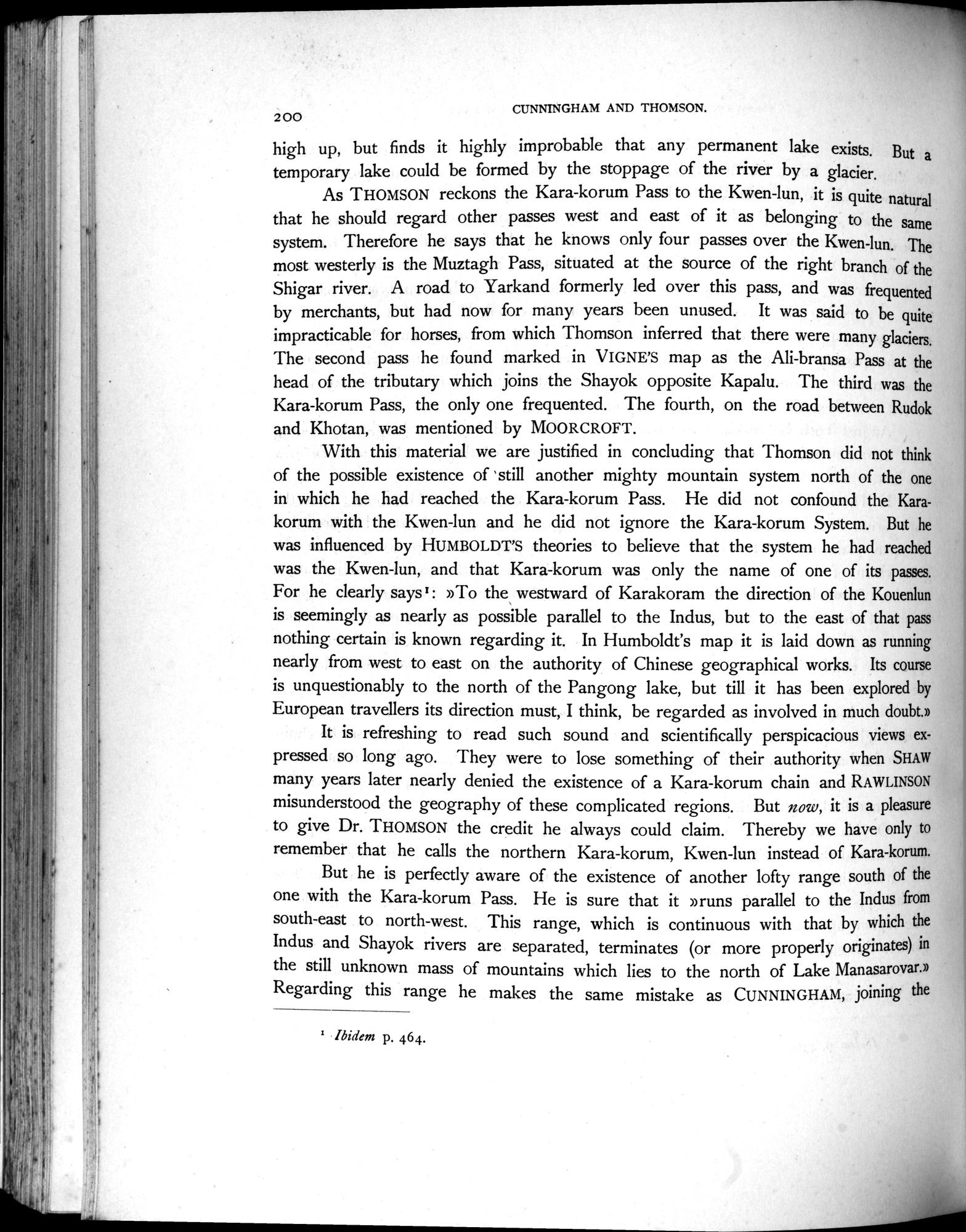
high up, but finds it highly improbable that any permanent lake exists. But a temporary lake could be formed by the stoppage of the river by a glacier.
As THOMSON reckons the Kara-korum Pass to the Kwen-lun, it is quite natural that he should regard other passes west and east of it as belonging to the same system. Therefore he says that he knows only four passes over the Kwen-lun. The most westerly is the Murtagh Pass, situated at the source of the right branch of the Shigar river. A road to Yarkand formerly led over this pass, and was frequented by merchants, but had now for many years been unused. It was said to be quite impracticable for horses, from which Thomson inferred that there were many glaciers. The second pass he found marked in VIGNE'S map as the Ali-bransa Pass at the head of the tributary which joins the Shayok opposite Kapalu. The third was the Kara-korum Pass, the only one frequented. The fourth, on the road between Rudok and Khotan, was mentioned by MOORCROFT.
With this material we are justified in concluding that Thomson did not think of the possible existence of 'still another mighty mountain system north of the one in which he had reached the Kara-korum Pass. He did not confound the Karakorum with the Kwen-lun and he did not ignore the Kara-korum System. But he was influenced by HUMBOLDT'S theories to believe that the system he had reached was the Kwen-lun, and that Kara-korum was only the name of one of its passes. For he clearly says 1: »To the westward of Karakoram the direction of the Kouenlun is seemingly as nearly as possible parallel to the Indus, but to the east of that pass nothing certain is known regarding it. In Humboldt's map it is laid down as running nearly from west to east on the authority of Chinese geographical works. Its course is unquestionably to the north of the Pangong lake, but till it has been explored by European travellers its direction must, I think, be regarded as involved in much doubt.»
It is refreshing to read such sound and scientifically perspicacious views expressed so long ago. They were to lose something of their authority when SHAW many years later nearly denied the existence of a Kara-korum chain and RAWLINSON misunderstood the geography of these complicated regions. But now, it is a pleasure to give Dr. THOMSON the credit he always could claim. Thereby we have only to remember that he calls the northern Kara-korum, Kwen-lun instead of Kara-korum.
But he is perfectly aware of the existence of another lofty range south of the one with the Kara-korum Pass. He is sure that it » runs parallel to the Indus from south-east to north-west. This range, which is continuous with that by which the Indus and Shayok rivers are separated, terminates (or more properly originates) in the still unknown mass of mountains which lies to the north of Lake Manasarovar.» Regarding this range he makes the same mistake as CUNNINGHAM, joining the
rr
Il
I Ibidem p. 464.
|
|
|
|
|
|
|
|
|
Copyright (C) 2003-2019
National Institute of Informatics(国立情報学研究所)
and
The Toyo Bunko(東洋文庫). All Rights Reserved.
本ウェブサイトに掲載するデジタル文化資源の無断転載は固くお断りいたします。