 IIIFカラー高解像度
国立情報学研究所 - ディジタル・シルクロード・プロジェクト
| |||||||||
|
| IIIFカラー高解像度 |
| Southern Tibet : vol.7 | |
| 南チベット : vol.7 |
 |
 |
 |
 |
 |
 |
|
|
 |
|
|
|
|
|
|
|
|
引用情報
~..
THE MONGOLIAN PILGRIMS' ROAD.
389
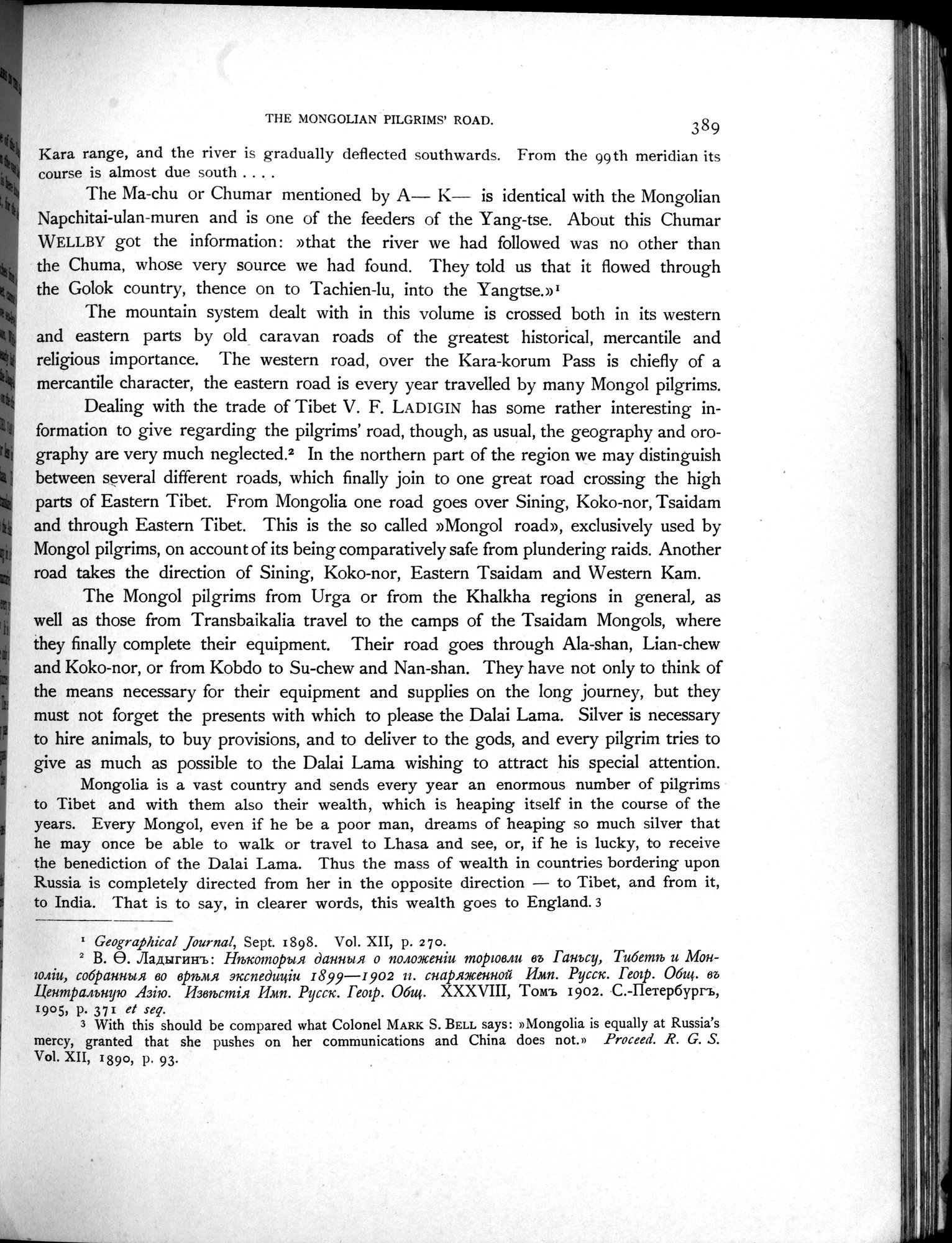
Kara range, and the river is gradually deflected southwards. From the 99th meridian its course is almost due south ... .
The Ma-chu or Chumar mentioned by A— K— is identical with the Mongolian Napchitai-ulan-muren and is one of the feeders of the Yang-tse. About this Chumar WELLBY got the information : »that the river we had followed was no other than the Chuma, whose very source we had found. They told us that it flowed through the Golok country, thence on to Tachien-lu, into the Yangtse.» I
The mountain system dealt with in this volume is crossed both in its western and eastern parts by old caravan roads of the greatest historical, mercantile and religious importance. The western road, over the Kara-korum Pass is chiefly of a mercantile character, the eastern road is every year travelled by many Mongol pilgrims.
Dealing with the trade of Tibet V. F. LADIGIN has some rather interesting in-
formation to give regarding the pilgrims' road, though, as usual, the geography and orography are very much neglected.2 In the northern part of the region we may distinguish between several different roads, which finally join to one great road crossing the high parts of Eastern Tibet. From Mongolia one road goes over Sining, Koko-nor, Tsaidam and through Eastern Tibet. This is the so called »Mongol road», exclusively used by Mongol pilgrims, on account of its being comparatively safe from plundering raids. Another road takes the direction of Sining, Koko-nor, Eastern Tsaidam and Western Kam.
The Mongol pilgrims from Urga or from the Khalkha regions in general, as
well as those from Transbaikalia travel to the camps of the Tsaidam Mongols, where they finally complete their equipment. Their road goes through Ala-shan, Lian-chew and Koko-nor, or from Kobdo to Su-chew and Nan-shan. They have not only to think of the means necessary for their equipment and supplies on the long journey, but they must not forget the presents with which to please the Dalai Lama. Silver is necessary to hire animals, to buy provisions, and to deliver to the gods, and every pilgrim tries to give as much as possible to the Dalai Lama wishing to attract his special attention.
Mongolia is a vast country and sends every year an enormous number of pilgrims to Tibet and with them also their wealth, which is heaping itself in the course of the years. Every Mongol, even if he be a poor man, dreams of heaping so much silver that he may once be able to walk or travel to Lhasa and see, or, if he is lucky, to receive the benediction of the Dalai Lama. Thus the mass of wealth in countries bordering upon Russia is completely directed from her in the opposite direction — to Tibet, and from it, to India. That is to say, in clearer words, this wealth goes to England. 3
I Geographical Journal, Sept. 1898. Vol. XII, p. 2 70.
2 B. e. JIa,wrnH1: Hmaxomopvusz daiiubt o mopio6.Mu 6ô Tauvcy, Tu6emw u Mou-
zo~iii, co6paunvisR 60 6p11,.MS1 sicneduiiu r899-1902 11. cxapsvxceunoü HMn. Pyccx. Temp. 06u4. 61? leumpaAvupo A3iio. H367vcmiR HMn. Pycctc. Temp. 06u4. XXXVIII, ToMI 1902. C.-IleTep6yprl,
19 0 5, P. 37 I et seq.
3 With this should be compared what Colonel MARK S. BELL says: »Mongolia is equally at Russia's mercy, granted that she pushes on her communications and China does not.» Proceed. R. G. S.
Vol. XII, 1890, P, 93•
|
|
|
|
|
|
|
|
|
Copyright (C) 2003-2019
National Institute of Informatics(国立情報学研究所)
and
The Toyo Bunko(東洋文庫). All Rights Reserved.
本ウェブサイトに掲載するデジタル文化資源の無断転載は固くお断りいたします。