 IIIFカラー高解像度
国立情報学研究所 - ディジタル・シルクロード・プロジェクト
| |||||||||
|
| IIIFカラー高解像度 |
| Southern Tibet : vol.7 | |
| 南チベット : vol.7 |
 |
 |
 |
 |
 |
 |
|
|
 |
|
|
|
|
|
|
|
|
引用情報
DIFFERENT OPINIONS REGARDING 'RIC.
215
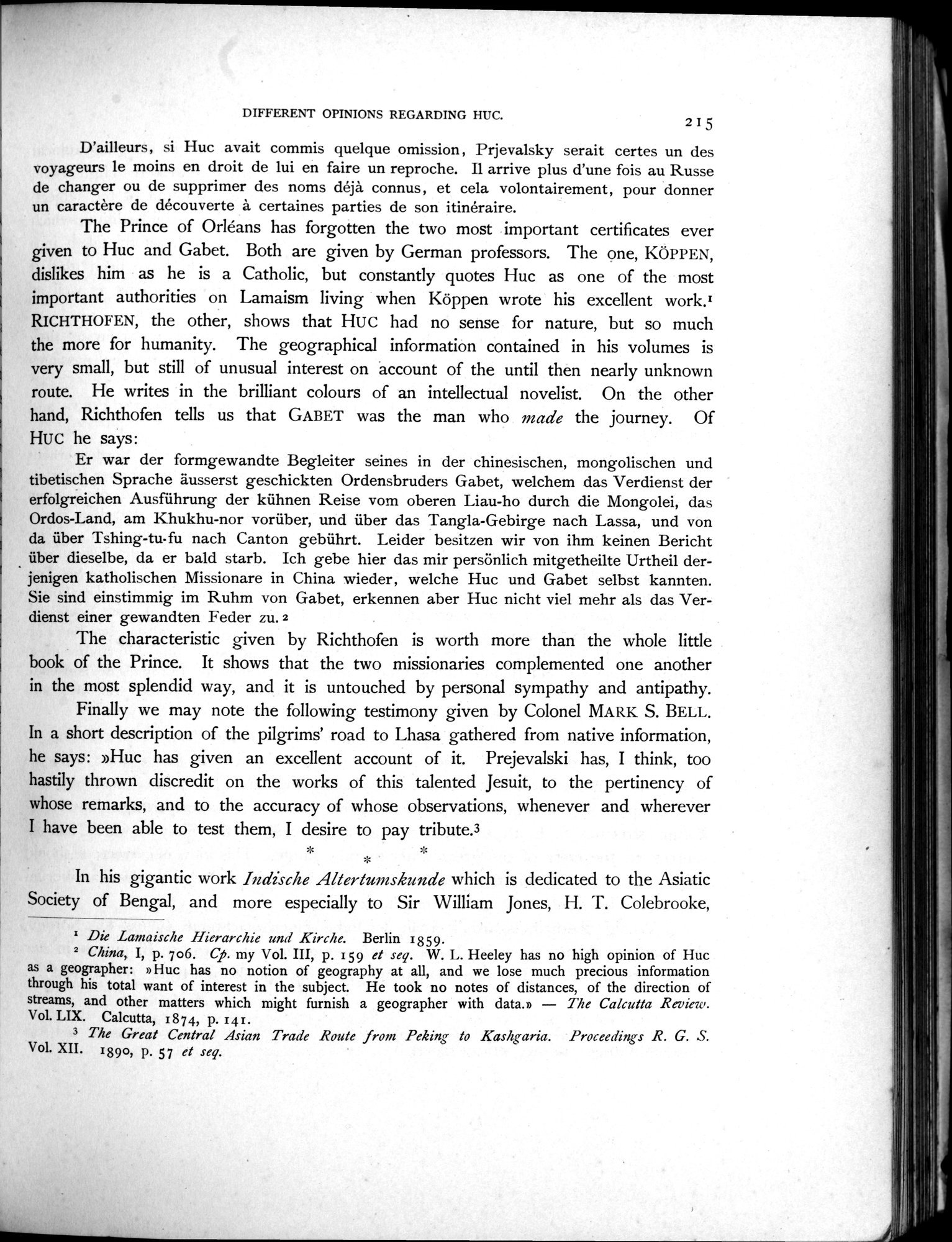
D'ailleurs, si Huc avait commis quelque omission, Prjevalsky serait certes un des voyageurs le moins en droit de lui en faire un reproche. Il arrive plus d'une fois au Russe de changer ou de supprimer des noms déjà connus, et cela volontairement, pour donner un caractère de découverte it certaines parties de son itinéraire.
The Prince of Orléans has forgotten the two most important certificates ever given to Huc and Gabet. Both are given by German professors. The one, KÜi'I'EN, dislikes him as he is a Catholic, but constantly quotes Huc as one of the most important authorities on Lamaism living when Köppen wrote his excellent work.' RICHTHOFEN, the other, shows that Huc had no sense for nature, but so much the more for humanity. The geographical information contained in his volumes is very small, but still of unusual interest on account of the until then nearly unknown route. He writes in the brilliant colours of an intellectual novelist. On the other hand, Richthofen tells us that GABET was the man who made the journey. Of
Huc he says:
Er war der formgewandte Begleiter seines in der chinesischen, mongolischen und tibetischen Sprache äusserst geschickten Ordensbruders Gabet, welchem das Verdienst der erfolgreichen Ausführung der kühnen Reise vorn oberen Liau-ho durch die Mongolei, das Ordos-Land, am Khukhu-nor vorüber, und über das Tangla-Gebirge nach Lassa, und von da über Tshing-tu-fu nach Canton gebührt. Leider besitzen wir von ihm keinen Bericht über dieselbe, da er bald starb. Ich gebe hier das mir persönlich mitgetheilte Urtheil derjenigen katholischen Missionare in China wieder, welche Huc und Gabet selbst kannten. Sie sind einstimmig im Ruhm von Gabet, erkennen aber Huc nicht viel mehr als das Verdienst einer gewandten Feder zu. 2
The characteristic given by Richthofen is worth more than the whole little book of the Prince. It shows that the two missionaries complemented one another in the most splendid way, and it is untouched by personal sympathy and antipathy.
Finally we may note the following testimony given by Colonel MARK S. BELL. In a short description of the pilgrims' road to Lhasa gathered from native information, he says: »Huc has given an excellent account of it. Prejevalski has, I think, too hastily thrown discredit on the works of this talented Jesuit, to the pertinency of whose remarks, and to the accuracy of whose observations, whenever and wherever
I have been able to test them, I desire to pay tribute.3
In his gigantic work Indische Altertumskunde which is dedicated to the Asiatic Society of Bengal, and more especially to Sir William Jones, H. T. Colebrooke,
I Die Lamaiscice Hierarchie und Kirche. Berlin 1859•
2 China, I, p. 706. Cp. my Vol. III, p. 159 et sey. W. L. Heeley has no high opinion of Huc as a geographer: »Huc has no notion of geography at all, and we lose much precious information through his total want of interest in the subject. He took no notes of distances, of the direction of streams, and other matters which might furnish a geographer with data.» — The Calcutta Review. Vol. LIX. Calcutta, 1874, p. 141.
3 The Great Central Asian Trade Route from Peking to Kashgaria. Proceedings R. G. S. Vol. XII. 189°, P. 57 et seq.
|
|
|
|
|
|
|
|
|
Copyright (C) 2003-2019
National Institute of Informatics(国立情報学研究所)
and
The Toyo Bunko(東洋文庫). All Rights Reserved.
本ウェブサイトに掲載するデジタル文化資源の無断転載は固くお断りいたします。