 IIIFカラー高解像度
国立情報学研究所 - ディジタル・シルクロード・プロジェクト
| |||||||||
|
| IIIFカラー高解像度 |
| Southern Tibet : vol.7 | |
| 南チベット : vol.7 |
 |
 |
 |
 |
 |
 |
|
|
 |
|
|
|
|
|
|
|
|
引用情報
HERMANN, ADOLPH AND ROBERT VON SCHLAGINTWEIT.
226
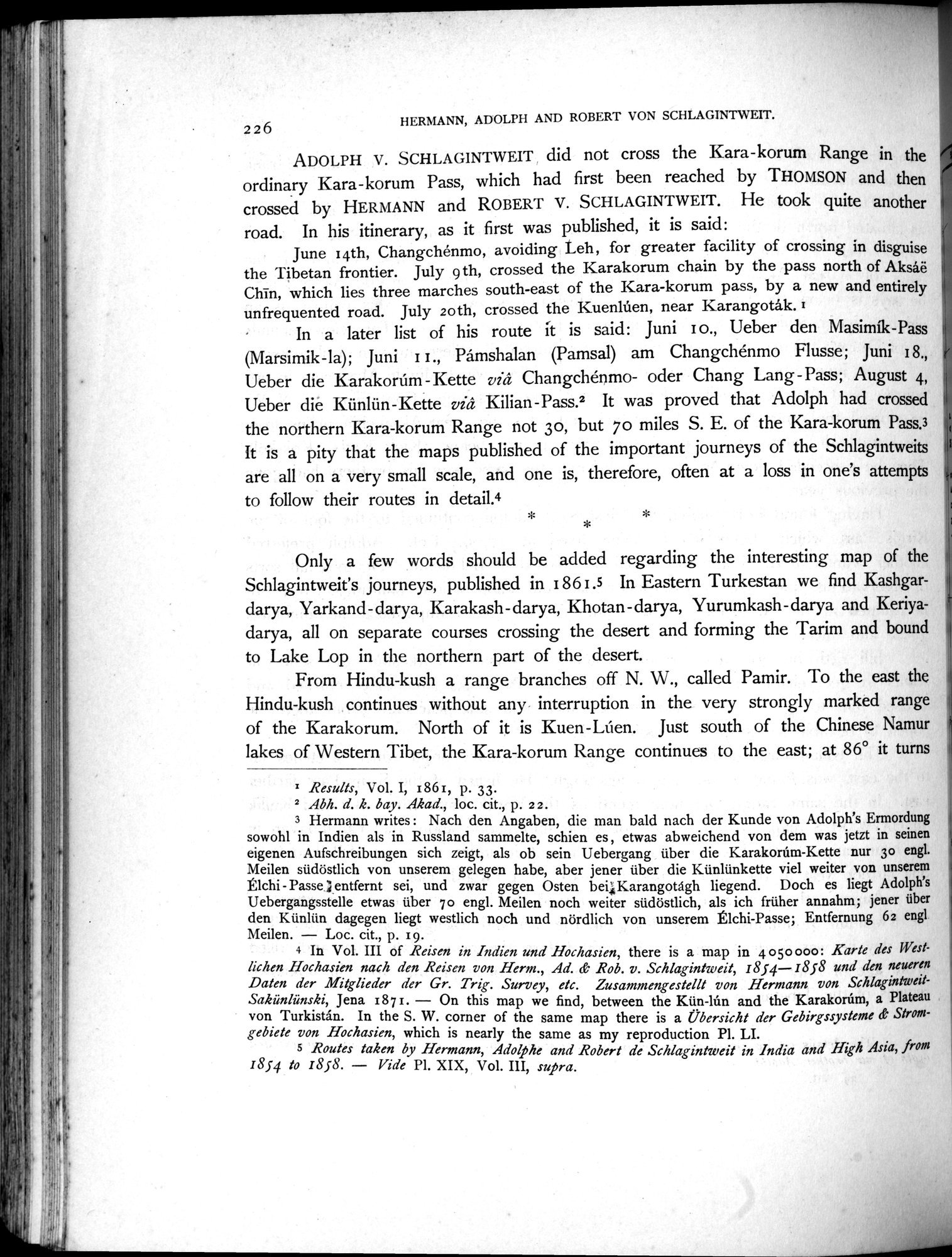
ADOLPH V. SCHLAGINTWEIT did not cross the Kara-korum Range in the ordinary Kara-korum Pass, which had first been reached by THWVISON and then crossed by HERMANN and ROBERT V. SCHLAGINTWEIT. He took quite another
road. In his itinerary, as it first was published, it is said:
June 14th, Changchénmo, avoiding Leh, for greater facility of crossing in disguise the Tibetan frontier. July 9th, crossed the Karakorum chain by the pass north of Aksåë Chin, which lies three marches south-east of the Kara-korum pass, by a new and entirely unfrequented road. July loth, crossed the Kuenlûen, near Karangotåk.
In a later list of his route it is said: Juni 1 o., Ueber den Masimik-Pass
(Marsimik-la); Juni 11., Påmshalan (Pamsal) am Changchénmo Flusse; Juni 18., y Ueber die Karakorum - Kette viz Changchénmo- oder Chang Lang-Pass; August 4, Ueber die Künlün-Kette viâ Kilian-Pass.2 It was proved that Adolph had crossed the northern Kara-korum Range not 3o, but 7o miles S. E. of the Kara-korum Pass.3 It is a pity that the maps published of the important journeys of the Schlagintweits are all on a very small scale, and one is, therefore, often at a loss in one's attempts to follow their routes in detail.4
~
Only a few words should be added regarding the interesting map of the Schlagintweit's journeys, published in 1861.5 In Eastern Turkestan we find Kashgardarya, Yarkand-darya, Karakash-darya, Khotan-darya, Yurumkash-darya and Keriyadarya, all on separate courses crossing the desert and forming the Tarim and bound to Lake Lop in the northern part of the desert.
From Hindu-kush a range branches off N. W., called Pamir. To the east the Hindu-kush continues without any interruption in the very strongly marked range of the Karakorum. North of it is Kuen-Lisen. Just south of the Chinese Namur lakes of Western Tibet, the Kara-korum Range continues to the east; at 86° it turns
I Results, Vol. I, 1861, p. 33.
2 Abh. d. k. bay. Akad., loc. cit., p. 22.
3 Hermann writes : Nach den Angaben, die man bald nach der Kunde von Adolph's Ermordung sowohl in Indien als in Russland sammelte, schien es, etwas abweichend von dem was jetzt in seinen eigenen Aufschreibungen sich zeigt, als ob sein Uebergang über die Karakorum-Kette nur 3o engl. Meilen südöstlich von unserem gelegen habe, aber jener über die Künlünkette viel weiter von unserem Élchi - Passe ;,entfernt sei, und zwar gegen Osten bei, Karangotagh liegend. Doch es liegt Adolph's Uebergangsstelle etwas über 7o engl. Meilen noch weiter südöstlich, als ich früher annahm; jener über den Künliin dagegen liegt westlich noch und nördlich von unserem lchi-Passe; Entfernung 62 engl Meilen. — Loc. cit., p. 19.
4 In Vol. III of Reisen in Indien und Hochasien, there is a map in 4 050 000: Karte des Westlichen Hochasien nach den Reisen von Herrn., Ad. c1î Rob. v. Schlagintzoeit, 1854-1858 und den neueren Daten der Mitglieder der Gr. Trig. Survey, etc. Zusammengestellt von Hermann von Schlagintu'eitSakiinliinski, Jena 1871. — On this map we find, between the Kiin-lien and the Karakorum, a Plateau von Turkistån. In the S. W. corner of the same map there is a Übersicht der Gebirgssysteme c . Stromgebiete von Hochasien, which is nearly the same as my reproduction Pl. LI.
5 Routes taken by Hermann, Adolphe and Robert de Schlagintweit in India and High Asia, from 1854 to 1S58. — Vide Pl. XIX, Vol. III, supra.
|
|
|
|
|
|
|
|
|
Copyright (C) 2003-2019
National Institute of Informatics(国立情報学研究所)
and
The Toyo Bunko(東洋文庫). All Rights Reserved.
本ウェブサイトに掲載するデジタル文化資源の無断転載は固くお断りいたします。