 IIIFカラー高解像度
国立情報学研究所 - ディジタル・シルクロード・プロジェクト
| |||||||||
|
| IIIFカラー高解像度 |
| Notes on Marco Polo : vol.2 | |
| マルコ=ポーロについての覚書 : vol.2 |
 |
 |
 |
 |
 |
 |
|
|
 |
|
|
|
|
|
|
|
|
引用情報
818 323. QUTAN-QUTANSUI
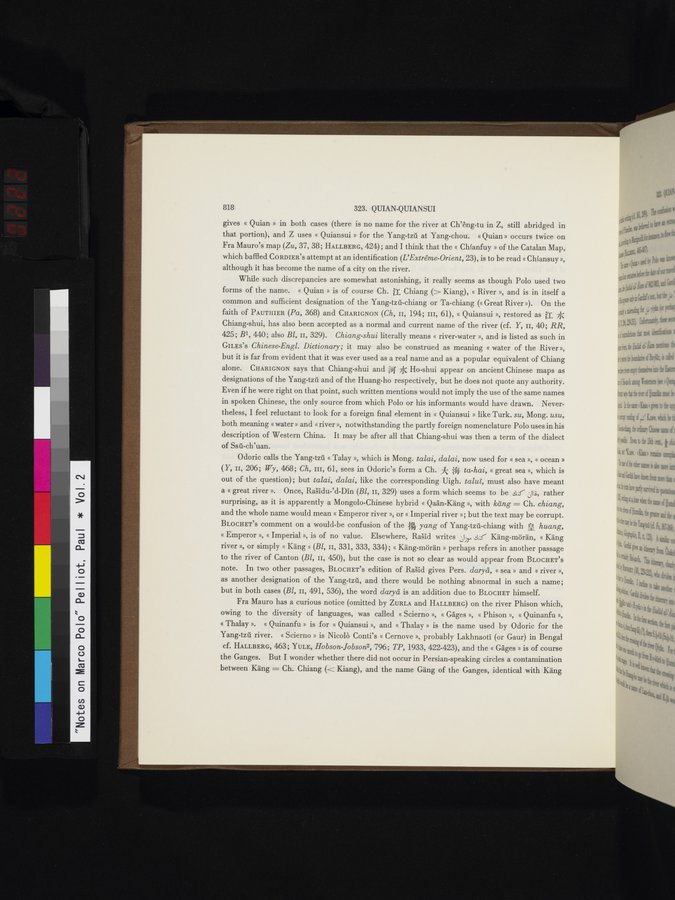
gives « Quian » in both cases (there is no name for the river at Ch'êng-tu in Z, still abridged in that portion), and Z uses « Quiansui » for the Yang-tzû at Yang-chou. « Quian » occurs twice on Fra Mauro's map (Zu, 37, 38; HALLBERG, 424); and I think that the « Chfanfuy » of the Catalan Map, which baffled CORDIER'S attempt at an identification (L'Extrême-Orient, 23), is to be read « Chfansuy », although it has become the name of a city on the river.
While such discrepancies are somewhat astonishing, it really seems as though Polo used two forms of the name. « Quian » is of course Ch. (1 Chiang (> Kiang), « River », and is in itself a common and sufficient designation of the Yang-tzû-chiang or Ta-chiang (« Great River »). On the faith of PAUTIIIER (Pa, 368) and CHARIGNON (Ch, II, 194; III, 61), « Quiansui », restored as 71 ,J` Chiang-shui, has also been accepted as a normal and current name of the river (cf. Y, II, 40; RR, 425; BI, 440; also Bl, II, 329). Chiang-shui literally means « river-water », and is listed as such in GILES's Chinese-Engl. Dictionary; it may also be construed as meaning « water of the River », but it is far from evident that it was ever used as a real name and as a popular equivalent of Chiang alone. CHARIGNON says that Chiang-shui and 7ûJ 4 Ho-shui appear on ancient Chinese maps as designations of the Yang-tzû and of the Huang-ho respectively, but he does not quote any authority. Even if he were right on that point, such written mentions would not imply the use of the same names in spoken Chinese, the only source from which Polo or his informants would have drawn. Nevertheless, I feel reluctant to look for a foreign final element in « Quiansui » like Turk. su, Mong. usu, both meaning « water » and « river », notwithstanding the partly foreign nomenclature Polo uses in his description of Western China. It may be after all that Chiang-shui was then a term of the dialect of Ssii-ch'uan.
Odoric calls the Yang-tzti « Talay », which is Mong. talai, dalai, now used for « sea », « ocean »
( Y, II, 206; Wy, 468; Ch, III, 61, sees in Odoric's form a Ch. - ta-hai, « great sea », which is
out of the question) ; but talai, dalai, like the corresponding Uigh. talui, must also have meant a « great river ». Once, Rasidu-'d-Din (Bl, II, 329) uses a form which seems to be. L( 3119, rather surprising, as it is apparently a Mongolo-Chinese hybrid « Qaan-Käng », with käng = Ch. chiang, and the whole name would mean « Emperor river », or « Imperial river »; but the text may be corrupt.
BLOCHET'S comment on a would-be confusion of the #g yang of Yang-tzii-chiang with huang,
Emperor », « Imperial », is of no value. Elsewhere, Raid writes ù1,r. Käng-mörän, « Käng
river », or simply « Käng » (Bl, II, 331, 333, 334) ; « Käng-mörän » perhaps refers in another passage to the river of Canton (Bl, II, 450), but the case is not so clear as would appear from BLOCHET'S note. In two other passages, BLOCHET'S edition of Raid gives Pers. daryd, « sea » and « river », as another designation of the Yang-tzû, and there would be nothing abnormal in such a name; but in both cases (Bl, II, 491, 536), the word daryâ is an addition due to BLOCHET himself.
Fra Mauro has a curious notice (omitted by ZURLA and HALLBERG) on the river Phison which, owing to the diversity of languages, was called « Scierno », « Gages », « Phison », « Quinanfu », « Thalay ». « Quinanfu » is for « Quiansui », and « Thalay » is the name used by Odoric for the Yang-tzû river. « Scierno » is Nicole) Conti's « Cernove », probably Lakhnaoti (or Gaur) in Bengal
cf. HALLBERG, 463; YULE, Hobson-Jobson2, 796; TP, 1933, 422-423), and the « Gages » is of course the Ganges. But I wonder whether there did not occur in Persian-speaking circles a contamination between Käng = Ch. Chiang (< Kiang), and the name Gang of the Ganges, identical with Käng
|
|
|
|
|
|
|
|
|
Copyright (C) 2003-2019
National Institute of Informatics(国立情報学研究所)
and
The Toyo Bunko(東洋文庫). All Rights Reserved.
本ウェブサイトに掲載するデジタル文化資源の無断転載は固くお断りいたします。