 IIIF Color HighRes
National Institute of Informatics - Digital Silk Road Project
| |||||||||
|
| IIIF Color HighRes |
| Southern Tibet : vol.7 |
 |
 |
 |
 |
 |
 |
|
|
 |
|
|
|
|
|
|
|
|
Citation Information
38
BENEDICT GOES.
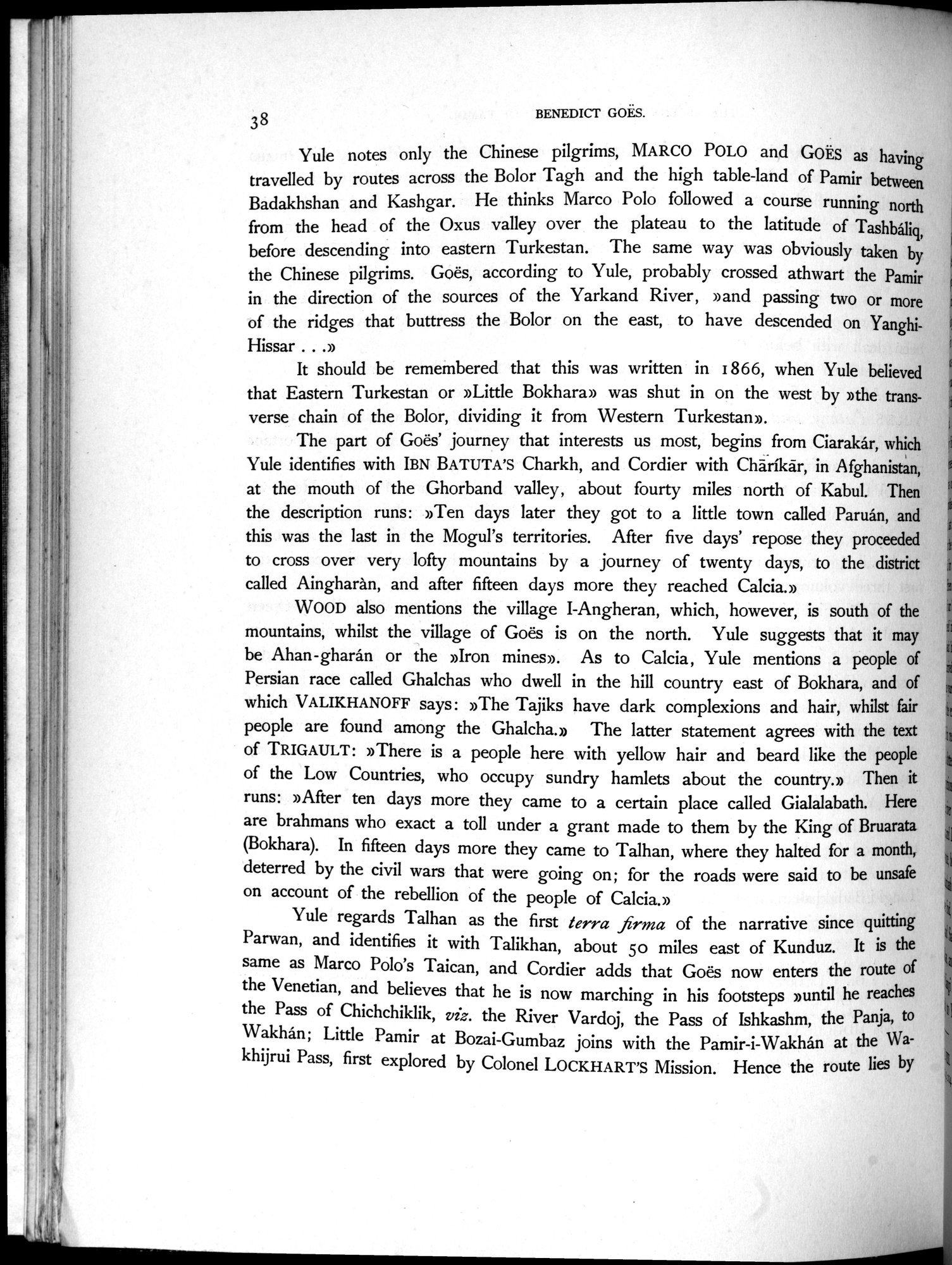
Yule notes only the Chinese pilgrims, MARCO POLO and GOES as having travelled by routes across the Bolor Tagh and the high table-land of Pamir between Badakhshan and Kashgar. He thinks Marco Polo followed a course running north from the head of the Oxus valley over the plateau to the latitude of Tashbåliq, before descending into eastern Turkestan. The same way was obviously taken by the Chinese pilgrims. Goës, according to Yule, probably crossed athwart the Pamir in the direction of the sources of the Yarkand River, »and passing two or more of the ridges that buttress the Bolor on the east, to have descended on Yanghi-
Hissar ...»
It should be remembered that this was written in i 866, when Yule believed that Eastern Turkestan or »Little Bokhara» was shut in on the west by »the transverse chain of the Bolor, dividing it from Western Turkestan».
The part of Goës' journey that interests us most, begins from Ciarakår, which Yule identifies with IBN BATUTA'S Charkh, and Cordier with Chårikår, in Afghanistan, at the mouth of the Ghorband valley, about fourty miles north of Kabul. Then the description runs : »Ten days later they got to a little town called Paruån, and this was the last in the Mogul's territories. After five days' repose they proceeded to cross over very lofty mountains by a journey of twenty days, to the district called Aingharàn, and after fifteen days more they reached Calcia.»
WOOD also mentions the village I-Angheran, which, however, is south of the mountains, whilst the village of Goës is on the north. Yule suggests that it may be Ahan-gharån or the »Iron mines». As to Calcia, Yule mentions a people of Persian race called Ghalchas who dwell in the hill country east of Bokhara, and of which VALIKHANOFF says : »The Tajiks have dark complexions and hair, whilst fair people are found among the Ghalcha.» The latter statement agrees with the text of TRIGAULT: »There is a people here with yellow hair and beard like the people of the Low Countries, who occupy sundry hamlets about the country.» Then it runs: »After ten days more they came to a certain place called Gialalabath. Here are brahmans who exact a toll under a grant made to them by the King of Bruarata (Bokhara). In fifteen days more they came to Talhan, where they halted for a month, deterred by the civil wars that were going on ; for the roads were said to be unsafe on account of the rebellion of the people of Calcia.»
Yule regards Talhan as the first terra firma of the narrative since quitting Parwan, and identifies it with Talikhan, about 5o miles east of Kunduz. It is the same as Marco Polo's Taican, and Cordier adds that Goës now enters the route of the Venetian, and believes that he is now marching in his footsteps »until he reaches the Pass of Chichchiklik, viz. the River Vardoj, the Pass of Ishkashm, the Panja, to Wakhan; Little Pamir at Bozai-Gumbaz joins with the Pamir-i-Wakhån at the Wakhijrui Pass, first explored by Colonel LOCKHART'S Mission. Hence the route lies by
|
|
|
|
|
|
|
|
|
Copyright (C) 2003-2019 National Institute of Informatics and The Toyo Bunko. All Rights Reserved.