 IIIF Color HighRes
National Institute of Informatics - Digital Silk Road Project
| |||||||||
|
| IIIF Color HighRes |
| Southern Tibet : vol.7 |
 |
 |
 |
 |
 |
 |
|
|
 |
|
|
|
|
|
|
|
|
Citation Information
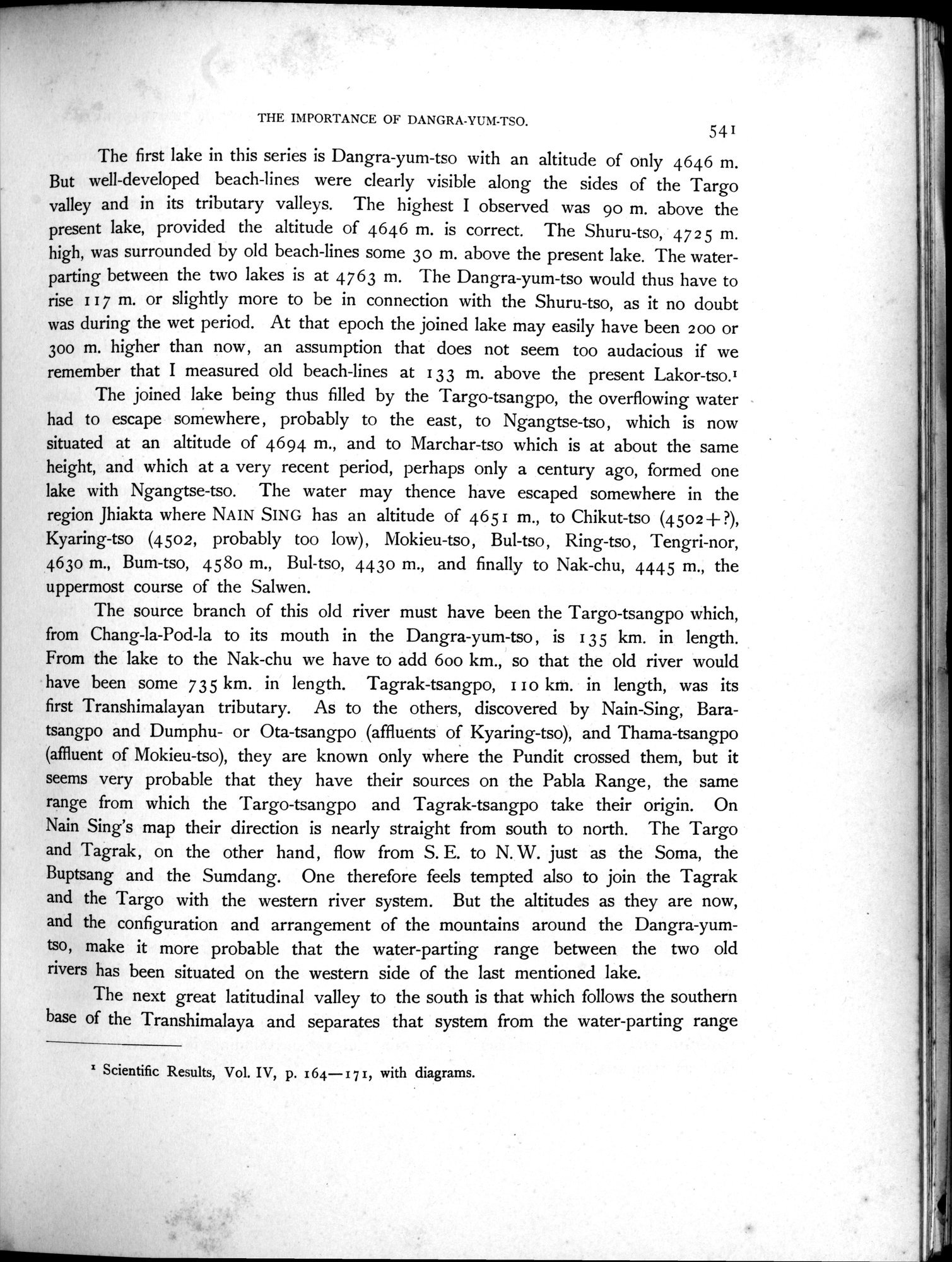
| THE IMPORTANCE OF DANGRA-YUM-TSO. 54' The first lake in this series is Dangra-yum-tso with an altitude of only 4646 m. But well-developed beach-lines were clearly visible along the sides of the Targo valley and in its tributary valleys. The highest I observed was 90 m. above the present lake, provided the altitude of 4646 m. is correct. The Shuru-tso, 4725 m. high, was surrounded by old beach-lines some 3o m. above the present lake. The water-parting between the two lakes is at 4763 m. The Dangra-yum-tso would thus have to rise I I7 m. or slightly more to be in connection with the Shuru-tso, as it no doubt was during the wet period. At that epoch the joined lake may easily have been 200 or 300 m. higher than now, an assumption that does not seem too audacious if we remember that I measured old beach-lines at 133 m. above the present Lakor-tso. I The joined lake being thus filled by the Targo-tsangpo, the overflowing water had to escape somewhere, probably to the east, to Ngangtse-tso, which is now situated at an altitude of 4694 m., and to Marchar-tso which is at about the same height, and which at a very recent period, perhaps only a century ago, formed one lake with Ngangtse-tso. The water may thence have escaped somewhere in the region Jhiakta where NAIN SING has an altitude of 4651 m., to Chikut-tso (4502 + ?), Kyaring-tso (4502, probably too low), Mokieu-tso, Bul-tso, Ring-tso, Tengri-nor, 4630 m., Bum-tso, 4580 m., Bul-tso, 4430 m., and finally to Nak-chu, 4445 m., the uppermost course of the Salwen. The source branch of this old river must have been the Targo-tsangpo which, from Chang-la-Pod-la to its mouth in the Dangra-yum-tso , is 135 km. in length. From the lake to the Nak-chu we have to add 600 km., so that the old river would have been some 735 km. in length. Tagrak-tsangpo, I I o km. in length, was its first Transhimalayan tributary. As to the others, discovered by Nain-Sing, Baratsangpo and Dumphu- or Ota-tsangpo (affluents of Kyaring-tso), and Thama-tsangpo (affluent of Mokieu-tso), they are known only where the Pundit crossed them, but it seems very probable that they have their sources on the Pabla Range, the same range from which the Targo-tsangpo and Tagrak-tsangpo take their origin. On Nain Sing's map their direction is nearly straight from south to north. The Targo and Tagrak, on the other hand, flow from S. E. to N. W. just as the Soma, the Buptsang and the Sumdang. One therefore feels tempted also to join the Tagrak and the Targo with the western river system. But the altitudes as they are now, and the configuration and arrangement of the mountains around the Dangra-yumtso, make it more probable that the water-parting range between the two old rivers has been situated on the western side of the last mentioned lake. The next great latitudinal valley to the south is that which follows the southern base of the Transhimalaya and separates that system from the water-parting range I Scientific Results, Vol. IV, p. 164-171, with diagrams. | ||||
|
|
|
|
|
|
|
|
|
Copyright (C) 2003-2019 National Institute of Informatics and The Toyo Bunko. All Rights Reserved.