 IIIF Color HighRes
National Institute of Informatics - Digital Silk Road Project
| |||||||||
|
| IIIF Color HighRes |
| Southern Tibet : vol.7 |
 |
 |
 |
 |
 |
 |
|
|
 |
|
|
|
|
|
|
|
|
Citation Information
THE DECADE 1818-1828.
i
34
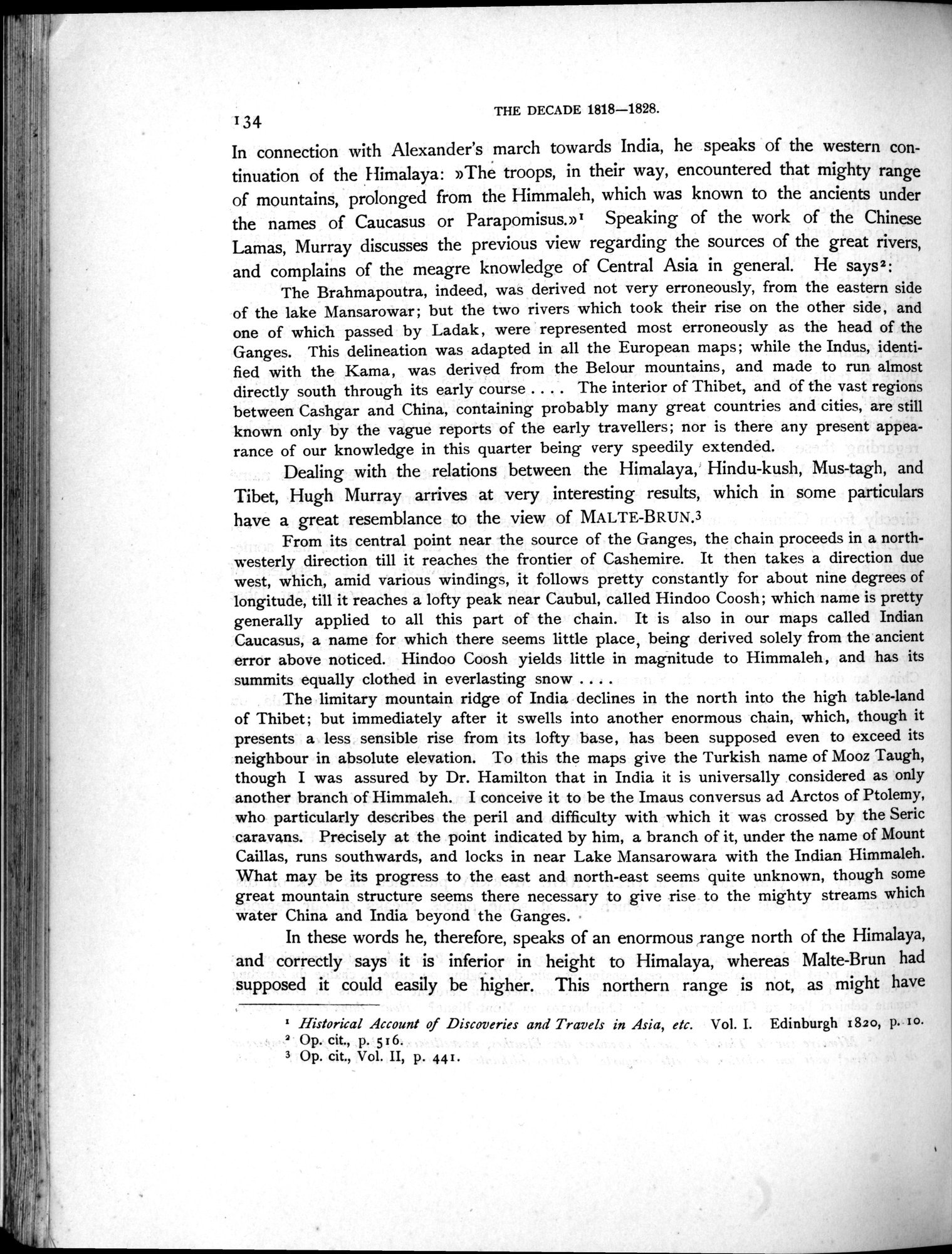
In connection with Alexander's march towards India, he speaks of the western continuation of the Himalaya: »The troops, in their way, encountered that mighty range of mountains, prolonged from the Himmaleh, which was known to the ancients under the names of Caucasus or Parapomisus.» I Speaking of the work of the Chinese Lamas, Murray discusses the previous view regarding the sources of the great rivers,
and complains of the meagre knowledge of Central Asia in general. He says 2:
The Brahmapoutra, indeed, was derived not very erroneously, from the eastern side of the lake Mansarowar; but the two rivers which took their rise on the other side, and one of which passed by Ladak , were represented most erroneously as the head of the Ganges. This delineation was adapted in all the European maps; while the Indus, identified with the Kama, was derived from the Belour mountains, and made to run almost directly south through its early course .... The interior of Thibet, and of the vast regions between Cashgar and China, containing probably many great countries and cities, are still known only by the vague reports of the early travellers; nor is there any present appearance of our knowledge in this quarter being very speedily extended.
Dealing with the relations between the Himalaya, Hindu-kush, Mus-tagh, and Tibet, Hugh Murray arrives at very interesting results, which in some particulars
have a great resemblance to the view of MALTE-BRUN.3
From its central point near the source of the Ganges, the chain proceeds in a northwesterly direction till it reaches the frontier of Cashemire. It then takes a direction due west, which, amid various windings, it follows pretty constantly for about nine degrees of longitude, till it reaches a lofty peak near Caubul, called Hindoo Coosh; which name is pretty generally applied to all this part of the chain. It is also in our maps called Indian Caucasus, a name for which there seems little place, being derived solely from the ancient error above noticed. Hindoo Coosh yields little in magnitude to Himmaleh , and has its summits equally clothed in everlasting snow ... .
The limitary mountain ridge of India declines in the north into the high table-land of Thibet ; but immediately after it swells into another enormous chain, which, though it presents a less sensible rise from its lofty base, has been supposed even to exceed its neighbour in absolute elevation. To this the maps give the Turkish name of Mooz Taugh, though I was assured by Dr. Hamilton that in India it is universally considered as only another branch of Himmaleh. I conceive it to be the Imaus conversus ad Arctos of Ptolemy, who particularly describes the peril and difficulty with which it was crossed by the Seric caravans. Precisely at the point indicated by him, a branch of it, under the name of Mount Caillas, runs southwards, and locks in near Lake Mansarowara with the Indian Himmaleh. What may be its progress to the east and north-east seems quite unknown, though some great mountain structure seems there necessary to give rise to the mighty streams which water China and India beyond the Ganges.
In these words he, therefore, speaks of an enormous range north of the Himalaya, and correctly says it is inferior in height to Himalaya, whereas Malte-Brun had supposed it could easily be higher. This northern range is not, as might have
I Historical Account of Discoveries and Travels in Asia, etc. Vol. I. Edinburgh 182o, p. Io. ' Op. cit., p. 516.
3 Op. cit., Vol. II, p. 441.
|
|
|
|
|
|
|
|
|
Copyright (C) 2003-2019 National Institute of Informatics and The Toyo Bunko. All Rights Reserved.