 IIIF Color HighRes
National Institute of Informatics - Digital Silk Road Project
| |||||||||
|
| IIIF Color HighRes |
| Southern Tibet : vol.7 |
 |
 |
 |
 |
 |
 |
|
|
 |
|
|
|
|
|
|
|
|
Citation Information
DELLA PENNA. ô „
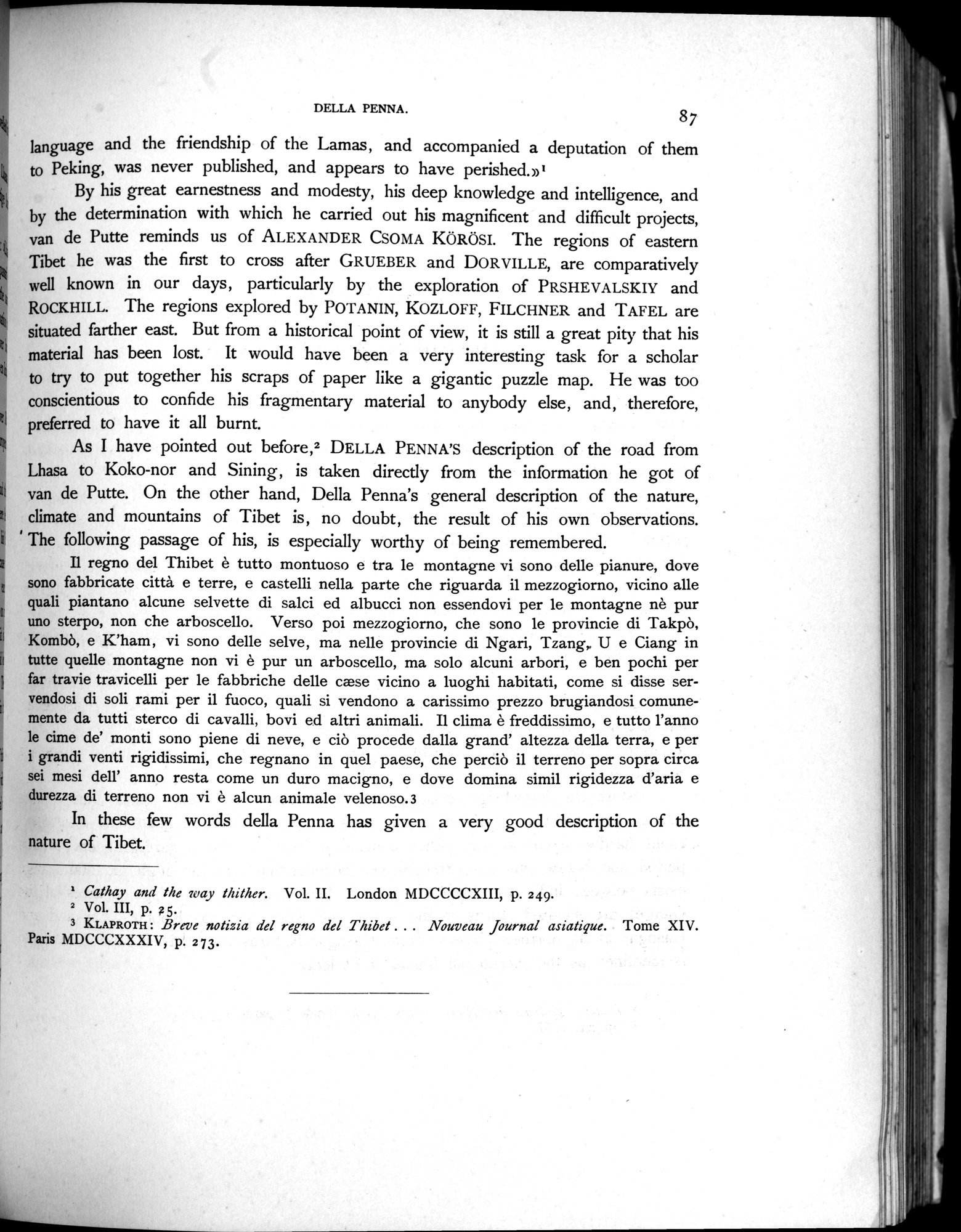
language and the friendship of the Lamas, and accompanied a deputation of them
to Peking, was never published, and appears to have perished.»'
By his great earnestness and modesty, his deep knowledge and intelligence, and
by the determination with which he carried out his magnificent and difficult projects,
;i van de Putte reminds us of ALEXANDER CSONIA KÜROSI. The regions of eastern
Tibet he was the first to cross after GRUEBER and DORVILLE, are comparatively
well known in our days, particularly by the exploration of PRSHEVALSKIY and
ROCKHILL. The regions explored by POTANIN, KOZLOFF, FILCHNER and TAFEL are
situated farther east. But from a historical point of view, it is still a great pity that his
material has been lost. It would have been a very interesting task for a scholar
to try to put together his scraps of paper like a gigantic puzzle map. He was too
conscientious to confide his fragmentary material to anybody else, and, therefore,
preferred to have it all burnt.
As I have pointed out before,2 DELLA PENNA'S description of the road from
Lhasa to Koko-nor and Sining, is taken directly from the information he got of
van de Putte. On the other hand, Della Penna's general description of the nature,
climate and mountains of Tibet is, no doubt, the result of his own observations.
The following passage of his, is especially worthy of being remembered.
Il regno del Thibet è tutto montuoso e tra le montagne vi sono delle pianure, dove sono fabbricate città e terre, e castelli nella parte the riguarda il mezzogiorno, vicino alle quali piantano alcune selvette di salci ed albucci non essendovi per le montagne nè pur uno sterpo, non the arboscello. Verso poi mezzogiorno, the sono le provincie di Takpè, Kombb, e K'ham, vi sono delle selve, ma nelle provincie di Ngari, Tzang,. U e Ciang in tutte quelle montagne non vi è pur un arboscello, ma solo alcuni arbori, e ben pochi per far travie travicelli per le fabbriche delle case vicino a luoghi habitati, come si disse servendosi di soli rami per il fuoco, quali si vendono a carissimo prezzo brugiandosi comunemente da tutti stereo di cavalli, bovi ed altri animali. Il clima è freddissimo, e tutto l'anno le cime de' monti sono piene di neve, e ciè procede dalla grand' altezza della terra, e per
i grandi venti rigidissimi, the regnano in quel paese, the perciè il terreno per sopra circa
r,
sei mesi dell' anno resta come un duro macigno, e dove domina simil rigidezza d'aria e durezza di terreno non vi è alcun animale velenoso. 3
In these few words della Penna has given a very good description of the
nature of Tibet.
1!n
1 Cathay and the way thither. Vol. II. London MDCCCCXIII, p. 249.
2 Vol. III, p. 25.
3 KLAPROTH : Breve notizia del regno del Thibet ... Nouveau Journal asiatique. Tome XIV. Paris MDCCCXXXIV, p. 273.
|
|
|
|
|
|
|
|
|
Copyright (C) 2003-2019 National Institute of Informatics and The Toyo Bunko. All Rights Reserved.