 IIIF Color HighRes
National Institute of Informatics - Digital Silk Road Project
| |||||||||
|
| IIIF Color HighRes |
| Southern Tibet : vol.7 |
 |
 |
 |
 |
 |
 |
|
|
 |
|
|
|
|
|
|
|
|
Citation Information
I I
216
THE VERACITY OF HUC.-LASSEN.
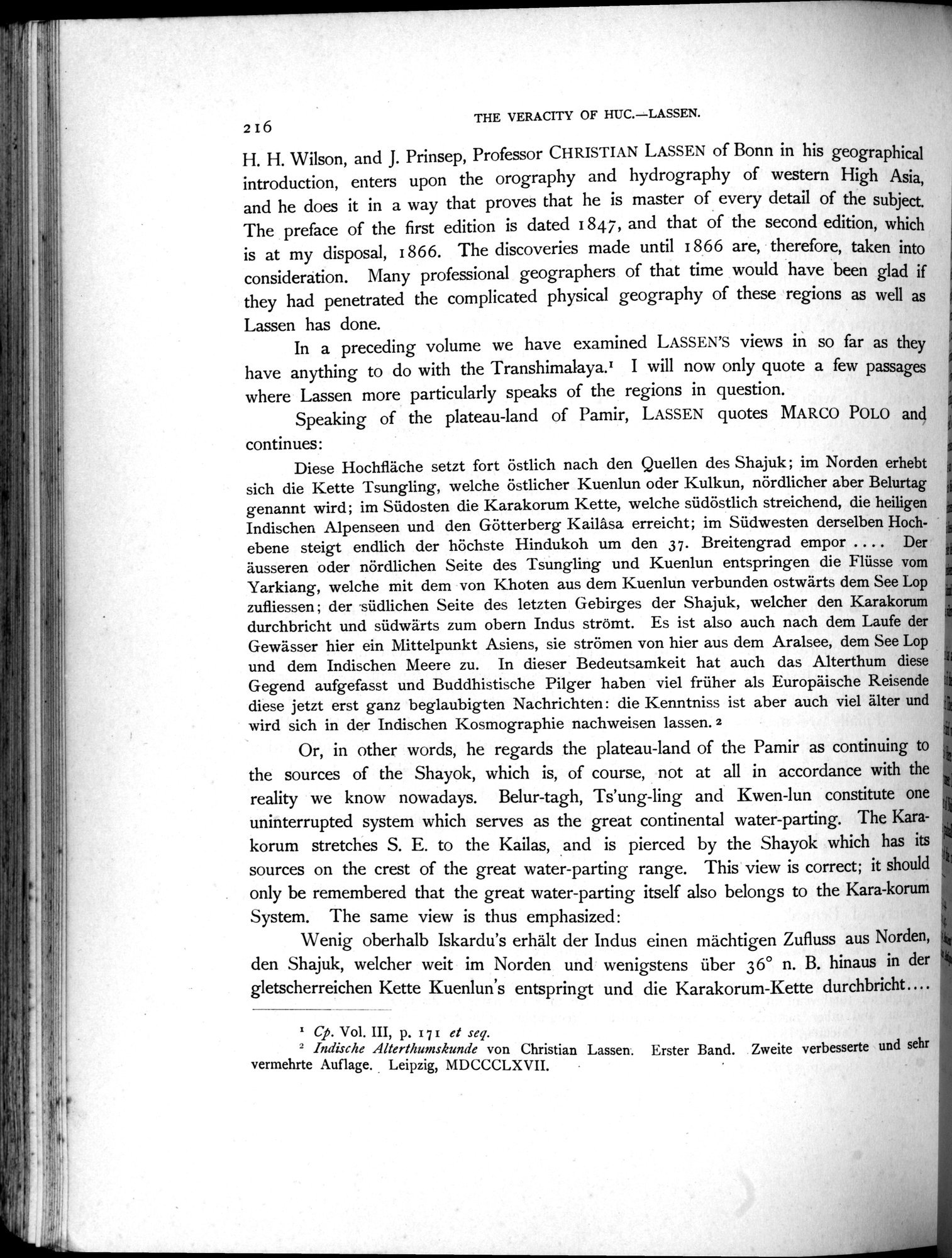
H. H. Wilson, and J. Prinsep, Professor CHRISTIAN LASSEN of Bonn in his geographical introduction, enters upon the orography and hydrography of western High Asia, and he does it in a way that proves that he is master of every detail of the subject. The preface of the first edition is dated 1847, and that of the second edition, which is at my disposal, 1866. The discoveries made until 1866 are, therefore, taken into consideration. Many professional geographers of that time would have been glad if they had penetrated the complicated physical geography of these regions as well as
Lassen has done.
In a preceding volume we have examined LASSEN'S views in so far as they
have anything to do with the Transhimalaya.' I will now only quote a few passages where Lassen more particularly speaks of the regions in question.
Speaking of the plateau-land of Pamir, LASSEN quotes MARCO POLO and continues:
Diese Hochfläche setzt fort östlich nach den Quellen des Shajuk ; im Norden erhebt sich die Kette Tsungling, welche östlicher Kuenlun oder Kulkun, nördlicher aber Belurtag genannt wird ; im Südosten die Karakorum Kette, welche südöstlich streichend, die heiligen Indischen Alpenseen und den Götterberg Kailâsa erreicht; im Südwesten derselben Hochebene steigt endlich der höchste Hindukoh um den 3 7. Breitengrad empor .... Der äusseren oder nördlichen Seite des Tsungling und Kuenlun entspringen die Flüsse vom Yarkiang, welche mit dem von Khoten aus dem Kuenlun verbunden ostwärts dem See Lop zufliessen ; der südlichen Seite des letzten Gebirges der Shajuk, welcher den Karakorum durchbricht und südwärts zum obern Indus strömt. Es ist also auch nach dem Laufe der Gewässer hier ein Mittelpunkt Asiens, sie strömen von hier aus dem Aralsee, dem See Lop und dem Indischen Meere zu. In dieser Bedeutsamkeit hat auch das Alterthum diese Gegend aufgefasst und Buddhistische Pilger haben viel früher als Europäische Reisende diese jetzt erst ganz beglaubigten Nachrichten : die Kenntniss ist aber auch viel älter und wird sich in der Indischen Kosmographie nachweisen lassen. 2
Or, in other words, he regards the plateau-land of the Pamir as continuing to the sources of the Shayok, which is, of course, not at all in accordance with the reality we know nowadays. Belur-tagh, Ts'ung-ling and Kwen-lun constitute one uninterrupted system which serves as the great continental water-parting. The Karakorum stretches S. E. to the Kailas, and is pierced by the Shayok which has its sources on the crest of the great water-parting range. This view is correct; it should only be remembered that the great water-parting itself also belongs to the Kara-korum System. The same view is thus emphasized:
Wenig oberhalb Iskardu's erhält der Indus einen mächtigen Zufluss aus Norden, den Shajuk, welcher weit im Norden und wenigstens über 36° n. B. hinaus in der gletscherreichen Kette Kuenlun's entspringt und die Karakorum-Kette durchbricht....
I Cp. Vol. III, p. 171 et seq.
2 Indische Alterthumskunde von Christian Lassen. Erster Band. Zweite verbesserte und sehr vermehrte Auflage. Leipzig, MDCCCLXVII.
|
|
|
|
|
|
|
|
|
Copyright (C) 2003-2019 National Institute of Informatics and The Toyo Bunko. All Rights Reserved.