 IIIFカラー高解像度
国立情報学研究所 - ディジタル・シルクロード・プロジェクト
| |||||||||
|
| IIIFカラー高解像度 |
| Southern Tibet : vol.7 | |
| 南チベット : vol.7 |
 |
 |
 |
 |
 |
 |
|
|
 |
|
|
|
|
|
|
|
|
引用情報
|
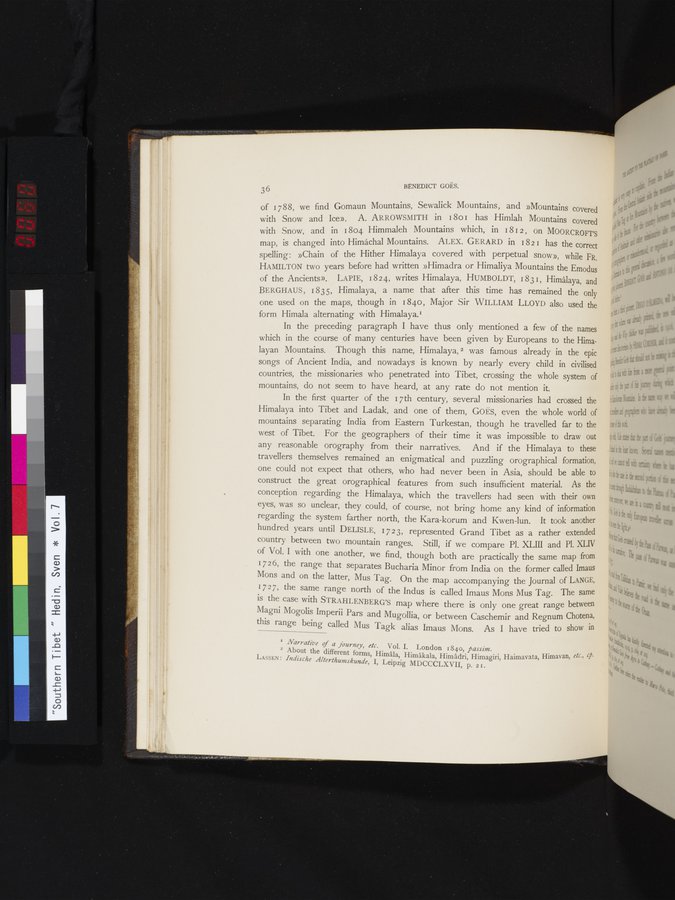
| 36 BENEDICT GOES. of 1788, we find Gomaun Mountains, Sewalick Mountains, and »Mountains covered with Snow and Ice». A. ARROWSMITH in 18o I has Himlah Mountains covered with Snow, and in 1804 Himmaleh Mountains which, in 1812, on MOORCROFT'S map, is changed into Himachal Mountains. ALEX. GERARD in 1821 has the correct spelling: »Chain of the Hither Himalaya covered with perpetual snow», while FR. HAMILTON two years before had written »Himadra or Himaliya Mountains the Emodus of the Ancients». LAPIE, 18 2 4, writes Himalaya, HUMBOLDT, 18 3 1, Himâlaya, and BERGHAUS , 1835, Himalaya, a name that after this time has remained the only one used on the maps, though in 1840, Major Sir WILLIAM LLOYD also used the form Himala alternating with Himalaya.' In the preceding paragraph I have thus only mentioned a few of the names which in the course of many centuries have been given by Europeans to the Himalayan Mountains. Though this name, Himalaya, 2 was famous already in the epic songs of Ancient India, and nowadays is known by nearly every child in civilised countries, the missionaries who penetrated into Tibet, crossing the whole system of mountains, do not seem to have heard, at any rate do not mention it. In the first quarter of the 17th century, several missionaries had crossed the Himalaya into Tibet and Ladak, and one of them, GOES, even the whole world of mountains separating India from Eastern Turkestan, though he travelled far to the west of Tibet. For the geographers of their time it was impossible to draw out any reasonable orography from their narratives. And if the Himalaya to these travellers themselves remained an enigmatical and puzzling orographical formation, one could not expect that others, who had never been in Asia, should be able to construct the great orographical features from such insufficient material. As the conception regarding the Himalaya, which the travellers had seen with their own eyes, was so unclear, they could, of course, not bring home any kind of information regarding the system farther north, the Kara-korum and Kwen-lun. It took another hundred years until DELISLE, 17 2 3, represented Grand Tibet as a rather extended country between two mountain ranges. Still, if we compare Pl. XLIII and PI. XLIV of Vol. I with one another, we find, though both are practically the same map from 17 2 6, the range that separates Bucharia Minor from India on the former called Imaus Mons and on the latter, Mus Tag. On the map accompanying the Journal of LANGE, 17 2 7, the same range north of the Indus is called Imaus Mons Mus Tag. The same is the case with STRAHLENBERG'S map where there is only one great range between Magni Mogolis Imperii Pars and Mugollia, or between Caschemir and Regnum Chotena, this range being called Mus Tagk alias Imaus Mons. As I have tried to show in | |||||
| I Narrative of a journey, etc. Vol. I. London i 840, passim. 2 About the different forms, Himâla, Himâkala, Himâdri, Himagiri, Haimavata, Himavan, etc., q. LASSEN: Indische Alterthumskunde, I, Leipzig MDCCCLXVII, p. 2 I. | ||||||
| i | ||||||
|
|
|
|
|
|
|
|
|
Copyright (C) 2003-2019
National Institute of Informatics(国立情報学研究所)
and
The Toyo Bunko(東洋文庫). All Rights Reserved.
本ウェブサイトに掲載するデジタル文化資源の無断転載は固くお断りいたします。