 IIIFカラー高解像度
国立情報学研究所 - ディジタル・シルクロード・プロジェクト
| |||||||||
|
| IIIFカラー高解像度 |
| Southern Tibet : vol.7 | |
| 南チベット : vol.7 |
 |
 |
 |
 |
 |
 |
|
|
 |
|
|
|
|
|
|
|
|
引用情報
GROMBTCHEVSKII".
r.
357
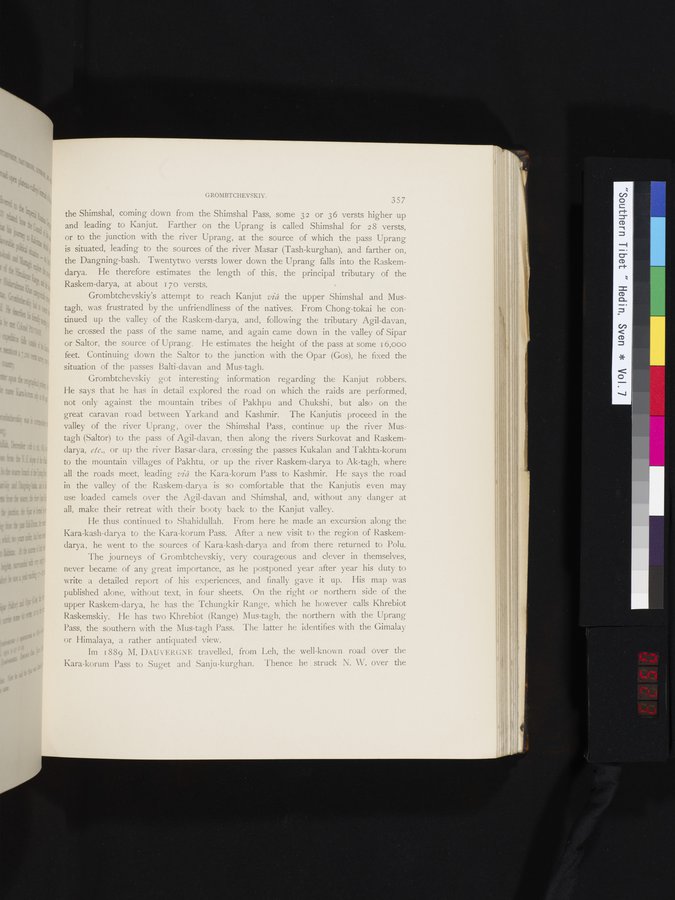
the Shimshal, coming down from the Shimshal Pass, some 32 or 36 versts higher up and leading to Kanjut. Farther on the Uprang is called Shimshal for 28 versts, or to the junction with the river Uprang, at the source of which the pass Uprang is situated, leading to the sources of the river Masar (Tash-kurghan), and farther on, the Dangning-bash. Twentytwo versts lower down the Uprang falls into the Raskemdarya. He therefore estimates the length of this, the principal tributary of the Raskem-darya, at about 170 versts.
Grombtchevskiy's attempt to reach Kanjut viâ the upper Shimshal and Mustagh, was frustrated by the unfriendliness of the natives. From Chong-tokai he continued up the valley of the Raskem-darya, and, following the tributary Agil-davan, he crossed the pass of the same name, and again came down in the valley of Sipar or Saltor, the source of Uprang. He estimates the height of the pass at some 16,000 feet. Continuing down the Saltor to the junction with the Opar (Gos), he fixed the situation of the passes Balti-davan and Mus-tagh.
Grombtchevskiy got interesting information regarding the Kanjut robbers. He says that he has in detail explored the road on which the raids are performed, not only against the mountain tribes of Pakhpu and Chukshi, but also on the great caravan road between Yarkand and Kashmir. The Kanjutis proceed in the valley of the river Uprang, over the Shimshal Pass, continue up the river Mustagh (Saltor) to the pass of Agil-davan, then along the rivers Surkovat and Raskemdarya, etc., or up the river Basar-dara, crossing the passes Kukalan and Takhta-korum to the mountain villages of Pakhtu, or up the river Raskem-darya to Ak-tagh, where all the roads meet, leading viâ the Kara-korum Pass to Kashmir. He says the road in the valley of the Raskem-darya is so comfortable that the Kanjutis even may use loaded camels over the Agil-davan and Shimshal, and, without any danger at all, make their retreat with their booty back to the Kanjut valley.
He thus continued to Shahidullah. From here he made an excursion along the Kara-kash-darya to the Kara-korum Pass. After a new visit to the region of Raskemdarya, he went to the sources of Kara-kash-darya and from there returned to Polu.
The journeys of Grombtchevskiy, very courageous and clever in themselves, never became of any great importance, as he postponed year after year his duty to write a detailed report of his experiences, and finally gave it up. His map was published alone, without text, in four sheets. On the right or northern side of the upper Raskem-darya, he has the Tchungkir Range, which he however calls Khrebiot Raskemskiy. He has two Khrebiot (Range) Mus-tagh, the northern with the Uprang Pass, the southern with the Mus-tagh Pass. The latter he identifies with the Gimalay or Himalaya, a rather antiquated view.
Im 1889 M. DAU ERGNE travelled, from Leh, the well-known road over the Kara-korum Pass to Suget and Sanju-kurghan. "Thence he struck N. W. over the
|
|
|
|
|
|
|
|
|
Copyright (C) 2003-2019
National Institute of Informatics(国立情報学研究所)
and
The Toyo Bunko(東洋文庫). All Rights Reserved.
本ウェブサイトに掲載するデジタル文化資源の無断転載は固くお断りいたします。