 IIIFカラー高解像度
国立情報学研究所 - ディジタル・シルクロード・プロジェクト
| |||||||||
|
| IIIFカラー高解像度 |
| Southern Tibet : vol.7 | |
| 南チベット : vol.7 |
 |
 |
 |
 |
 |
 |
|
|
 |
|
|
|
|
|
|
|
|
引用情報
AN ITINERARY FROM AKSU TO LADAR.
297
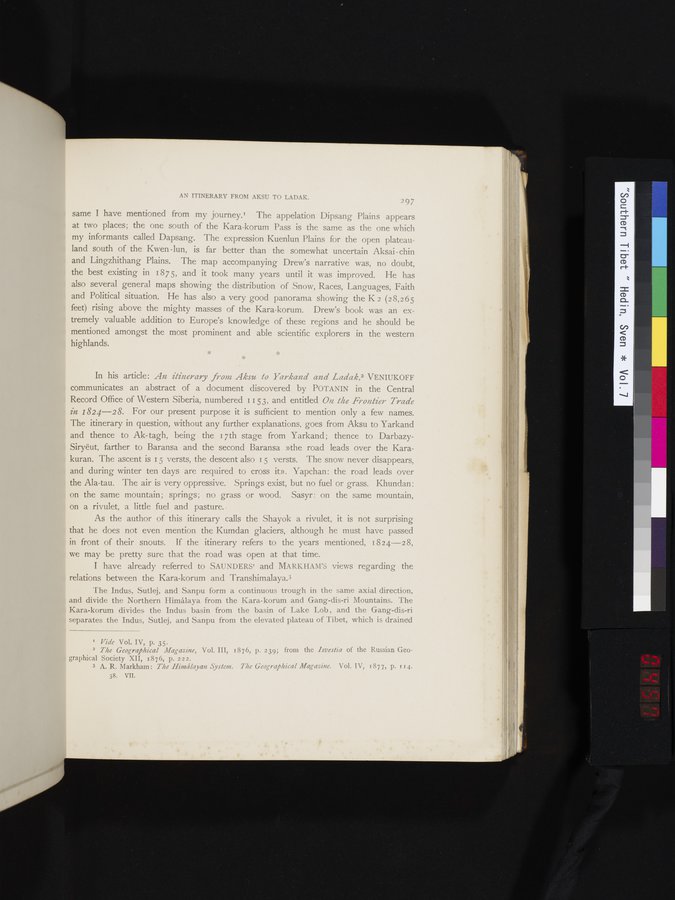
same I have mentioned from my journey.' The appelation Dipsang Plains appears at two places; the one south of the Kara-korum Pass is the same as the one which my informants called Dapsang. The expression Kuenlun Plains for the open plateau-land south of the Kwen - lun, is far better than the somewhat uncertain Aksai-chin and Lingzhithang Plains. The map accompanying Drew's narrative was, no doubt, the best existing in 1875, and it took many years until it was improved. He has also several general maps showing the distribution of Snow, Races, Languages, Faith and Political situation. He has also a very good panorama showing the K 2 (28,265 feet) rising above the mighty masses of the Kara-korum. Drew's book was an extremely valuable addition to Europe's knowledge of these regions and he should be mentioned amongst the most prominent and able scientific explorers in the western highlands.
In his article: An itinerary from Aksu to Yarkand and Ladak,2 VENIUKOFF communicates an abstract of a document discovered by POTANIN in the Central Record Office of Western Siberia, numbered 1153, and entitled On the Frontier Trade in 1824-28. For our present purpose it is sufficient to mention only a few names. The itinerary in question, without any further explanations, goes from Aksu to Yarkand and thence to Ak-tagh, being the 17th stage from Yarkand ; thence to DarbazySiryëut, farther to Baransa and the second Baransa »the road leads over the Karakuran. The ascent is 15 versts, the descent also 15 versts. The snow never disappears, and during winter ten days are required to cross it» . Yapchan: the road leads over the Ala-tau. The air is very oppressive. Springs exist, but no fuel or grass. Khundan: on the same mountain; springs; no grass or wood. Sasyr: on the same mountain, on a rivulet, a little fuel and pasture.
As the author of this itinerary calls the Shayok a rivulet, it is not surprising that he does not even mention the Kumdan glaciers, although he must have passed in front of their snouts. If the itinerary refers to the years mentioned, 1824--28, we may be pretty sure that the road was open at that time.
I have already referred to SAUNDERS' and MARKHAM'S views regarding the relations between the Kara-korum and Transhimalaya.3
The Indus, Sutlej, and Sanpu form a continuous trough in the same axial direction, and divide the Northern Himalaya from the Kara-korum and Gang-dis-ri Mountains. The Kara-korum divides the Indus basin from the basin of Lake Lob , and the Gang-dis-ri separates the Indus, Sutlej, and Sanpu from the elevated plateau of Tibet, which is drained
T Vide Vol. IV, p. 35.
2 The Geographical Magazine, Vol. III, 1876, p• 239; from the Isvestia of the Russian Geo-
graphical Society XII, 1876, p. 2 2 2.
3 A. R. Markham: The Himalayan System. The Geographical Magazine. Vol. IV, 1877, p. 114.
38. VII.
|
|
|
|
|
|
|
|
|
Copyright (C) 2003-2019
National Institute of Informatics(国立情報学研究所)
and
The Toyo Bunko(東洋文庫). All Rights Reserved.
本ウェブサイトに掲載するデジタル文化資源の無断転載は固くお断りいたします。