 IIIFカラー高解像度
国立情報学研究所 - ディジタル・シルクロード・プロジェクト
| |||||||||
|
| IIIFカラー高解像度 |
| Innermost Asia : vol.2 | |
| 極奥アジア : vol.2 |
 |
 |
 |
 |
 |
 |
|
|
 |
|
|
|
|
|
|
|
|
引用情報
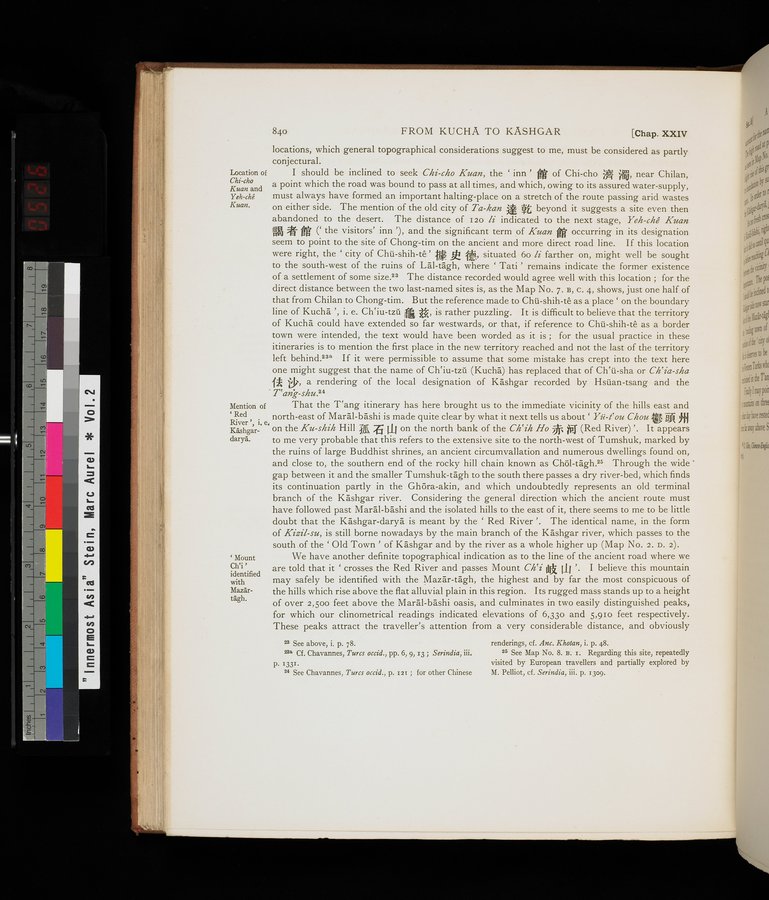
| 84o FROM KUCHA TO KASHGAR [Chap. XXIV locations, which general topographical considerations suggest to me, must be considered as partly conjectural. Location of I should be inclined to seek Chi-cho Kuan, the ` inn ' OR of Chi-cho 7 4, near Chilan, Chi-cho a point which the road was bound to pass at all times, and which, owing to its assured water-supply, Kuan and Yeh-chê must always have formed an important halting-place on a stretch of the route passing arid wastes Kuan. on either side. The mention of the old city of Ta-kan A tL beyond it suggests a site even then abandoned to the desert. The distance of 120 li indicated to the next stage, Yeh-chê Kuan i * (` the visitors' inn '), and the significant term of Kuan occurring in its designation were right, the ` city of Chü-shih-tê' k it, situated 6o li farther on, might well be sought line of Kuchâ', i. e. Ch`iu-tzû #, is rather puzzling. It is difficult to believe that the territory I a rendering of the local designation of Kâshgar recorded by Hsüan-tsang and the
Mention of That the Tang itinerary has here brought us to the immediate vicinity of the hills east and ` Red north-east of Marâl-bâshi is made quite clear by what it next tells us about ` Yü-t`ou Chou KâshgarRive i. e~ on the Ku-shih Hill at on the north bank of the Ch`ih Ho tff (Red River)'. It appears the ruins of large Buddhist shrines, an ancient circumvallation and numerous dwellings found on, and close to, the southern end of the rocky hill chain known as Chöl-tâgh.25 Through the wide gap between it and the smaller Tumshuk-tâgh to the south there passes a dry river-bed, which finds its continuation partly in the Ghôra-akin, and which undoubtedly represents an old terminal branch of the Kâshgar river. Considering the general direction which the ancient route must have followed past Marâl-bâshi and the isolated hills to the east of it, there seems to me to be little doubt that the Kâshgar-daryâ is meant by the ` Red River '. The identical name, in the form of Kizil-su, is still borne nowadays by the main branch of the Kâshgar river, which passes to the south .of the ` Old Town ' of Kâshgar and by the river as a whole higher up (Map No. 2. D. 2). ` Mount We have another definite topographical indication as to the line of the ancient road where we Ch`i' are told that it ` crosses the Red River and passes Mount Ch` . I believe this mountain Mazàr- the hills which rise above the flat alluvial plain in this region. Its rugged mass stands up to a height tagh. of over 2,500 feet above the Marâl-bâshi oasis, and culminates in two easily distinguished peaks, for which our clinometrical readings indicated elevations of 6,33o and 5,910 feet respectively. These peaks attract the traveller's attention from a very considerable distance, and obviously | |||||||
| 23 See above, i. p. 78. 23a Cf. Chavannes, Turcs occid., pp. 6, 9, 13 ; Serindia, iii. p. 1335. 24 See Chavannes, Turcs occid., p. 121 ; for other Chinese | renderings, cf. Anc. Khotan, i. p. 48. 25 See Map No. 8. B. s. Regarding this site, repeatedly visited by European travellers and partially explored by M. Pelliot, cf. Serindia, iii. p. 1309. | ||||||
|
|
|
|
|
|
|
|
|
Copyright (C) 2003-2019
National Institute of Informatics(国立情報学研究所)
and
The Toyo Bunko(東洋文庫). All Rights Reserved.
本ウェブサイトに掲載するデジタル文化資源の無断転載は固くお断りいたします。